How to treat gut dysbiosis in the right order, not a guess
A structured, step-by-step protocol for confirming gut dysbiosis, then correcting it in sequence, without guessing which supplement your gut actually needs.
The first step in treating gut dysbiosis is confirming what is actually happening in your gut
Learning how to treat gut dysbiosis begins with real testing that measures what is actually happening in your gut. Stool or microbiome analysis confirms which bacterial groups are out of range, while blood work rules out conditions that can look like dysbiosis, such as thyroid dysfunction or celiac disease.
That instability is part of a bigger picture: the gut microbiome behaves like a genuinely chaotic ecosystem, and the reasoning behind that idea, including how gut flora shapes everyday digestive comfort, is laid out in full in a companion piece on healing gut dysbiosis. A few numbers make the scale of that chaos concrete.

Trillions of neighbors

Hundreds of species
It shifts fast

No single yardstick
Bacterial cells make up over half of your total cell count
Sender, Fuchs and Milo, PLOS Biology, 2016
What stool and microbiome testing can actually tell you
Stool testing typically reports three layers of information, which bacterial groups are present, how diverse the community is, and specific markers such as calprotectin or elastase that flag inflammation or pancreatic function, the raw material behind any dysbiosis diagnosis. A 2021 review in Applied and Environmental Microbiology by Wei and colleagues catalogued the many competing dysbiosis indices used across the field and concluded that dysbiosis remains a loosely defined term from study to study. That variety means the raw numbers on a lab report benefit from a clinician who knows which index fits your specific pattern, diet, and history.
Why symptoms alone leave real gaps in a treatment plan
Bloating, urgency, and fatigue can come from a genuinely overgrown small intestine, from a gut reacting to stress, or from a food intolerance that has little to do with bacteria at all. A landmark 2019 Nature Communications study by Saffouri and colleagues at Mayo Clinic found that small intestinal bacterial overgrowth on standard testing correlated poorly with how symptomatic patients actually were, while direct sequencing of the small intestinal microbiome tracked closely with symptom severity.
STUDY Small intestinal bacterial overgrowth correlated poorly with patient symptoms, while direct microbiome sequencing tracked closely with symptom severity. Saffouri et al., 2019, Nature Communications.
Have you taken antibiotics in the past year?
Is your diet mostly one pattern, like carnivore or vegan?
Do your symptoms extend beyond digestion, like fatigue, skin, or joint pain?
0/3
This is exactly the kind of profile that calls for individualized interpretation, built around your own testing, diet pattern, and history.
Take the full Quiz
Treating gut dysbiosis works best as a fixed sequence of four steps
Treatment works in a fixed order, behavior first, then diet, then medications and supplements, and finally highly targeted interventions guided by testing and genetics. Skipping ahead to step three before finishing step one usually means paying for a supplement that never had a fair chance to work.
- 1
Step 1, behavioral corrections
Sleep, meal timing, and stress load reset gut motility before anything else is introduced.
- 2
Step 2, targeted diet changes
Food choices are matched to the specific bacterial populations a test shows are out of range.
- 3
Step 3, medications and supplements
A targeted antimicrobial, probiotic strain, or prokinetic enters once the foundation is in place.
- 4
Step 4, diagnostics and genetics
Findings specific to the individual fine-tune every earlier step.
Step one, behavioral corrections that come before anything else
Sleep timing, meal spacing, and stress load reset gut motility and the immune signals that shape bacterial populations before any supplement gets involved. Late-night eating, constant grazing between meals, and chronic sleep debt all slow the migrating motor complex, the wave of contractions that sweeps leftover bacteria out of the small intestine between meals. Fixing these patterns first, for two to four weeks, gives every later step a cleaner baseline to work from, and often eases the low-grade leaky gut pattern that keeps bloating going.
Step two, dietary interventions that target the specific imbalance
Diet changes at this stage are chosen for their effect on specific bacterial populations, favoring the prebiotic fiber types that feed the exact strains a test shows are depleted. A vegan pattern and a carnivore pattern shift pancreatic enzyme output and short-chain fatty acid production in opposite directions, so the same food swap can raise one person's beneficial bacteria while barely moving another's.
Step three, when medications and supplements actually enter the picture
Medications and supplements enter once behavior and diet have had a real chance to work, because each one targets a narrower, more specific problem. A targeted antimicrobial, a specific probiotic strain, or a prokinetic each address a distinct finding on testing, timed to when the gut is ready to hold the change. Introducing them earlier tends to mask whether the foundational steps were ever going to work on their own.
Step four, targeted interventions guided by diagnostics and genetics
The final step layers in findings specific to the individual, a genetic variant, a strain-level test result, or a diagnosed autoimmune condition, to fine-tune everything chosen in the earlier steps. A 2016 Diabetes Care study by Dujic and colleagues found that a serotonin transporter gene variant predicted which patients on metformin developed gastrointestinal intolerance, the same logic that applies to matching a probiotic strain or a supplement dose to a person's own biology.
STUDY A serotonin transporter gene variant predicted which patients on metformin developed gastrointestinal intolerance. Dujic et al., 2016, Diabetes Care.
The same probiotic gives different results in different people
A probiotic that works well for one person can sit inert, or shift symptoms in an unexpected direction, in someone with a different baseline gut microbiome diversity. A landmark 2018 Cell study by Zmora and colleagues at the Weizmann Institute found that an identical eleven-strain probiotic colonized each volunteer's gut in a highly individual pattern, predictable from each person's own baseline host and microbiome features and invisible in a simple stool sample.
STUDY An identical eleven-strain probiotic colonized each volunteer's gut in a highly individual pattern, predictable from baseline biology alone. Zmora et al., 2018, Cell.
Low pancreatic elastase means something different in a vegan than in an omnivore
The same lab number, a low fecal elastase reading, points to a completely different explanation depending on what someone eats. Pancreatic elastase breaks down protein, and a body processing far less animal protein simply produces less of the enzyme. That exact pattern, a vegan whose enzyme readings mimicked pancreatic insufficiency, sits at the center of one particular case followed on this site, where the eventual answer had nothing to do with the pancreas at all.
Low elastase reading
In someone eating a mixed diet, a low fecal elastase result usually points toward reduced pancreatic enzyme output and warrants a closer look at exocrine pancreatic function.
Same low elastase reading
A 2012 British Journal of Nutrition study by Walkowiak and colleagues found that a vegan diet alone lowered fecal elastase-1 output through reduced and modified protein intake, an adaptive dietary response with a completely different clinical meaning.
STUDY A vegan diet alone lowered fecal elastase-1 output through reduced and modified protein intake, an adaptive response rather than pancreatic disease. Walkowiak et al., 2012, British Journal of Nutrition.
Elevated Akkermansia carries a different meaning in multiple sclerosis
Akkermansia muciniphila is usually framed as a marker of a healthy gut, yet in multiple sclerosis research the same bacterium consistently appears in higher abundance.
Higher Akkermansia reading
In most contexts, more Akkermansia muciniphila tracks with a thicker mucus layer and better metabolic markers, one of the more consistently reassuring signals on a stool test.
Same higher Akkermansia reading
A 2017 PNAS study by Berer and colleagues found Akkermansia muciniphila consistently elevated in the gut of twins with multiple sclerosis, and transferring that gut microbiota into genetically susceptible mice triggered brain autoimmunity at a higher rate than microbiota from each twin's healthy sibling.
STUDY Gut microbiota from multiple sclerosis affected twins, marked by elevated Akkermansia, triggered brain autoimmunity when transferred into susceptible mice. Berer et al., 2017, PNAS.
Fusobacterium becomes a bigger cancer risk once Candida joins it
Fusobacterium nucleatum alone is a well-documented passenger in colorectal tumors, but its risk profile changes once a second organism enters the picture. A 2026 Cancer Cell study by Li and colleagues found that the fungus Candida albicans binds directly to Fusobacterium through a specific protein pair, Flo9 on the fungus and RadD on the bacterium, and that this pairing helped the bacterium reach the colon lining and accelerated tumor growth in animal models beyond either microbe alone.
Bacterium alone
Fusobacterium nucleatum alone already correlates with colorectal tumor tissue and poor outcomes, largely through binding proteins like Fap2 that let it dock onto cancer cells directly.
Bacterium plus fungus
Once Candida albicans is present too, the Flo9-RadD interaction between the two organisms measurably speeds up tumor progression compared with either microbe on its own, based on the same animal models.
STUDY Candida albicans binds Fusobacterium nucleatum through the Flo9-RadD interaction, accelerating colorectal cancer progression beyond either microbe alone. Li et al., 2026, Cancer Cell.
Medications and supplements each carry their own hidden risks
A medication and a supplement can each solve one problem while quietly creating another, and the risk usually shows up in a completely different system than the one being treated. Metformin causes gastrointestinal side effects in roughly a fifth to a third of users, and a serotonin transporter gene variant, examined in the metformin and gut side effect research on this site, predicted which patients actually developed that intolerance. On the supplement side, long-term proton pump inhibitor use and vitamin B12 absorption show a similar hidden interaction, easy to miss when the two prescriptions come from different specialists.
| When a medication hides the risk | When a supplement hides the risk |
|---|---|
| Metformin | Gastrointestinal intolerance in genetically susceptible users, often mistaken for a food problem |
| Proton pump inhibitors | Reduced vitamin B12 absorption over months of continuous use |
| Broad-spectrum antibiotics | Collateral loss of beneficial strains alongside the target pathogen |
| High-dose iron or fiber | Can feed exactly the bacterial group testing was trying to reduce |
DIY treatment and practitioner-guided treatment tend to reach different outcomes
Restoring gut balance through self-directed treatment versus practitioner-guided treatment can start from the same test result and still end in very different places, mainly because of what happens after a first attempt only partly works. A self-guided approach usually means one intervention at a time, adjusted by trial and error over months, while a practitioner reviewing the full panel alongside history and genetics can layer several targeted steps together and catch an interaction, like the metformin and proton pump inhibitor example above, before it derails progress.
| Self-directed approach | Practitioner-guided approach |
|---|---|
| Interpretation | One index or number read in isolation |
| Adjustments | Trial and error, one change at a time, over months |
| Interactions | Medication and supplement conflicts often caught only after symptoms appear |
| Timeline | Often longer, since each restarted attempt resets the clock |
A specialist catches what generic protocols and self-testing miss
A specialist adds two things a generic protocol or an at-home test kit rarely can, the full clinical picture across every system involved, and the pattern recognition that comes from having seen hundreds of similar cases. A single stool report rarely flags that a supplement recommended online interacts with a prescription, or that a persistent symptom actually traces back to a completely different organ system.
The bottom line on how to treat gut dysbiosis the right way
Treating gut dysbiosis works best as a sequence, confirm with real testing, correct behavior and diet first, then bring in medications, supplements, and highly targeted interventions once that foundation is in place. The same lab result can mean opposite things in a vegan and an omnivore, or in a healthy adult and someone with an autoimmune condition, which is exactly why matching each step to your own biology outperforms copying someone else's protocol.
See how personalized gut dysbiosis cases actually resolve
IBSyncrasy walks through more than a thousand real IBS cases sorted by underlying cause, the same layered approach behind everything in this guide.
Frequently asked questions
Gut dysbiosis develops when a single course of antibiotic treatment, chronic stress, a low-fiber or ultra-processed diet, infections, or long-term medication use shift the balance of gut bacteria away from a diverse, stable community. Most cases involve more than one of these triggers acting together, layered on top of each other over months or years.
A probiotic and prebiotic combination works best as one tool inside a broader plan that includes testing, diet, and behavior changes together. A 2018 Cell study found that identical probiotic strains colonize each person's gut differently, so matching the strain to a person's own biology matters more than the label on the bottle.
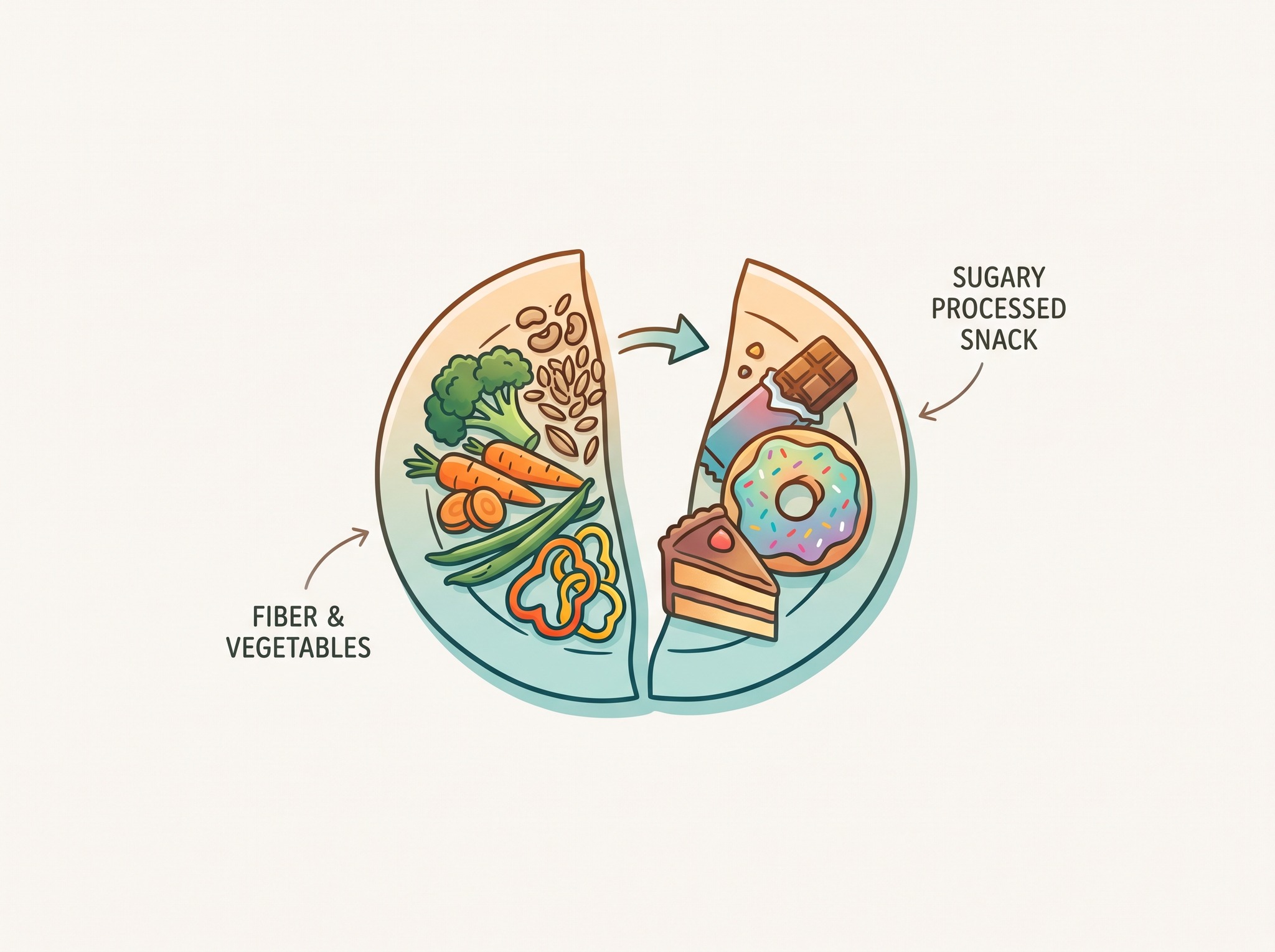
Ultra-processed foods and restrictive mono-diets, such as a strict carnivore pattern, both narrow the range of fuel available to a diverse bacterial community over time. Excess added sugar, frequent artificial sweeteners, and chronically low fiber intake add three more well-documented dietary pressures that push the balance in the same direction.
Recovery timelines vary with how many years the imbalance has been present, how many rounds and types of antibiotics a person has taken, and how consistently they can make the behavior and diet changes involved. A dedicated breakdown of the full recovery timeline lives in the companion piece linked earlier in this guide.