PPIs and vitamin B12 deficiency: what the data show
Long-term PPI use is linked to a B12 shortfall more often than most people realize. Here is the mechanism, the real numbers, and what actually protects you.
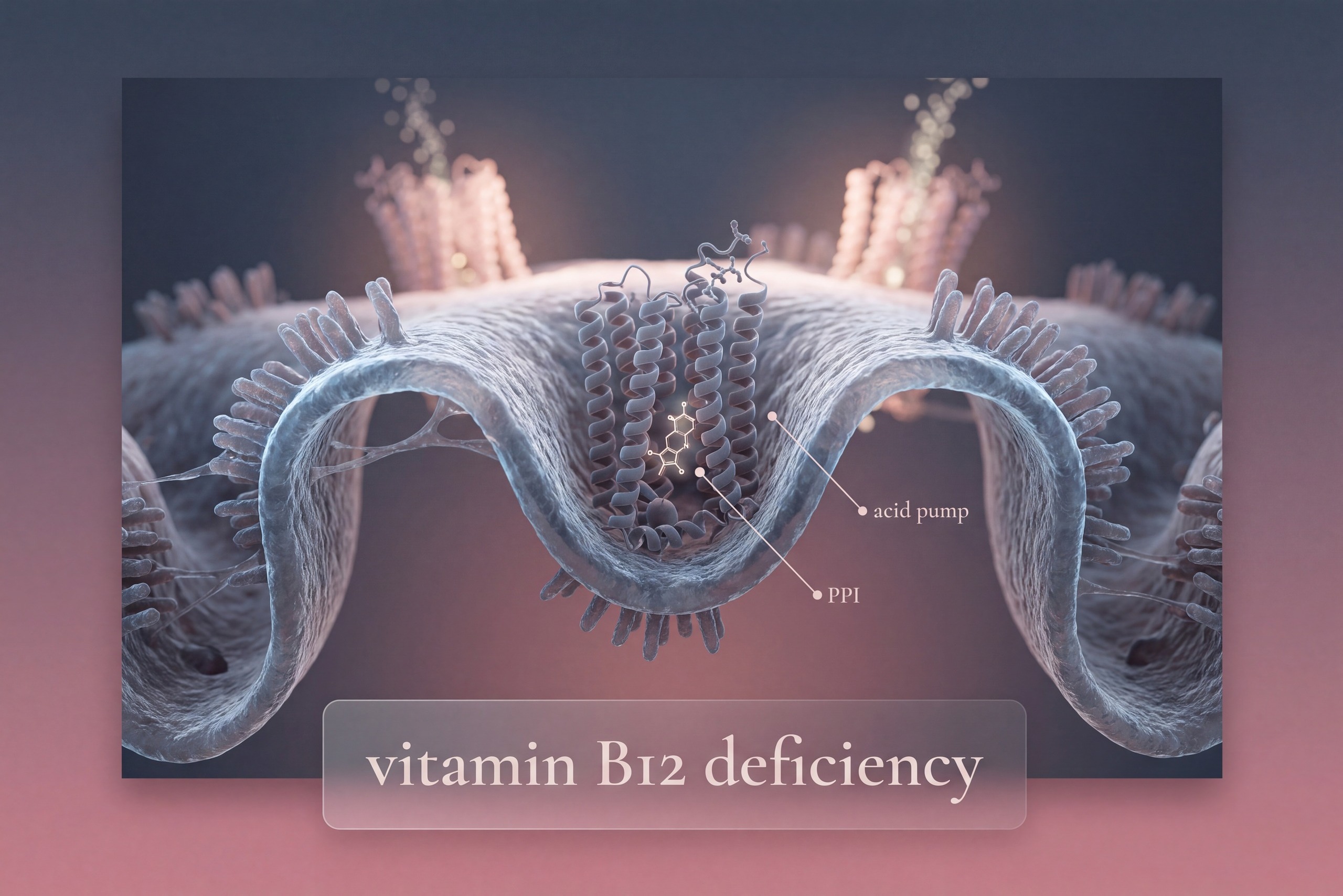
How common is vitamin B12 deficiency in people taking PPIs?
Vitamin B12 deficiency shows up more often in long-term PPI users than in people with no acid-suppressing history, with the largest study on the question linking two or more years of use to a 65 percent higher risk. That figure comes from a case-control analysis of more than 200,000 people inside the Kaiser Permanente system in California, still the biggest dataset addressing this specific question. Smaller studies place the size of the effect higher or lower, yet the direction stays remarkably consistent across nearly all of them.
STUDY Patients dispensed two or more years' supply of a PPI carried 65 percent higher odds of a B12 deficiency diagnosis than patients with no exposure to acid-suppressing drugs. Lam et al., 2013, Proton pump inhibitor and histamine 2 receptor antagonist use and vitamin B12 deficiency, JAMA.
Left unaddressed for long enough, this pattern can progress toward megaloblastic anemia or nerve-related symptoms such as tingling in the hands and feet, both classic markers of advanced B12 depletion.
What the largest study found
That same Kaiser Permanente study uncovered a clear dose relationship. People taking more than 1.5 pills a day carried higher odds than those on less than 0.75 pills a day, and the association ran strongest in adults under 30 and weakest after age 80. Histamine-2 blockers such as ranitidine and famotidine produced a smaller version of the same pattern, pointing to acid suppression itself as the shared driver across this whole drug class.
A 2023 systematic review and meta-analysis pooling multiple studies landed on a more moderate combined estimate across the literature, and an older case-control study in geriatric primary care found an even sharper association at the twelve-month mark. The four numbers below come from four different populations and study designs, which is exactly why they land in a similar range even while the exact figures vary, each one still points the same direction.
Odds of B12 deficiency across four studies
Choudhury et al. 2023 Expert Review of Gastroenterology and Hepatology, Lam et al. 2013 JAMA, cross-sectional diabetes cohort 2024, Valuck and Ruscin 2004 Journal of Clinical Epidemiology. Reference line at OR 1.0, log-scaled.
Why does suppressing stomach acid affect vitamin B12 absorption?
Stomach acid is the tool the body uses to cut vitamin B12 free from the animal protein it travels with in food, and decreased gastric acid from a PPI removes that tool for as long as the drug stays in the system. Absorption further downstream still depends on a separate carrier protein, but the acid step comes first, and blocking it is where the whole chain starts to slow down.
From food to free B12
Meat, eggs, and dairy carry vitamin B12 bound tightly to protein. Pepsin, an enzyme that only works in an acidic stomach, cuts that bond and releases the vitamin. The freed B12 then attaches to a protein called haptocorrin, made in saliva, for its trip through the stomach and into the small intestine. When a PPI raises stomach pH well above the level pepsin needs, this first release step slows down, and more B12 stays locked to its food protein than usual. Vitamin B12 already present as a supplement in crystalline form skips this step entirely, since it starts out unbound, which is exactly why supplementation works so reliably even during PPI therapy.
The intrinsic factor handoff
Once B12 reaches the small intestine, pancreatic enzymes strip it off haptocorrin and hand it to intrinsic factor, a protein made by the same stomach cells that produce acid. The B12-intrinsic factor pair travels to the terminal ileum, where dedicated receptors absorb the whole complex into the bloodstream. Intrinsic factor production continues largely on schedule at typical PPI doses, distinct from atrophic gastritis, another common cause of low stomach acid in older adults that does lower intrinsic factor output directly. So this final absorption step usually still works during ordinary PPI therapy. The bottleneck sits earlier, at the acid-dependent release from food, which is also why B12 deficiency from a PPI tends to build slowly, across years of continuous therapy.
Does the type of PPI change the risk?
The type of PPI changes the strength of acid suppression, and stronger, longer-lasting acid suppression is exactly the mechanism behind B12 deficiency, so the choice of drug plausibly matters for long-term risk. Head-to-head trials measuring intragastric pH across the five main PPIs found a nearly eightfold spread in relative potency, with rabeprazole and esomeprazole suppressing acid the most and pantoprazole the least.
How potency compares across the five main PPIs
Researchers standardized this comparison to omeprazole, set at 1.00, using the percentage of a 24-hour period each drug kept intragastric pH above 4, the threshold where pepsin activity and B12 release from food both drop off. Pantoprazole came out weakest at 0.23 times omeprazole's strength, lansoprazole close behind omeprazole at 0.90, and esomeprazole and rabeprazole well above it at 1.60 and 1.82.
Relative acid-suppression potency, omeprazole = 1.00
Kirchheiner et al. 2009 European Journal of Clinical Pharmacology, pharmacodynamic modeling of intragastric pH across 57 studies. Inner ring marks omeprazole-equivalent potency of 1.00, outer ring marks 2.00.
Meet the six PPIs
Six PPIs cover most prescriptions and over-the-counter shelves between them. Each treats a similar set of acid-related conditions, with small differences in strength, metabolism, and approved use.
Omeprazole
Approved for gastroesophageal reflux disease (GERD), peptic ulcers, and H. pylori eradication alongside antibiotics. The original PPI, and still one of the most widely prescribed.
Esomeprazole
Cleared more slowly by the liver than omeprazole. Used for GERD, erosive esophagitis healing and maintenance, and lowering ulcer risk during long-term NSAID use.
Pantoprazole
A common hospital choice, including intravenous dosing, for GERD, erosive esophagitis, and hypersecretory conditions such as Zollinger-Ellison syndrome.
Lansoprazole
Used for GERD, duodenal and gastric ulcers, and H. pylori eradication. One of the few PPIs with pediatric approval.
Rabeprazole
Approved for GERD, duodenal ulcers, and Zollinger-Ellison syndrome. Broken down largely through a non-enzymatic pathway, so CYP2C19 genetic variation matters less.
Dexlansoprazole
A dual-release form of lansoprazole. Used for GERD and erosive esophagitis, with a longer window of acid control from a single daily dose.
How does the risk change with how long someone has used a PPI?
The risk of B12 deficiency climbs the longer someone stays on a PPI, with most well-powered studies finding little signal under a year and a clearly elevated odds ratio once use passes the two-year mark. A twelve-month prospective study in adults found no clinically meaningful drop in B12 or iron over that first year, which lines up with the idea that the deficiency needs sustained acid suppression to develop.
Odds of B12 deficiency by duration of PPI use
Reference point from 12-month prospective cohort data, Valuck and Ruscin 2004 at 12 months, Lam et al. 2013 JAMA at 2 years and for the high-dose subgroup. Each point reflects its own study population, shown together here for comparison.
Can PPIs create gut problems that look like IBS?
In practice, I see this pattern often: patients with irritable bowel syndrome who run low on B12 far more frequently than expected, regardless of how carefully they eat or which foods they have already cut out. Stomach acid keeps the small intestine relatively free of bacteria, and a PPI removes that barrier, opening the door to small intestinal bacterial overgrowth, a condition that mimics IBS symptom for symptom while adding its own hit to nutrient absorption.
The SIBO connection
A 2013 meta-analysis pooling eleven studies found PPI users carried more than double the odds of small intestinal bacterial overgrowth compared with non-users, a finding a 2025 update confirmed with a similar pooled estimate and a clear duration-dependent trend, each additional month on the drug tracked with a measurable rise in overgrowth rates. SIBO produces bloating, gas, and diarrhea that overlap heavily with an IBS diagnosis, and the same low-acid environment that lets bacteria migrate upward also interferes with B12 release from food, which helps explain why the two problems, low B12 and IBS-pattern symptoms, keep turning up in the same patients. The two-way relationship between histamine intolerance and SIBO runs through this same acid-suppression pathway, and long-term PPI use often traces back to silent reflux that never caused classic heartburn in the first place.
STUDY PPI users carried more than double the odds of small intestinal bacterial overgrowth compared with non-users, pooled across eleven studies. Lo and Chan, 2013, Proton pump inhibitor use and the risk of small intestinal bacterial overgrowth, a meta-analysis, Clinical Gastroenterology and Hepatology.
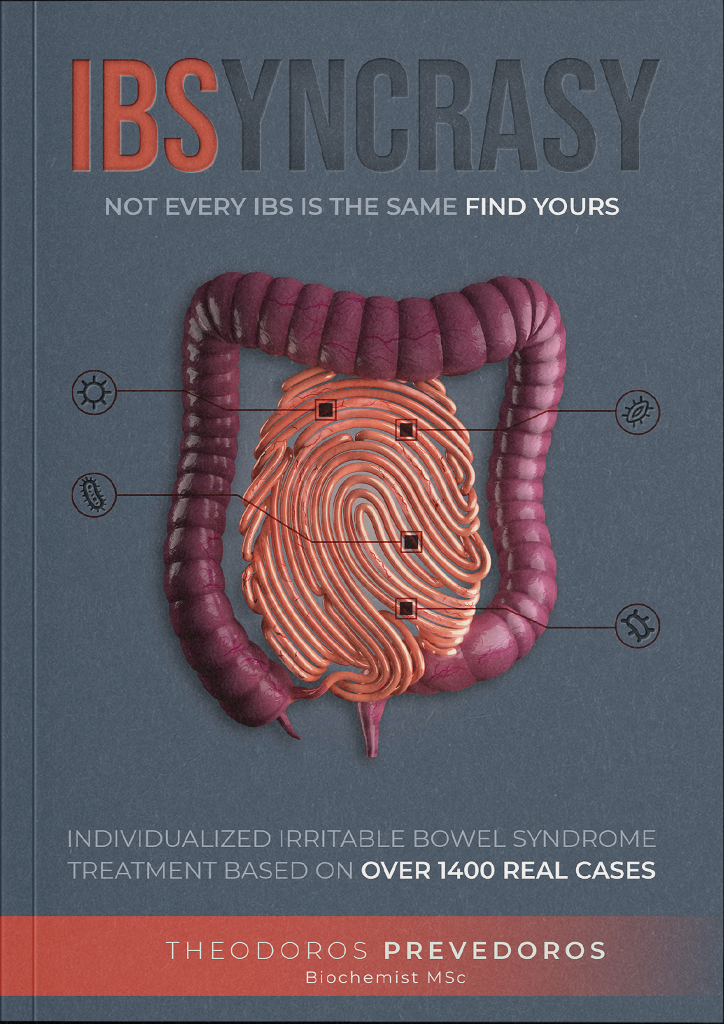
This mirrors a case on the site where SIBO-driven malabsorption was initially mistaken for celiac disease, the same low-acid, bacterial-overgrowth axis that quietly drains B12, explored in depth through IBSyncrasy's case-based approach to IBS.
One case, ten patterns
The same low-acid, overgrowth-driven picture that muddies a B12 panel also runs through several of the ten IBS patterns mapped in IBSyncrasy, each with its own case history and its own path back to a working gut.
Buy IBSyncrasyWhat is the MTHFR connection, and why does it matter?
Two separate pathways can compound in the same direction when a PPI and a common MTHFR variant overlap in the same person. A PPI limits how much B12 gets released from food upstream, while a low-activity MTHFR variant limits how well the body puts B12 and folate to use downstream, in the cycle that keeps homocysteine in check.
- MTHFR
- A gene coding for methylenetetrahydrofolate reductase, an enzyme the body relies on to process folate and convert homocysteine back into methionine. Common variants such as C677T lower the enzyme's activity and raise homocysteine when folate and B12 intake run low.
Research has documented each half of this picture well on its own, acid suppression lowering B12 release, and low-activity MTHFR variants raising homocysteine when B vitamin status runs low, though a study following PPI users stratified by MTHFR genotype together has yet to be published. For someone who carries a low-activity MTHFR variant and stays on a PPI for years, the overlap points toward paying closer attention to B12 and homocysteine together, a reasonable precaution grounded in two established mechanisms even ahead of a combined study.
What other nutrients can long-term PPI use affect?
Vitamin B12 gets most of the attention, yet it shares the same acid-dependent absorption story with several other nutrients, and long-term acid suppression carries its own, separately documented increased risk profile beyond nutrition alone. A comprehensive literature review lists reduced levels of several minerals and vitamins alongside a wider set of associated conditions in long-term users.
How the risks stack up against each other
B12 deficiency sits in the middle of the pack when placed next to other conditions linked to long-term PPI use. Small intestinal bacterial overgrowth carries the largest relative increase among the four compared here, hip fracture the smallest, with community-acquired pneumonia landing close to B12 deficiency itself.
Relative increase in risk across four PPI-associated conditions
Lo and Chan 2013 meta-analysis (SIBO), pooled fracture and pneumonia review 2025, Lam et al. 2013 JAMA (B12), Poly et al. 2019 meta-analysis (hip fracture). Bars scaled to each odds or risk ratio above 1.0.
How long should someone actually take a PPI?
Most PPI courses are meant to run for a matter of weeks, with both the FDA and the American College of Gastroenterology pointing toward a defined stopping point and a reassessment. Only a handful of specific conditions call for staying on the medication indefinitely.
How to protect your vitamin B12 status while on a PPI
A short list of habits covers most of the protection someone on long-term PPI therapy needs against a B12 shortfall, starting with periodic testing well ahead of any symptoms. None of it requires stopping an otherwise necessary medication.
- Ask for a serum test of vitamin B12 levels alongside a methylmalonic acid level, since MMA rises before serum B12 falls low enough to flag on its own.
- Time the first check around a year after starting the PPI, then repeat every one to two years for anyone staying on the medication long-term.
- Choose a crystalline B12 supplement, the form found in fortified cereal and most tablets, since it absorbs independently of stomach acid.
- Bring up the lowest effective dose and the original reason for the prescription at each follow-up, so the plan keeps matching what the gut currently needs.
Taken together, these four habits turn vitamin B12 deficiency from a silent, years-long drift into something caught early and corrected easily, while leaving the original reason for the PPI properly managed alongside it.
IBSyncrasy
Ten real IBS patterns, worked out case by case, from the same evidence-first approach behind this article.
IBSyncrasy
IBSyncrasy collects over a decade of case-based work on irritable bowel syndrome into ten recurring patterns, each traced back to its underlying driver and paired with the protocol that resolved it.
Buy IBSyncrasyFrequently asked questions
In the largest study on the question, people with two or more years of PPI use carried 65 percent higher odds of a B12 deficiency diagnosis than people with no history of acid-suppressing medication. Smaller studies place the number higher or lower, though the direction stays consistent.
Vitamin B12 in food travels bound to protein, and stomach acid frees it for absorption. A PPI lowers that acid output, so less B12 gets released from food and made ready for the intrinsic-factor step that carries it into the bloodstream.
A crystalline B12 supplement, the form found in fortified foods and most tablets, skips the acid-dependent release step entirely, so it absorbs well even during PPI therapy. Sublingual or oral doses in the 500 to 1000 microgram range are the usual starting point, guided by a follow-up blood test.
A periodic B12 and methylmalonic acid check, together with a conversation about the lowest effective dose and whether the original reason for the PPI still applies, gives a prescriber what they need to weigh the trade-off properly. That conversation belongs with the prescriber, since the condition the PPI treats carries its own risks when it goes unmanaged.