How long does it really take to heal gut dysbiosis?
Twenty years of clinical cases point to one real healing order, and it rarely matches what gets sold online.
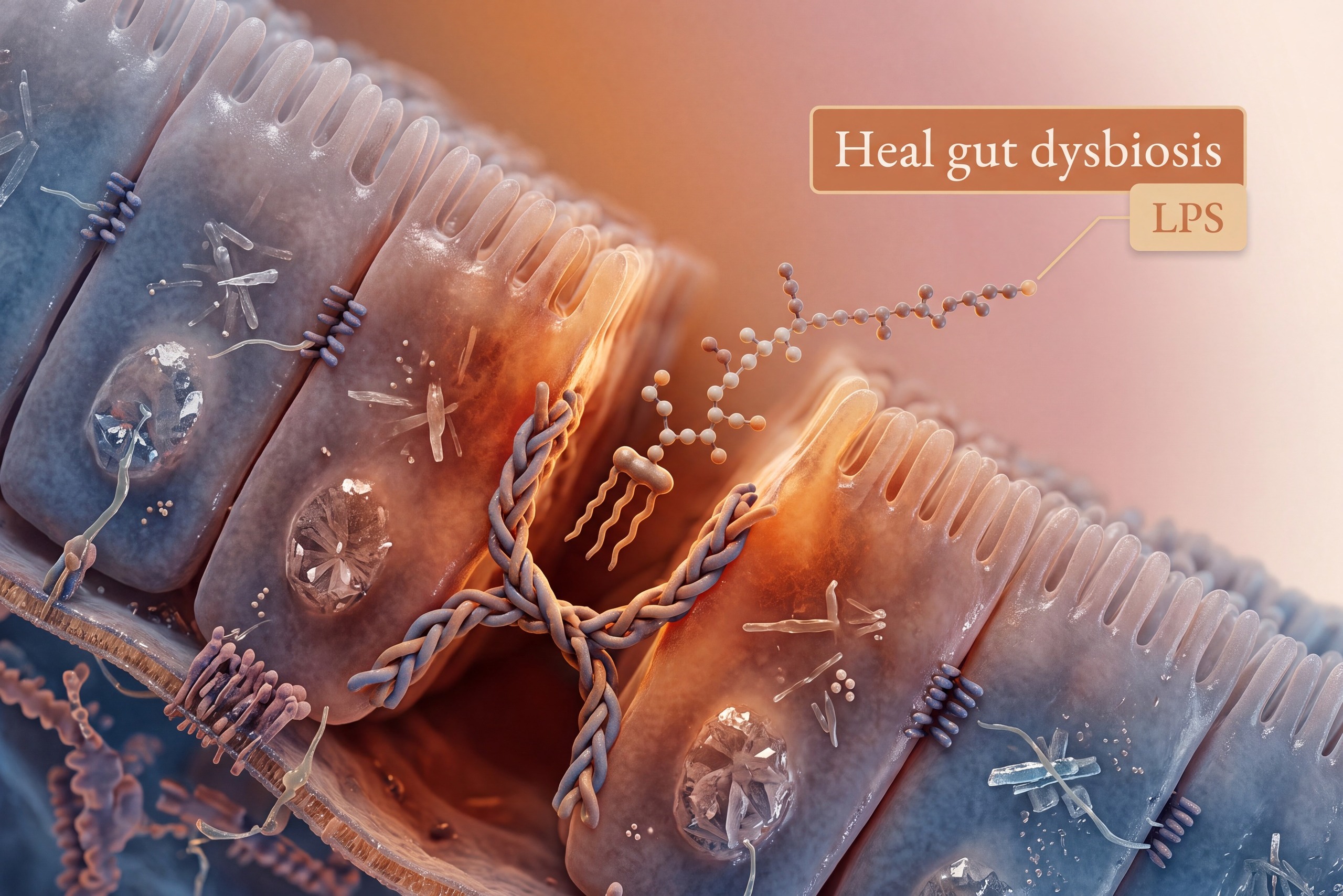
What actually causes gut dysbiosis, beyond the usual antibiotics story?
Most people trying to heal gut dysbiosis focus only on antibiotics, and antibiotics do deserve real blame, but the fuller picture runs wider. Poor sleep, chronic stress, late-night eating, and a diet heavy in ultra-processed food all reshape which bacteria thrive in your gut, often compounding whatever antibiotic history is already there.
The classic drivers are still worth naming clearly. A course of broad-spectrum antibiotics can flatten whole families of bacteria within days, proton pump inhibitors lower stomach acid enough to let unusual species travel further down the gut, and repeated gastrointestinal infections leave a lasting mark on the microbial community long after the original bug clears.
The overlooked behavioral side of gut dysbiosis
Sleep and stress deserve equal billing with diet and drugs. Irregular sleep timing shifts the same circadian genes that control gut motility, chronic stress raises cortisol in a way that changes gut permeability, and a pattern of grazing on ultra-processed snacks all day starves the fiber-fermenting bacteria that keep the gut lining fed.
STUDY Duodenal brushings from IBS patients carried Pseudomonas aeruginosa at 8.3% of clones, compared with 0.1% in healthy volunteers, roughly an 83-fold difference that held up in matched stool samples too. Kerckhoffs et al., 2011, Molecular analysis of faecal and duodenal samples reveals significantly higher prevalence and numbers of Pseudomonas aeruginosa in irritable bowel syndrome, Journal of Medical Microbiology.
One overgrowth worth naming on its own is Pseudomonas aeruginosa, a soil and water organism that finds the duodenum surprisingly welcoming once conditions shift in its favor. A cohort of 47 IBS patients showed this organism turning up far more often than in matched healthy controls, at 97.9% versus 33.3%, spread fairly evenly across diarrhea, constipation, and mixed presentations.
Elevated Pseudomonas aeruginosa across IBS subtypes
Kerckhoffs et al., 2011, Journal of Medical Microbiology. Duodenal and faecal molecular analysis of 37 IBS patients (13 IBS-D, 11 IBS-C, 13 IBS-A) and 20 healthy controls. Elevated Pseudomonas aeruginosa levels appeared across all three IBS subtypes compared with healthy volunteers.
How Pseudomonas aeruginosa turns overgrowth into symptoms
This organism has a genuine talent for exploiting the body's own chemistry. Serotonin in the gut activates its quorum sensing system, the chemical language bacteria use to coordinate as a group, which then ramps up biofilm formation and toxin output. Histamine works alongside it, guiding the bacterium toward inflamed tissue and further amplifying the genes behind its more aggressive behavior.
STUDY Pseudomonas aeruginosa senses histamine directly through a dedicated chemoreceptor, using it to steer toward sites of inflammation and to adjust the expression of numerous virulence genes along the way. Krell et al., 2021, Histamine: A bacterial signal molecule, International Journal of Molecular Sciences.
What are the most common symptoms of gut dysbiosis?
Bloating and an unpredictable bowel pattern top the list for most people, showing up as alternating diarrhea and constipation, visible abdominal distension after meals, and cramping that tracks closely with what and when you last ate. These digestive signs are usually the first clue, but gut dysbiosis rarely stays confined to the gut.
| Symptom category | What it typically looks like |
|---|---|
| Digestive | Bloating, gas, cramping, and irregular bowel habits that shift between loose and hard stools |
| Absorption | Fatigue after meals, occasional nutrient gaps even on a reasonable diet |
| Immune and skin | Frequent minor infections, skin flares that track with flare-ups in gut symptoms |
| Mood and cognition | Brain fog, low mood, and mood swings that often move in the same rhythm as gut symptoms |
That last row surprises people the most. The gut and the nervous system share so much chemical signaling, including serotonin production, that a rough patch in the microbiome often shows up as a rough patch in mood and focus within the same week.
How long does it really take to heal gut dysbiosis?
There is no single timeline that fits everyone for gut dysbiosis to heal, and after twenty years of clinical cases, that variation is the most consistent finding I have. Three factors do most of the work in setting the pace: how many rounds of antibiotics the gut has absorbed over the years, how long the current problem has been running, and each person's own neuro-hormonal makeup.
What actually predicts a harder or longer recovery
A large meta-analysis of post-infectious IBS gives real numbers to factors that clinicians already sense in the room. Somatization and neuroticism carried the strongest odds, antibiotic exposure during the original infection added meaningful risk on its own, and anxiety and depression each shifted the odds further, on top of whatever the infection itself already set in motion.
Factors linked with developing IBS after an infection
Klem et al., 2017, Gastroenterology. Systematic review and meta-analysis of 45 cohort studies, over 21,000 individuals followed after infectious enteritis. Odds ratios for developing post-infectious IBS by host and psychological factor. Reference line at OR 1 (no elevated risk).
STUDY Across 45 pooled cohort studies following more than 21,000 people after a bout of infectious enteritis, somatization and neuroticism carried the strongest odds for later IBS, with antibiotic exposure, anxiety, and depression each adding to the picture. Klem et al., 2017, Prevalence, risk factors, and outcomes of irritable bowel syndrome after infectious enteritis, Gastroenterology.
These are population averages built from cohort data, the kind that describe a pattern across thousands of people. Your own antibiotic history, how many years the pattern has been running, and your baseline stress reactivity still decide where you personally land within that pattern, which is exactly why a fixed number of weeks never fits everyone equally well.
Ready for a plan built around what your own gut actually shows?
IBSyncrasy walks through this same four-layer order case by case, with real diagnostics, real timelines, and the kind of nuance a generic protocol never captures.
Can probiotics actually help heal a dysbiotic gut?
Yes, probiotics genuinely help many people with gut dysbiosis, and the honest detail people rarely hear is how they help. Most strains work best as an active, temporary support you renew on purpose, since few of them ever become a lasting part of your resident microbiome, so the way you use them matters as much as which strain you pick.
Once a probiotic capsule reaches the gut, that strain moves in and joins the resident microbiome for good, quietly protecting the gut lining from then on.
A systematic review of colonization studies found that most probiotic strains pass through the gut and clear the system within days of stopping supplementation, with only a handful of exceptions showing longer persistence in specific populations like infants.
STUDY Across nine colonization studies of probiotic strains in adults, most demonstrated transient passage through the gut, with detectable presence limited to the supplementation period and a short washout window afterward. Roselli et al., 2021, Colonization ability and impact on human gut microbiota of foodborne microbes from traditional or probiotic-added fermented foods, Frontiers in Nutrition.
That temporary nature is actually good news for how you use them. Think of a probiotic course the way you would a targeted antimicrobial protocol, useful and sometimes essential for a defined stretch of time, most valuable when it works alongside the sleep, stress, and diet changes covered elsewhere in this article.
What foods should you eat, or avoid, for a dysbiotic gut?
There is genuinely no universal food list that works for gut dysbiosis, since the bacteria that thrive on a given food vary from one gut to the next. What holds true across almost every case is the pattern that follows months of cutting foods out: real relief up front, followed by a shrinking list of foods your gut can comfortably handle.
Where low FODMAP actually fits
Low FODMAP has become the trendy answer for gut symptoms, and it earns that popularity through genuine short-term symptom relief. Used as a brief, structured phase with a clear reintroduction plan built in from the very first day, it works well as one tool among several. Used for months on end without that plan, it quietly narrows the diet further and further, and the diet itself becomes part of the problem it was meant to solve.
STUDY A meta-analysis of nine randomized trials found low FODMAP diets consistently lowered Bifidobacteria abundance, a shift with no clear effect on overall microbial diversity in the short trials studied but one that raises real questions the longer the diet continues unchecked. So, Loughman and Staudacher, 2022, Effects of a low FODMAP diet on the colonic microbiome in irritable bowel syndrome, American Journal of Clinical Nutrition.
The practical version of this is straightforward: treat any elimination approach, low FODMAP included, as a phase with a planned exit built in from day one.
What is the right order for healing gut dysbiosis, from foundation to precision testing?
However loud the influencers and the supplement-selling practitioners get, irritable bowel and gut dysbiosis are never healed by one pill or one diet. What actually works is retraining the gut itself, and how long that takes depends on how long the problem has been there and on the changes the patient is genuinely willing to make.
Retraining the gut works best in a specific order, moving from the widest, most foundational layer toward the narrowest and most specific. Skipping ahead to the inner layers before the outer ones hold steady is the single most common reason a protocol that worked for someone else quietly fails for you.
The four layers of healing gut dysbiosis
Foundation on the outside, precision testing at the center
💡 Tap a ring — desktop: hover
Sleep, stress, and meal rhythm
The outermost layer everything else depends on, since consistent sleep and steady meal timing set the baseline the gut responds to before any diet or supplement enters the picture.
That last layer is where identifying the specific organism behind an overgrowth earns its place, since a targeted finding like elevated Pseudomonas aeruginosa points toward a genuinely different plan than a generic antimicrobial approach would.
A protocol built around the actual finding
IBSyncrasy walks through this same four-layer order case by case, including a full chapter on Pseudomonas-predominant IBS built from Aspa's real case, from the first duodenal finding through the follow-up that confirmed it held. Buy IBSyncrasyWhat does healing gut dysbiosis actually look like, day to day?
In practice, healing looks far less dramatic than the before-and-after posts suggest when you actually heal gut dysbiosis. It looks like steadier sleep for a few consecutive weeks, meals eaten at roughly the same times, a probiotic or antimicrobial course used for a defined stretch, and a food list that keeps expanding week by week.
The order matters as much as the individual pieces, since the same fiber-rich diet that helps one person can flare symptoms in another whose behavioral foundation, sleep and stress, is still shaky underneath it. Working through the layers in sequence, and matching the innermost layers to an actual confirmed finding, is what separates a plan that holds from one that quietly falls apart after a few good weeks.
IBSyncrasy
IBSyncrasy is built from real clinical cases like Aspa's, walking through the same four-layer order this article covers: behavior, diet, targeted support, and precision testing, case by case, with the diagnostics and timelines each one actually needed.
Buy IBSyncrasyFrequently asked questions
There is no fixed number of weeks. Recovery time tracks with how many antibiotic courses the gut has absorbed, how long the current problem has run, and each person's own stress and hormonal makeup, which is why two people with a similar diagnosis can heal at genuinely different speeds.
Bloating, gas, and an unpredictable bowel pattern lead the list, often alongside post-meal fatigue, skin flares, and mood swings that tend to move in step with the gut symptoms themselves.
No single food list works for every gut. Short, structured elimination phases, including low FODMAP, help most people when paired with a clear reintroduction plan from day one, while months of open-ended restriction tend to narrow the diet further and add to the original problem.
Yes, as an active, temporary support you keep renewing on purpose. Most strains pass through the gut within days of stopping, so probiotics work best alongside sleep, stress, and diet changes, used together as one plan.
Antibiotics, proton pump inhibitors, and repeated gut infections are the classic causes, alongside less obvious behavioral drivers like poor sleep, chronic stress, and a diet heavy in ultra-processed food, plus specific overgrowths like Pseudomonas aeruginosa that show up often in IBS.