Oregano for SIBO: what the evidence actually shows
Oregano for SIBO is popular because oregano oil is antimicrobial. The useful question is where it belongs in a treatment plan that also corrects motility, acid defense and relapse risk.
Does oregano for SIBO actually work?
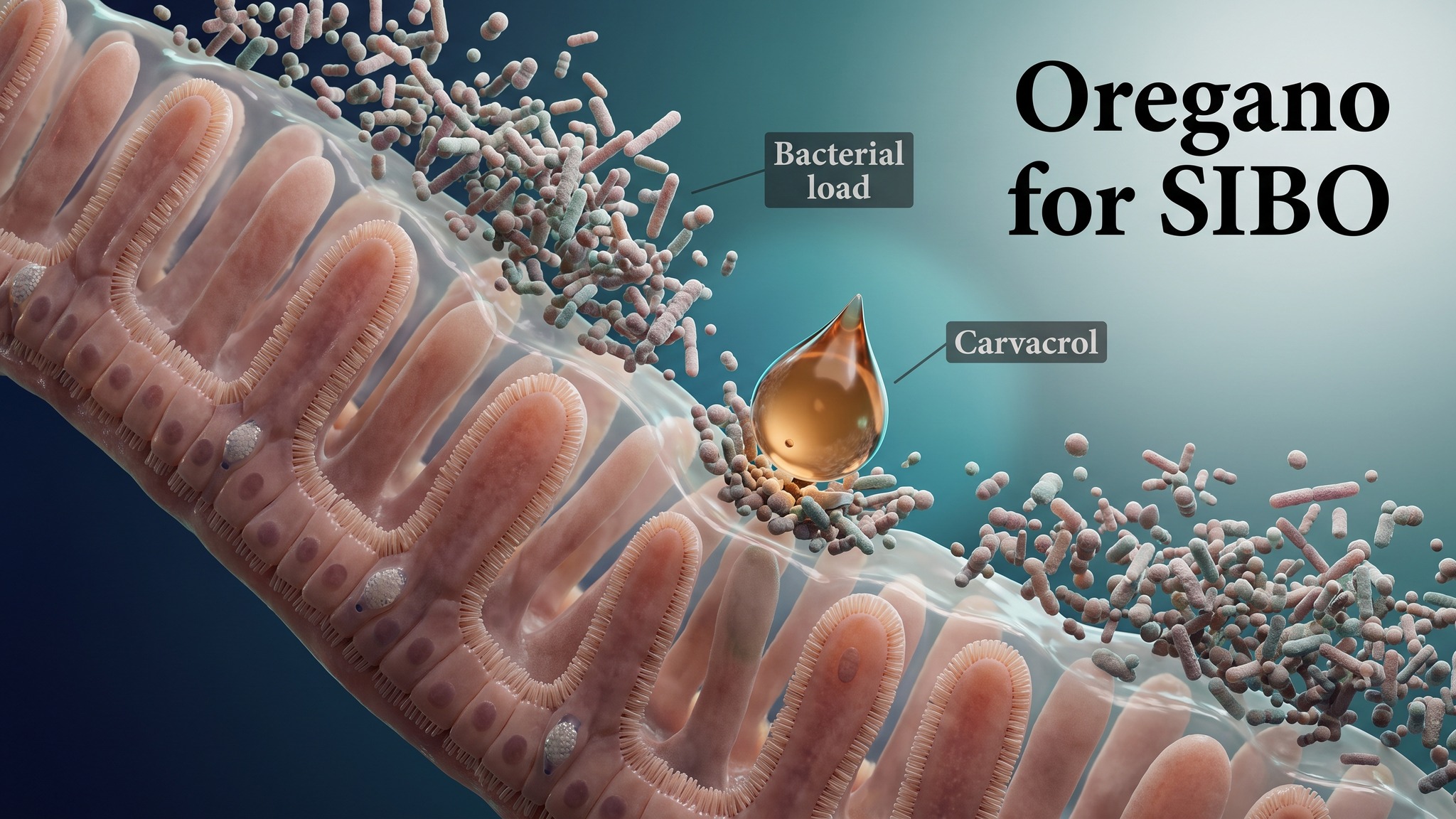
Oregano for SIBO can be useful as one antimicrobial component of a broader plan. Its main compounds, carvacrol and thymol, disrupt microbial membranes in laboratory models, and a small human study found that multi-ingredient herbal therapies performed similarly to rifaximin in patients with a positive gas test. One detail shapes the whole conclusion: the products contained several ingredients, so the result belongs to the combination, with oil of oregano as one component.
That distinction matters. A targeted agent may lower the microbial load and reduce bloat, gas or digestive discomfort. The wider system still needs attention: the migrating motor complex, stomach acid, bile flow, intestinal anatomy and the gut community displaced by repeated antibiotic exposure. In the PPI-related SIBO case from my book, the turning point was understanding the complete chain, from the first cause to the last symptom.
STUDY Among 104 patients who completed follow-up testing, breath-test normalization occurred in 17 of 37 people receiving one of two multi-herb regimens and 23 of 67 receiving rifaximin. The difference was not statistically significant. This was a retrospective study, not a trial of oregano oil alone. Chedid et al., 2014, Herbal therapy is equivalent to rifaximin for the treatment of small intestinal bacterial overgrowth, Global Advances in Health and Medicine.
What is SIBO, what causes it and how do PPIs contribute?
Small intestinal bacterial overgrowth is an abnormal increase or disruption of microbes in the small intestine, where microbial density is normally far lower than in the large intestine. Contemporary studies often use more than 103 colony-forming units per milliliter in a duodenal aspirate as a threshold, although definitions and sampling methods still vary. Once excess microbes ferment carbohydrates too early, SIBO symptoms such as bloat, abdominal distension, pain, diarrhea or constipation can appear.
A classic pathogen is optional here. The condition can also involve friendly gut bacteria in the wrong place or at the wrong concentration. Lactobacillus, Streptococcus and Enterococcus may belong to a healthy oral or intestinal ecosystem, yet contribute to overgrowth when clearance through the small bowel fails. Location, load and community behavior matter as much as a microbe's reputation, which is why identifying the bacteria behind SIBO requires more than assigning every species a good or bad label.
The drivers of overgrowth
The small intestine protects itself through stomach acid, bile, pancreatic secretions, the ileocecal valve and waves of fasting motility called the migrating motor complex. Overgrowth develops when one or more of these defenses weakens. This is why managing SIBO starts by finding the driver before assembling any natural-remedy plan. The PPI link also clarifies the role of a herbal antimicrobial: one possible intervention inside a wider effort to restore the defense that failed.
| Condition, operation or medication | How it can promote overgrowth |
|---|---|
| Autoimmune thyroiditis with hypothyroidism | Low thyroid function can slow intestinal transit and weaken clearance between meals. The risk relates to hypothyroidism and dysmotility more than to the antibody label itself. |
| Diabetes and autonomic neuropathy | Neuropathy can impair gastric emptying and small-intestinal motility, allowing microbes to remain and multiply. |
| Systemic sclerosis | Smooth-muscle and nerve dysfunction can produce severe intestinal stasis, a well-established setting for bacterial overgrowth. |
| Cholecystectomy | Continuous, meal-independent bile delivery may alter the microbe-limiting action of bile and gut ecology. Observational studies report an association, and most people never develop overgrowth after surgery. |
| Gastric or intestinal surgery | Blind loops, bypassed segments, adhesions, fistulae and loss of the ileocecal valve can create stagnant areas or permit colonic microbes to move upward. |
| Celiac disease and Crohn's disease | Mucosal injury, inflammation, strictures and altered motility can overlap with overgrowth and make symptoms difficult to distinguish. |
| Chronic pancreatitis or exocrine pancreatic insufficiency | Reduced digestive enzymes change nutrient availability and local defenses in the small bowel. |
| Cirrhosis | Altered bile acids, motility and immune defense increase the probability of bacterial translocation and overgrowth. |
| Gastroparesis, pseudo-obstruction and small-bowel diverticula | Each can produce stasis, leaving more time for fermentation and microbial expansion. |
| Proton pump inhibitors | Chronic acid suppression weakens the gastric barrier. Meta-analysis data links PPI exposure with a higher prevalence of SIBO, although confounding and diagnostic variation limit causal certainty. |
| Opioids and anticholinergic medicines | Both can slow intestinal transit. Medication review is therefore part of a credible treatment plan. |
The PPI to SIBO pathway
Proton pump inhibitors reduce stomach acid. That can be appropriate and sometimes essential, but long-term suppression also allows more oral and food-borne bacteria to survive the gastric phase. Hypochlorhydria can then sit beside altered upper-gut flora, impaired digestion and vitamin B12 deficiency. The final clinical picture may resemble IBS, especially when bloating, bowel changes and dyspepsia are treated as separate diagnoses.
META-ANALYSIS A 2025 systematic review and meta-analysis found SIBO more often in PPI users than in controls, with longer exposure associated with greater prevalence. Study heterogeneity and mixed diagnostic methods mean this is an association, not proof that every PPI causes overgrowth. Khurmatullina et al., 2025, Duration of proton pump inhibitor therapy and risk of small intestinal bacterial overgrowth, Journal of Clinical Medicine.
How does oregano oil work as an antimicrobial against SIBO?
Oregano oil works mainly by damaging microbial membranes and disturbing ion balance, energy production and cellular integrity. Carvacrol and thymol are lipophilic phenols that can enter the membrane, increase permeability and promote leakage of intracellular material. These effects explain why oregano oil inhibits both Gram-positive and Gram-negative bacteria in vitro. The open clinical questions are the dose that reaches the human small intestine, which microbes are exposed and how a complex overgrowth community responds.
Oregano essential oil activity against eight bacterial targets
Tao et al., 2025, Frontiers in Pharmacology. Dots are median MIC values and bars are observed MIC ranges across four oregano essential oil preparations, in mg/mL, plotted on a log2 scale. The ranges are observed spreads across preparations, distinct from statistical confidence intervals. Lower MIC indicates stronger in-vitro inhibition. The vertical reference is 1 mg/mL.
LAB STUDY Four oregano essential oil preparations inhibited eight Gram-positive and Gram-negative bacteria, but potency varied substantially with chemical composition and organism. The work supports a broad laboratory mechanism, not a clinical dose. Tao et al., 2025, Antibacterial activities of oregano essential oils and their active components, Frontiers in Pharmacology.
What does the human evidence for oregano oil in SIBO show?
Human evidence for oregano oil in SIBO is promising and still indirect. The study most often cited compared rifaximin with two commercial herbal therapies containing oregano alongside berberine-containing plants and other compounds, so oregano worked there as part of a combination. Breath-test normalization was numerically higher with herbal therapy. The difference stayed within statistical chance, and treatment allocation followed clinical practice without randomization.
The fair description: a herbal antimicrobial with laboratory activity and a place in some clinician-guided protocols. Calling it proven or equivalent to an antibiotic would need more than one retrospective, multi-ingredient comparison. Neem, berberine, allicin and oregano oil may appear in herbal therapies, and methane-dominant, hydrogen-dominant and hydrogen-sulfide patterns each call for their own strategy.
What supports oregano oil
- Carvacrol-rich oregano oil has broad in-vitro inhibitory activity.
- A multi-herb protocol containing oregano produced breath-test normalization in a small retrospective cohort.
- Oregano may be considered during a microbial-load reduction phase with clinical supervision.
What remains unproven
- No high-quality randomized trial shows that oregano oil alone can treat SIBO.
- There is no standardized formulation, active-compound content, dose or duration for treatment.
- A positive follow-up gas result leaves open whether normal physiology and gut health have recovered.
Why does oregano oil often fall short as a stand-alone SIBO treatment?
The challenge with relying on oregano oil alone is that overgrowth usually reflects a broken control system. If slow transit, a damaged migrating motor complex, low stomach acid, altered anatomy or an untreated disease remains, the same ecological pressure returns as soon as treatment stops. No antimicrobial can repair a blind loop or restart fasting motility.
It can also affect beneficial gut bacteria. The answer to the common question is therefore yes: oregano oil may suppress some friendly organisms as well as unwanted ones. When intestinal homeostasis returns, those communities may recover because the new conditions favor them. That recovery is possible and depends on diet, motility, medication exposure and the starting microbiome. This is why probiotic and prebiotic choices belong to an individualized plan, guided by tolerance and clinical context.
If oregano oil reduces SIBO symptoms, the condition is cured.
Symptom relief can reflect less fermentation without proving that motility, nutrient status or the underlying disease has recovered. A durable outcome requires a treatment plan for both the microbial load and the reason it accumulated.
How do you diagnose SIBO and confirm treatment worked?
Before starting any herbal antimicrobial, the diagnosis deserves real examination. The condition is usually investigated with a glucose or lactulose breath test measuring hydrogen and methane for up to three hours. It is convenient and non-invasive, and it works as an indirect fermentation test that tracks gas production, with no bacterial count. A negative result still leaves overgrowth possible, and a positive result stays silent about which organisms are involved. Interpretation must sit beside symptoms, risk factors, preparation quality and the clinical response.
How breath-test accuracy changes by method and population
Losurdo et al., 2020, Journal of Neurogastroenterology and Motility. Pooled performance against jejunal aspirate culture. Subgroups come from different study sets and some were based on few studies.
META-ANALYSIS Across 14 studies, pooled sensitivity and specificity were 42.0% and 70.6% for lactulose, and 54.5% and 83.2% for glucose. Accuracy varied with cutoff and patient selection. Losurdo et al., 2020, Breath tests for the non-invasive diagnosis of small intestinal bacterial overgrowth, Journal of Neurogastroenterology and Motility.
Every important limitation of the SIBO breath test
- Breath testing measures exhaled gases produced after a substrate. It tracks gas patterns only: no bacterial count, no taxa identification, no susceptibility testing, no view of the mucosa.
- Lactulose reaches the colon. Rapid orocecal transit can create an early hydrogen rise that looks like overgrowth and causes a false positive.
- Glucose is absorbed in the proximal small intestine. It may never reach distal bacterial overgrowth and can therefore produce a false negative.
- Some microbial communities produce little hydrogen. Others consume hydrogen to make methane or hydrogen sulfide, flattening the hydrogen curve.
- Many commercial tests measure hydrogen and methane only. A two-gas test can miss hydrogen sulfide, an important metabolic pattern.
- Methane comes from archaea. It can arise in the small or large intestine, so the preferred term is intestinal methanogen overgrowth (IMO), distinct from classic SIBO.
- Substrate choice, substrate dose, gas cutoffs, sampling intervals and total test duration vary between laboratories and guidelines.
- High baseline gas values and persistently flat profiles are difficult to interpret and may reflect preparation, oral fermentation or non-gas-producing communities.
- Antibiotics, probiotics, laxatives, prokinetics, the preparation diet, fasting, smoking, exercise and recent sleep can change results.
- Day-to-day biological variation means the same patient can produce a different curve on another day.
- Poor breath collection, delayed analysis, leaking bags and differences between devices create pre-analytical and analytical error.
- Diagnostic performance changes with the population. Tests may perform better after gastrointestinal surgery than in patients without an obvious predisposing condition.
- Duodenal or jejunal aspiration is also imperfect. Oral contamination, one sampling site, non-standard culture thresholds and organisms that routine culture misses all affect the reference standard.
When a negative test meets persistent symptoms
DUODENAL STUDY Duodenal aspirates from 140 symptomatic patients showed higher culturable bacterial burdens and a distinct 16S microbial profile in culture-defined SIBO. In the small subgroup who also had lactulose testing, breath results did not perfectly match aspirate findings. Leite et al., 2020, The duodenal microbiome is altered in small intestinal bacterial overgrowth, PLOS ONE.
Testing after treatment earns its place when it answers a clinical question. A repeat gas study can be useful when the original result was clearly positive and the answer would change management. Duodenal aspiration with culture and molecular analysis can add detail in selected complex cases. Stool 16S rRNA testing describes the large-intestinal community, a different neighborhood from the small intestine. Fecal elastase, vitamin B12, folate, zinc and vitamin D can reveal consequences or competing diagnoses. Clearance itself needs a small-intestinal answer.
CLINICAL APPRAISAL A 2024 expert review concluded that lactulose breath testing is especially vulnerable to transit-related false positives and that inconsistent criteria have encouraged overdiagnosis in disorders such as IBS. Kashyap et al., 2024, Critical appraisal of the SIBO hypothesis and breath testing: a clinical practice update, Neurogastroenterology and Motility.
When long-term PPI use led to SIBO: a clinical case
This clinical case follows a patient whose long-term PPI exposure was followed by persistent bloating, dyspepsia and bowel disturbance. The important clue was the sequence itself: chronic gastric acid suppression weakened the first acid barrier, the upper intestinal ecosystem changed, and the resulting overgrowth picture was repeatedly treated as disconnected symptoms.
The pattern
A patient with long-term acid suppression developed bloating, dyspepsia and IBS-like bowel changes that persisted as apparently separate complaints.
The overlooked trigger
The medication history revealed sustained PPI exposure and the physiological consequences of a weakened gastric acid barrier.
The connected findings
The case linked bacterial overgrowth with dysbiosis, digestive impairment and nutrient vulnerabilities in one connected picture.
The result
In the wider clinical series of more than 98 cases, patients were 30 to 55 years old, overall success exceeded 70% and recovery usually took two to six months.
In this clinical series, bloating was reported by about 80% of patients before care and about 15% afterward. Dyspepsia fell from roughly 80% to 10%. These are observational case-series outcomes from the book's clinical archive. They describe what happened in that cohort, and individual responses always vary. The complete case explains how the findings were connected and translated into a structured clinical strategy.
What keeps SIBO from returning after treatment?
The best relapse prevention plan treats the reason overgrowth developed, protects fasting motility and avoids repeated antimicrobial courses without reassessment. That can mean reviewing the need and dose of a PPI with the prescribing clinician, treating hypothyroidism or diabetes, addressing constipation, testing pancreatic function, managing adhesions or supporting nutrition. It means managing SIBO as a system, with gut ecology intact.
In this clinical case, the maintenance routine included finishing food by 7 pm, using a 16:8 eating window and avoiding large amounts of water with meals. These were individualized choices intended to preserve fasting intervals and digestive concentration, matched to this patient's profile. A long fasting window needs individual medical judgment, especially during pregnancy, low body weight, frailty, hypoglycemia risk or a history of eating disorder.
- Review the driver and any motility-slowing medication before repeating an antimicrobial.
- Leave appropriate meal spacing if it is safe for you, because the migrating motor complex works during fasting.
- Correct B12, iron, folate, zinc, vitamin D or fat-soluble vitamin deficiencies when testing confirms them.
- Match probiotics and prebiotics to tolerance and clinical context, because individual response decides what helps.
- Reassess when constipation, diarrhea, weight loss, anemia, vomiting, bleeding or severe pain changes the diagnostic picture.
Oregano for SIBO may help reduce microbial pressure, inside a plan that also includes diagnosis, root-cause work and follow-up. The goal is the right microbial load in the right place, supported by the physiology that keeps it there.
Discover the complete clinical strategy
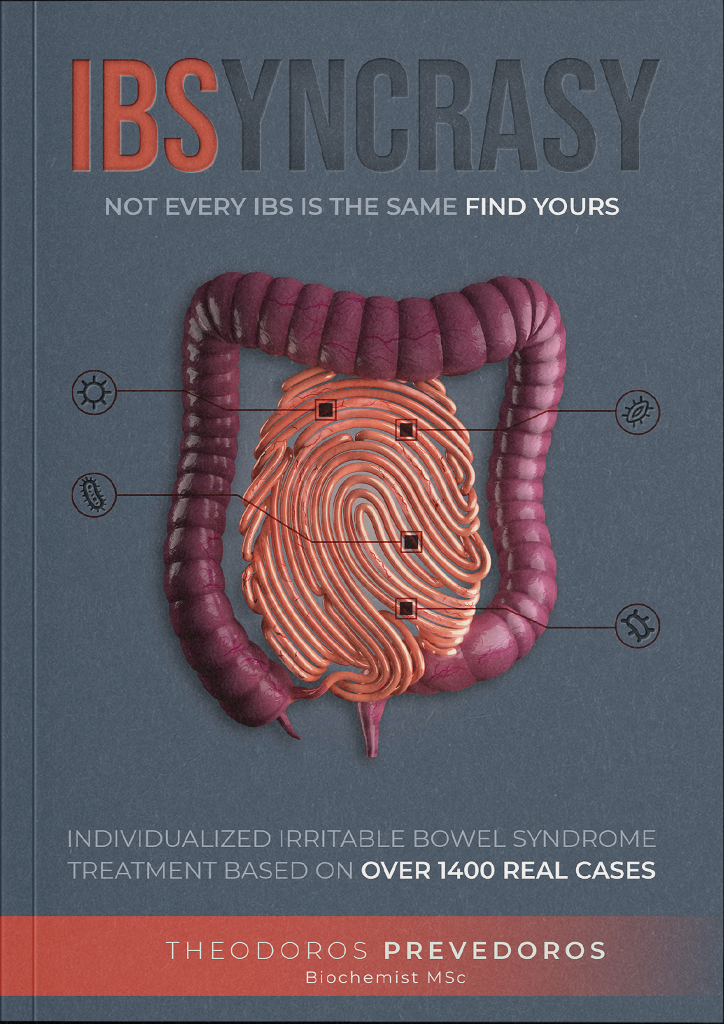
IBSyncrasy takes you through the complete PPI-to-SIBO case, its diagnostic logic and the full treatment sequence, so you can understand how every clinical decision connects.
Frequently asked questions
No single herb reliably kills all forms of SIBO. Oregano oil, berberine-containing herbs, neem and allicin appear in herbal antimicrobial protocols, but the evidence is limited and products often combine several ingredients. Methane, hydrogen and hydrogen sulfide patterns also involve different microbial ecosystems. The safer question is which treatment fits the test pattern, symptoms, underlying driver and medical history.
Yes, oregano oil can suppress some friendly gut bacteria as well as unwanted organisms because its antimicrobial effect has limited selectivity. When intestinal homeostasis returns, beneficial communities may recover because motility, diet and the chemical environment favor them again. Recovery is not guaranteed, which is why prolonged or repeated use of oregano oil without a clear treatment plan can work against gut health.
People with a sensitive stomach, reflux or gastritis may find that they burp it back up or develop burning, nausea, diarrhea or abdominal discomfort. Avoid medicinal oregano oil during pregnancy because safety data are lacking. Extra caution is appropriate with an allergy to plants in the mint family, a bleeding disorder, anticoagulant or antiplatelet medication, upcoming surgery, or glucose-lowering medicine. Concentrated essential oil should never be swallowed undiluted. Discuss it with your clinician and pharmacist if you have a chronic condition or take regular medication.
There is no standardized, evidence-based dose or duration of oregano oil for SIBO. Products vary widely in carvacrol content, formulation and release, so copying a drop count is unsafe. A clinician may use oregano for a defined, short active phase and decide whether a probiotic belongs during or after it. If both are used, separating their timing is sensible, and the best schedule remains an individual clinical decision.
Do not stop a prescribed PPI abruptly. Ask the prescriber to review the indication, lowest effective dose and alternatives, because some conditions require ongoing acid suppression. If SIBO symptoms return, reassess constipation, motility, thyroid and glucose control, anatomy, pancreatic function, diet and test quality before repeating oregano oil or an antibiotic. Recurrence is a reason to revisit the cause before repeating any treatment.