Is snacking bad for digestion? What your gut does between meals
For many people, yes. The problem is not the snack itself but what it interrupts: the gut's between-meals housekeeping, the neural timing of each meal and the acid that breaks your food down.

Is snacking bad for digestion?
Is snacking bad for digestion? For many people who graze from morning to night, the answer is yes, and the reason is not what is inside the snack. It is what the snack interrupts. Your gut is not a conveyor belt that runs better the more you feed it. It is a system built to alternate between two states, and constant snacking traps it in one of them.
This pattern has quietly become the norm. Between 1977 and 2006, the share of American adults who snack rose from 71% to 97%, and daily eating occasions climbed from 3.8 to 4.9, according to national diet surveys that track eating occasions. In practice, many people report far more, often 8 to 12 episodes a day once caloric drinks, tastes and handfuls are counted.
How grazing became the default: US adults, 1977-78 vs 2003-06
Piernas and Popkin, J Nutr 2010 (NHANES 1977-2006). Bar heights normalized within each pair; values as published.
- Migrating motor complex (MMC)
- A cyclical pattern of contractions that sweeps leftover food particles and bacteria out of the stomach and small intestine while you are not eating. It only runs in the fasting state, and it stops the moment food arrives.
So when someone asks me whether all this grazing harms their gut, I do not start with the snack. I start with how many times a day their digestive system is switched on, and how rarely it is allowed to switch off. It is usually a gut health question of rhythm, not of ingredients.
What does your gut actually do between meals?
Between meals, your gut runs a cleaning program called the migrating motor complex. During fasting, researchers measured the full cycle at about 95 minutes: a wave of strong contractions starts in the stomach or upper small intestine and travels downward, pushing undigested residue, shed cells and bacteria toward the colon.
The cycle has four phases, and phase III is the active burst. Just before it begins, a plasma peak of the hormone motilin rises by roughly 35%, acting like a starter pistol for the stomach's cleaning contractions. Feeding abolishes the whole pattern within moments. One bite, one sweetened coffee, one smoothie, and the gut flips back to fed mode until the calories clear.
ΜΕΛΕΤΗ The migrating motor complex is a four-phase fasting pattern whose phase III waves sweep residual content forward, and it is interrupted by feeding; its absence is linked to gastroparesis and small intestinal bacterial overgrowth. Deloose et al., 2012. The migrating motor complex: control mechanisms and its role in health and disease. Nature Reviews Gastroenterology and Hepatology.
Digestion on
Acid and enzyme secretion, insulin release, mixing and absorption. The cleaning wave stays switched off for as long as nutrients keep arriving.
Housekeeping on
Motilin rises, phase III contractions sweep residue and bacteria toward the colon, and the gut lining gets its only real downtime of the day.
This is why the frequency of eating matters as much as the content. A gut that is fed every 45 to 90 minutes spends the whole day in a semi-fed state. Housekeeping never completes, so residue lingers where bacteria can ferment it, feeding the wrong members of the gut microbiome, and the bloating that follows gets blamed on the last thing you ate rather than on the rhythm. That rhythm, not any single food, is why this question keeps surfacing in my assessments.
How does all-day chewing rewire the nerves of digestion?
Digestion is neurologically timed, and chewing is one of its main clocks. Before food even reaches the stomach, the sight, smell and mastication of a meal trigger the cephalic phase: a vagal rehearsal that primes acid, enzymes and motility for what is about to arrive.
The vagus nerve runs this rehearsal through specific mediators. Acetylcholine acts directly on the acid-producing parietal cells and prompts gastrin release, which in turn orders histamine from neighboring ECL cells. Serotonin, about 95% of which resides in the gut, initiates peristaltic and secretory reflexes. Meanwhile motilin and ghrelin schedule the fasting contractions of the cleaning wave. Every one of these signals is timed to an expected meal.
ΜΕΛΕΤΗ About 95% of the body's serotonin resides in the gut, where it activates the neurons that initiate peristaltic and secretory reflexes and report to the brain. Gershon and Tack, 2007. The serotonin signaling system: from basic understanding to drug development for functional GI disorders. Gastroenterology.
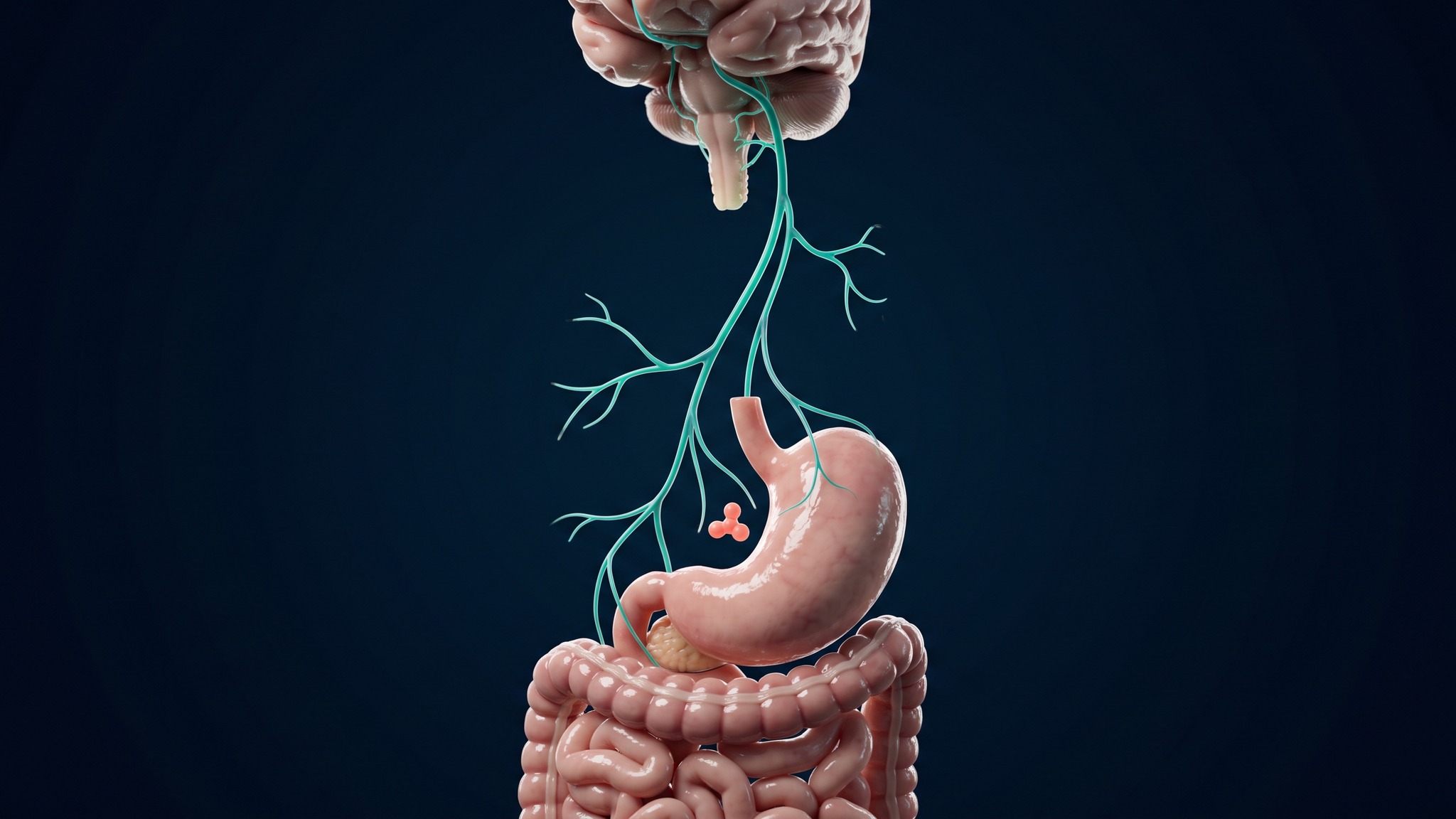
Now consider what happens when chewing happens ten or more times a day, at irregular intervals, for amounts that are neither snacks nor meals. Each episode fires the same cephalic signal for a meal that never truly comes. Acid and enzymes are primed at the wrong moments, the fasting signals never get a clear window, and the nervous system gradually stops distinguishing a real meal from a nibble. The neurological regulation of digestion shifts from a predictable rhythm to static. Most people never think about grazing in neurological terms, yet this is exactly where the answer lives.
What happens to stomach acid when you graze all day?
Hydrochloric acid does the early heavy work of digestion: it unfolds proteins and activates pepsin, the enzyme that cuts them apart. A meaningful share of that output, about 30% in classic physiology, is released during the cephalic phase, before the first bite even reaches the stomach. In sham-feeding experiments in humans, seeing, smelling and tasting food without swallowing it raised acid output several-fold.
Constant grazing corrupts this sequence from both directions. Acid is triggered at random times for trivial loads, so secretion arrives when there is nothing to work on. Then, when a real meal finally lands, the priming is blunted and the acid response is weaker than the meal requires. Over years of this pattern, I repeatedly see the same downstream picture in assessed cases: protein reaching the small intestine half-processed, bacterial fermentation of what should have been digested higher up, and a stomach that struggles to break food down on demand.
ΜΕΛΕΤΗ The main stimulants of gastric acid secretion are the hormone gastrin from antral G cells, the paracrine agent histamine from ECL cells, and the neurotransmitter acetylcholine released from intramural neurons. Schubert, 2017. Physiologic, pathophysiologic, and pharmacologic regulation of gastric acid secretion. Current Opinion in Gastroenterology.
By the time a person connects a struggling stomach to years of snacking, the pattern is usually old. None of these signs proves low acid on its own. Together, however, they sketch a stomach whose chemical timing has been trained into inconsistency, and inconsistent chemistry is a digestion problem no supplement stack fixes.
Does snacking affect appetite, weight, or blood sugar?
Yes, and mostly through timing rather than calories. Repeated rises and drops in blood sugar levels do not always register as hunger. They register as urgency: irritability, shaky fatigue, brain fog, a sudden need to eat something right now. The next snack fixes the dip, blood sugar climbs again, and the loop repeats on a shorter fuse each time.
Here is the part worth sitting with: snacking is not hunger. If it were true hunger, the 150 or 200 calories in a typical snack would never be enough to switch it off. What the snack actually switches off is the dip, the ghrelin spike and the conditioned urge. Genuine hunger for a meal does not negotiate with a handful of crackers.
ΜΕΛΕΤΗ Ghrelin rises shortly before every scheduled meal, by an average of 78%, and falls to trough levels within an hour of eating, a pattern reciprocal to insulin. Cummings et al., 2001. A preprandial rise in plasma ghrelin levels suggests a role in meal initiation in humans. Diabetes.
That signal is trainable, for better and for worse. Eat at random times all day and ghrelin learns to fire at random times all day, which is why grazers feel ravenous at odd hours and never truly satisfied after meals. Larger population data point the same direction. In large prospective cohorts in men and women, adding snacks on top of three meals, or making a habit of the late-night snack, tracked with a higher risk of type 2 diabetes over 6 to 16 years of follow-up.
Is the problem digestion, blood sugar, or both?
Higher eating frequency, higher cardiometabolic risk (adjusted OR / RR with 95% CI)
Murakami 2015 (NHANES, cross-sectional, >=5 vs <=3 eating times/d, EI:EER-adjusted); Mekary 2012 (HPFS men) and Mekary 2013 (NHS women), prospective, multivariable pre-BMI models. Reference line = 1.0 (no association).
A note of honesty about the evidence: the weight associations are observational and, in the NHANES analysis, only appear after adjusting for self-reported energy intake, which is famously under-reported by frequent eaters. The diabetes signal, however, comes from prospective cohorts that follow people forward in time, and it survives adjustment for everything except body weight itself. So is snacking bad for digestion and metabolism alike? The digestive case is mechanistic and strong; the metabolic case is consistent enough to take seriously.
Snacking every couple of hours keeps your metabolism stoked.
The thermic effect of food depends on what and how much you eat, not on how often you eat it. What frequent eating reliably does is keep insulin elevated, blood sugar swinging and the gut's cleaning wave switched off.
Why is quitting snacking so hard at first?
In my experience, the people who struggle most with this change are the chronic all-day eaters, the ones who have been snacking all day for years and whose hunger signals have been trained into noise. When they first structure their meals, many report almost no difference. Some feel worse for two or three weeks: more preoccupied with food, less energetic between meals, convinced the experiment is failing.
What changes their mind is usually an accident. Six or eight snack-free weeks in, a stressful day, a trip or a celebration puts them back into grazing mode, and within hours the old heaviness, the bloating and the fog return. That is the moment they understand how hard digestion had been all along. They had simply never felt the alternative, so they had nothing to compare against.
People rarely believe the pattern until they break it twice: once to quit, and once more, by accident, to feel why they quit.
I also want to be direct about the general rule. Snacking is not a good habit, full stop, and the modern idea that healthy snacks are harmless misses what the snack interrupts. The snack choice is rarely the problem; the frequency is. The exceptions are specific clinical situations, such as medically planned small frequent meals for particular digestive or metabolic conditions. Those are designed patterns with a purpose, not the improvised grazing that fills the gap between a commute and a desk. So, is snacking bad for digestion for everyone, always? Biology rarely deals in absolutes, but as a default for a healthy adult, the answer stays yes.
How can you break the habit of constant snacking?
If the question is whether years of grazing have harmed your gut, structure is the answer. You break constant snacking by changing the frame, not by fighting urges: four or five distinct main meals with real gaps between them, an overnight window of about twelve hours, and plates built to hold you to the next meal. That means adequate protein, fat and fiber every time you sit down. Willpower is a poor substitute for a meal that actually satiates.
The most underrated structural tool is slow chewing. In one trial, men who chewed each bite 40 times instead of 15 ate 11.9% less, with lower ghrelin and higher satiety hormones after the meal. In another, eating the same test meal over 30 minutes instead of 5 raised the satiety hormones GLP-1 and PYY by roughly 41% and 27%. Chewing is not etiquette. It is the first mechanical and neurological step of digestion, and rushing it short-circuits the very signals that tell you to stop.
Same meal, slower eating: stronger satiety-hormone response
Kokkinos et al., JCEM 2010. Postprandial AUC (pmol/L x min) after a 675-kcal meal eaten in 5 vs 30 minutes, n = 17 men.
ΜΕΛΕΤΗ Chewing each bite 40 times instead of 15 led men to eat 11.9% less in a single meal, with lower postprandial ghrelin and higher GLP-1 and CCK. Li et al., 2011. Improvement in chewing activity reduces energy intake in one meal and modulates plasma gut hormone concentrations in obese and lean young Chinese men. American Journal of Clinical Nutrition.
ΜΕΛΕΤΗ Eating the same meal over 30 minutes instead of 5 produced a markedly stronger anorexigenic hormone response, with significantly higher GLP-1 and PYY. Kokkinos et al., 2010. Eating slowly increases the postprandial response of the anorexigenic gut hormones, peptide YY and glucagon-like peptide-1. Journal of Clinical Endocrinology and Metabolism.
And if a snack is truly unavoidable?
Then eat it slowly. Thorough chewing recruits the same cephalic and satiety machinery properly, which takes much of the edge off the false drive that would otherwise send you back for another bite an hour later. It will not give the gut its cleaning window, but it keeps one episode from recruiting the wrong mechanisms that would otherwise disrupt the rest of the day's rhythm. On the days you cannot avoid snacking, slow chewing is how you keep one episode from becoming five, and how the snacking question quietly stops being one.
When is it not just a snacking problem?
Meal timing explains a lot: the bloat, the irregularity, the swings between constipation and looser stools. It does not explain everything. Some patterns call for proper medical evaluation rather than a restructuring of snacks and meals, and they should not be waited out.
If any of these apply, see a gastroenterologist first. And if your picture is the familiar cluster of bloating, irregularity and unpredictable appetite without red flags, the same physiology that links grazing to irritable bowel patterns is a good place to start looking.
Still grazing all day and still bloated?
Book an in-person session. We will map your eating episodes, your symptoms and the physiology behind them, then build a meal structure your digestion can actually keep.
IBSyncrasy
IBSyncrasy goes deeper into the physiology behind this article, in plain language: the housekeeping wave your gut runs between meals, why four or five distinct meals beat eight mini-meals for most sensitive guts, and the full chapter I wrote specifically for all-day eaters, the Símbolo chapter, with the meal structures that finally hold.
Get IBSyncrasyFrequently asked questions
For most healthy adults, frequent daily snacking is a net negative for digestion, because every eating episode interrupts the gut's cleaning wave and re-primes acid and enzymes at the wrong time. Four or five distinct meals with gaps beat eight mini-meals for most people, including most people with sensitive digestion.
Often, yes. The type of snack matters for blood sugar, but the frequency matters for digestion: even a handful of nuts switches the gut from housekeeping mode back to fed mode. Planned snacks only make sense inside specific, medically designed diets, not as an all-day default.
Black coffee and plain water do not meaningfully interrupt the fasting state. Caloric drinks do: a sweetened coffee, a smoothie or a sports drink is a full eating episode. Chewing gum is a gray zone: it triggers cephalic digestive signals and swallowed air without delivering nutrients, which can worsen bloating in sensitive people.
One full cleaning cycle takes about 95 minutes, so practical gaps of roughly 3.5 to 4 hours between meals give the wave time to run. Add a 12-hour overnight window, and the gut gets several complete housekeeping cycles every day.