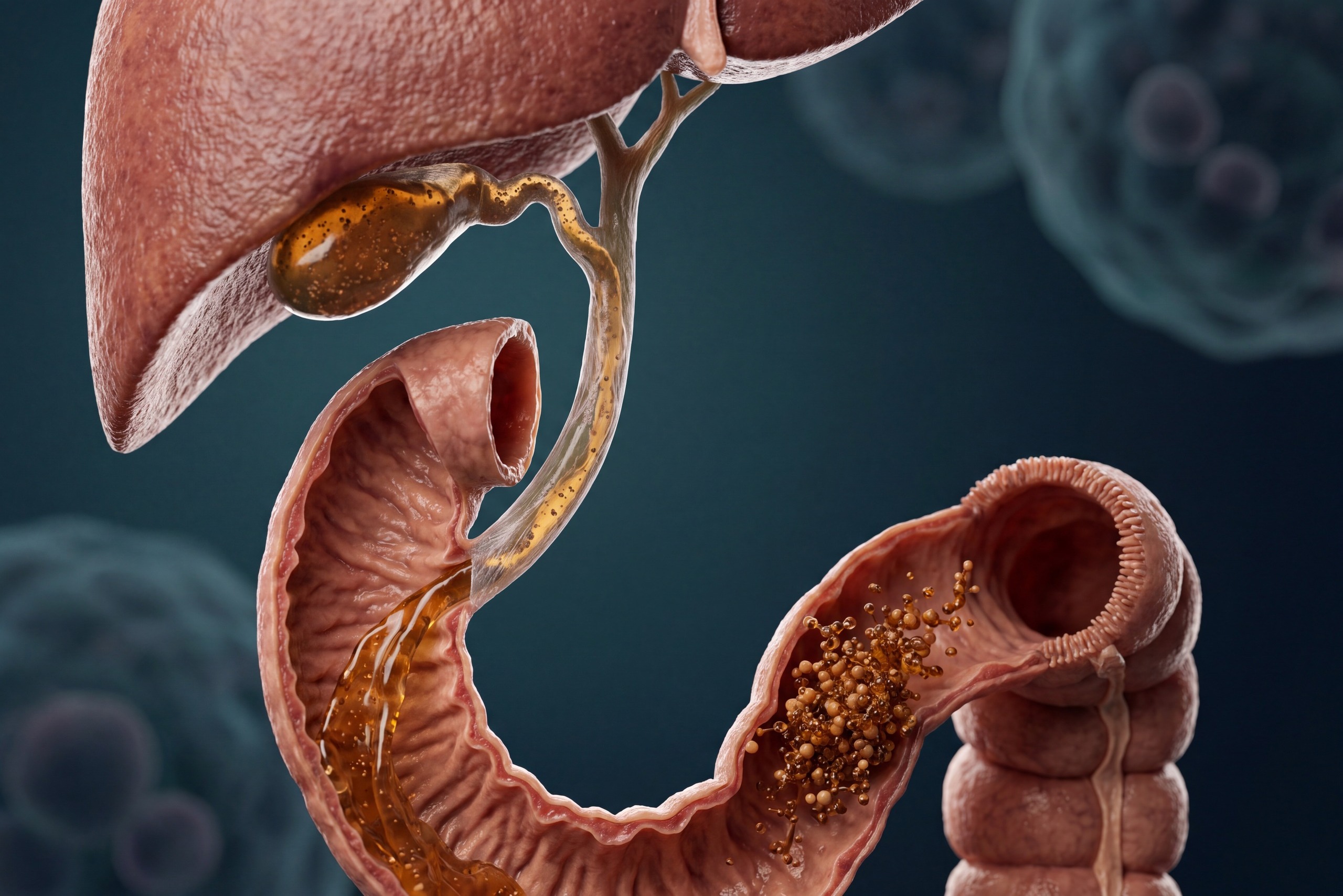
Diarrhea episodes after cholecystectomy begin months or years later in some patients and remain intermittent. After gallbladder removal, bile flows continuously from the liver. However, diarrhoea starts only when the colonic bile-acid mixture crosses a secretory threshold. Lydia’s episodes occurred every 10 to 15 days. Her diverticular disease, recent Campylobacter infection, pantoprazole exposure, repeated antibiotics and stool pH of 7.5 identified several mechanisms that push the bowel above that threshold on selected days.
Understand the mechanisms behind digestive symptoms
IBSyncrasy explains how bile acids, the microbiome and meal patterns influence bowel habits. The book connects these mechanisms with everyday digestive issues. Buy IBSyncrasyWho is Lydia and what happened before her bowel habits changed?
A 65-year-old woman with a long digestive history
Lydia is 65 and has a body mass index near 32. She also lives with gastro-oesophageal reflux disease and Hashimoto’s thyroiditis. Her chronic digestive issues became more prominent after gallbladder surgery. However, the pattern was never a continuous daily diarrhoea syndrome.
Normal stools between discrete attacks
Most days brought one or two formed bowel movements. Then, every 10 to 15 days, a postprandial episode caused diarrhoea and diffuse pain below the navel. This separation between attacks matters. It points toward a variable threshold with secretion switching on during attacks.
Diverticulitis, Campylobacter and repeated antibiotics
A CT scan identified diverticulitis in late 2024. Antibiotics reduced the acute problem without restoring stable digestion. In May 2025, Campylobacter caused a sharper increase in diarrhoea and another antibiotic course. A further diverticulitis episode followed shortly before assessment. Therefore, the colon had faced repeated inflammatory and ecological disturbances.
Low diversity, depleted butyrate producers and alkaline stool
Faecal calprotectin remained at or below 50 mg/kg. However, faecal occult blood was positive and stool pH measured 7.5. Microbiome testing found lower diversity, absent Coprococcus and Akkermansia, Faecalibacterium at 0.20% and Eubacterium at 0.028%. Enterobacteriaceae reached 2.16%, while Escherichia reached 2.13%. These measurements describe the bowel environment between acute attacks.
Fast eating, starch-heavy meals and pantoprazole
Lydia ate quickly and chewed poorly. Bread, wheat and other starches appeared frequently, including late in the evening. She also used pantoprazole for reflux. Consequently, meal size, timing, gastric acid suppression and microbial recovery all became relevant to the timing of each symptom episode.
Why do diarrhea episodes after cholecystectomy start late and come and go?
Gallbladder removal changes bile delivery from meal-triggered release to a continuous flow from the liver. The ileum still reabsorbs most bile acids. However, the amount escaping into the colon changes with meals, transit, fat intake and bacterial conversion. Diarrhoea begins when the arriving mixture exceeds colonic absorption and detoxification capacity.[1][3]
What does a bile-acid threshold mean?
The threshold depends on concentration and chemical structure. In human colon perfusion, deoxycholic acid caused consistent secretion at 3 mM. Chenodeoxycholic acid required 5 mM. By contrast, cholic acid produced no significant change at 10 mM. Dihydroxy bile acids therefore exert a stronger secretory effect than the trihydroxy form. Once the active mixture reaches the large intestine and crosses its threshold, sodium and chloride enter the lumen. Water follows them, which creates loose stool and urgency.[2]
Concentrations tested during human colonic perfusion
Mekhjian, Phillips and Hofmann, 1971.[2]
Why does the threshold create intermittent episodes?
Continuous bile flow produces a changing colonic concentration. On many days, ileal uptake and colonic bacterial metabolism keep exposure below the secretory line. After a larger or fattier meal, faster transit leaves less time for reabsorption. Meanwhile, microbial conversion increases hydrophobic secondary bile acids. The combined load then crosses the threshold. After the lumen clears, secretion falls again and formed stools return. Therefore, attacks remain separated by 10 to 15 symptom-free days.
Post-cholecystectomy diarrhoea must start immediately and continue every day.
The altered bile flow is continuous, while threshold crossing is episodic. Later changes in diet, transit, medicines, infection and microbiota produce a delayed clinical pattern.
Bile-acid synthesis marker after cholecystectomy
Prospective study of 51 patients. Loose stools were reported by 2%, 47% and 33% at the same time points.[1]
How do the microbiome and serotonin amplify an episode?
Secondary bile acids also change motility. In an experimental model using microbiota from patients with post-cholecystectomy diarrhoea, DCA, HDCA and LCA increased colonic serotonin. TGR5 and TRPA1 signalling drove this response. Serotonin then accelerated colon movement and raised faecal water. Therefore, one threshold activates both secretion and propulsion.[4]
What moves the colon toward the threshold?
Each layer changes the bile-acid concentration, composition or colonic response.
Select a ring to read its mechanism
Loss of gallbladder storage
The liver supplies bile between meals, while gallbladder contraction is absent after surgery.
Where do diverticular disease and bile acids meet?
The closest direct human bridge comes from symptomatic uncomplicated diverticular disease. A 2025 prospective study found higher total faecal bile-acid concentrations in symptomatic patients. Concentrations also correlated positively with faecal calprotectin and endotoxin activity. This cohort differs from acute diverticulitis. However, it demonstrates that diverticula, pain, looser stool and a higher faecal bile-acid burden occupy the same colonic environment.[5] A separate study in women also identified distinct microbial and metabolic activity with diverticulitis.[6]
Which factors strengthened Campylobacter susceptibility?
Pantoprazole supplies the strongest quantified human association. Acid suppression weakens the gastric barrier before organisms reach the intestine. A meta-analysis found an odds ratio of 5.09 for community-acquired Campylobacter infection among proton-pump inhibitor users.[7] Repeated antibiotics also reduce colonisation resistance by removing protective competitors.[9] Moreover, lower baseline diversity and lower Coprococcus abundance preceded Campylobacter acquisition in a human travel cohort.[8]
| Factor | Evidence and mechanism |
|---|---|
| Pantoprazole | Human meta-analysis. Lower gastric acidity increases survival of swallowed enteric pathogens. Campylobacter OR 5.09.[7] |
| Repeated antibiotics | Mechanistic and clinical literature. Commensal depletion reduces nutrient competition and colonisation resistance.[9] |
| Lower diversity and absent Coprococcus | Human prospective association. Uninfected travellers had higher diversity, Lachnospiraceae, Dorea and Coprococcus.[8] |
| Altered bile exposure | Experimental mechanism. Campylobacter jejuni uses the CmeABC efflux pump for bile-salt resistance and intestinal colonisation.[10] |
| Cholecystectomy itself | Evidence rank remains mechanistic because an independent human acquisition estimate is unavailable. |
Community-acquired enteric infection associated with PPI use
Nine observational studies and 12 analyses.[7]
Why does stool pH 7.5 matter?
A stool pH of 7.5 is alkaline relative to the mildly acidic environment created by carbohydrate fermentation. Across five human studies, higher total short-chain fatty acids and higher butyrate tracked with lower faecal pH.[12] Lydia’s low Faecalibacterium and Eubacterium, absent Coprococcus and low diversity fit reduced fermentation resilience. Cholecystectomy connects through altered bile-acid ecology and microbial selection.[4] Therefore, pH 7.5 supports this combined ecological mechanism. Its role is supportive, while dedicated BAD tests measure bile-acid handling.
What do the proposed tests clarify about chronic diarrhea?
The proposed tests separate active inflammation, metabolic strain, nutrient status and pancreatic function. This matters because chronic diarrhea after gallbladder surgery has several overlapping causes. Moreover, Lydia already has positive occult blood, recurrent diverticulitis and a recent bacterial infection. Those findings require a broader diagnostic map than stool frequency alone.
Which tests measure bile acid diarrhea directly?
Bile acid diarrhea has dedicated diagnostic tools. SeHCAT retention measures whole-body retention where the test is available. Fasting serum C4 estimates hepatic bile-acid synthesis. FGF19 reflects ileal feedback, while a 48-hour faecal collection measures total and primary bile acids. Current reviews also describe validated combined approaches using stool bile acids and serum C4.[3][13] Cholestyramine is a bile-acid sequestrant used in the treatment pathway. These tools answer a different question from calprotectin, stool pH or microbiome composition.
What would each result change?
Raised inflammatory markers would redirect attention toward active mucosal or diverticular inflammation. Normal markers with an abnormal BAD test would support bile-acid sequestration as a treatment pathway. Nutrient deficits would identify consequences of restricted intake or impaired absorption. Finally, stable inflammation with persistent episodic diarrhoea would strengthen the value of a meal, stool and medicine timeline.
How long do diarrhea episodes after cholecystectomy continue? If they recur for months, does that make the pattern permanent?
These diarrhea episodes vary because gallbladder removal changes bile flow permanently, while the bowel’s response changes over time. In one prospective study, loose stools affected 47% at one month and 33% at three months. Six percent specifically reported intermittent diarrhoea at three months. Persistent symptoms therefore describe an ongoing mechanism with variable daily expression. The duration depends on ileal reabsorption, bile-acid synthesis, colonic sensitivity, diet, transit and microbial adaptation.
What did we recommend and how does it help?
The initial strategy reduces the daily inputs that push the bowel toward its secretory threshold. It also creates cleaner observations before the next diagnostic step. Each change targets a documented feature of Lydia’s routine. This preserves her individual post-cholecystectomy pattern.
Finish dinner earlier and stop food after 19:00
Late starch-heavy meals compress digestion into the evening and prolong postprandial intestinal activity. Therefore, an earlier final meal separates the digestive load from sleep. The schedule also makes attack timing easier to compare with meal size and fat content. An unsweetened herbal tea replaces habitual evening eating without creating another bile-acid stimulus.
Use a two-month bread withdrawal followed by structured reintroduction
Bread and wheat appeared repeatedly in Lydia’s starch-heavy pattern. A time-limited withdrawal reduces one frequent variable. Next, reintroduction twice weekly tests reproducibility under controlled conditions. Its purpose is a controlled food challenge. Coeliac assessment follows its own diagnostic pathway. The challenge distinguishes a wheat-related fermentative load from a broader postprandial bile response.
Remove the afternoon sweet and protect the evening fast
Frequent refined carbohydrate exposure changes fermentation substrate and meal rhythm. Consequently, removing the afternoon sweet creates a longer interval before dinner. It also reduces rapid glucose exposure within Lydia’s metabolic context. Fasting glucose, LDL cholesterol and body mass index make that context clinically relevant.
Slow eating and chew each mouthful 20 to 30 times
Fast eating delivers a larger bolus before satiety and digestive feedback adjust intake. Slower chewing reduces eating speed and supports oral processing. Moreover, it creates a consistent meal pace for the symptom diary. That consistency helps separate the effect of food composition from the effect of meal rate and portion size.
Use a defined probiotic course after repeated antibiotic exposure
Repeated antibiotics reduce colonisation resistance and disrupt microbial recovery.[9] A seasonal probiotic course provides a defined intervention window. Stool form, urgency, pain and episode frequency then measure the response. Product selection belongs to the clinical plan because strain and dose determine biological action.
Add daily movement and breathing practice
Daily exercise supports insulin sensitivity and regular bowel transit. Meanwhile, slow breathing reduces autonomic arousal around meals and urgent symptoms. Their role concerns background influences on motility, meal behaviour and symptom perception.
MECHANISM Antibiotic-driven microbiota disruption removes colonisation resistance. Human studies also connect lower faecal pH with higher SCFA and butyrate concentrations.[9][12]
Why do these changes fit bile acid diarrhea?
Lydia’s pattern fits threshold-driven bile acid diarrhea because normal stools return between attacks. Continuous bile flow supplies the background exposure. Variable meals, transit and microbial conversion determine when the active colonic mixture becomes secretory. Diverticular disease supplies a pain-sensitive colonic context, while pantoprazole and repeated antibiotics explain the infection susceptibility more strongly than surgery alone.
How does the alkaline pH complete the mechanism?
Stool pH 7.5 becomes meaningful beside low diversity and depleted butyrate-associated bacteria. Lower SCFA production weakens luminal acidification.[12] Meanwhile, altered bile exposure selects different microbial functions after cholecystectomy.[4] Together, these findings describe an ecosystem with less fermentation resilience and different bile-acid handling.
How does this differ from post-cholecystectomy IBS?
Pain, urgency and changing bowel habits often satisfy symptom-based IBS labels. However, BAD supplies a measurable secretory mechanism. The distinction matters because post-cholecystectomy IBS, SIBO after gallbladder removal and bile acid diarrhea overlap clinically. Targeted testing separates these pathways.
Why does the combined plan make sense?
The plan reduces meal-related variability, supports microbial recovery and measures unresolved inflammatory and metabolic factors. It also preserves the distinction between association and diagnosis. At MedCaseStudies, we have seen comparable intermittent patterns improve when timing, digestive load and diagnostic precision are addressed together. The related explanations on diverticula and dinner timing and why the gut remains acidic expand those two mechanisms.
Intermittent symptoms still have a measurable mechanism
A structured assessment distinguishes bile-acid secretion, inflammation, infection-related dysbiosis and other causes of post-cholecystectomy diarrhoea.
Frequently asked questions
Loose stools are common during the first months after gallbladder removal. In a prospective study, 47% reported loose stools at one month and 33% at three months. The mechanism involves continuous bile flow, incomplete ileal reabsorption and a colonic bile-acid load that crosses a secretory threshold. Persistent or recurrent episodes form part of post-cholecystectomy syndrome and include several possible mechanisms.
The duration ranges from a short postoperative adjustment to chronic or intermittent episodes. Symptoms also become clinically apparent later because diet, transit, medicines, infection and microbiota influence whether the colonic threshold is crossed. Therefore, later modifiers leave the duration open after surgery.
Bile dumping syndrome is a non-technical term for excessive bile-acid exposure in the colon. Without a gallbladder, bile flows continuously from the liver into the small intestine. When ileal recovery leaves an excessive active mixture, bile acids stimulate chloride, water and faster colonic movement.
The underlying bile flow remains continuous while the secretory threshold is crossed only after particular combinations of meal load, transit speed, microbial conversion and colonic sensitivity. This produces normal bowel habits between discrete attacks.
Stool pH provides ecological context for bile acid diarrhea. A value of 7.5 shows reduced acidity and becomes informative beside microbiome and fermentation findings. BAD-specific assessment uses SeHCAT retention, serum C4, FGF19 or quantitative faecal bile-acid testing.
References
- Sauter GH, Moussavian AC, Meyer G, Steitz HO, Parhofer KG, Jüngst D. (2002). Bowel habits and bile acid malabsorption in the months after cholecystectomy. American Journal of Gastroenterology, 97(7).
- Mekhjian HS, Phillips SF, Hofmann AF. (1971). Colonic secretion of water and electrolytes induced by bile acids: perfusion studies in man. Journal of Clinical Investigation, 50(8).
- Camilleri M, BouSaba J. (2023). New Developments in Bile Acid Diarrhea. Gastroenterology & Hepatology, 19(9).
- Xu Y, Wang J, Wu X, et al. (2023). Gut microbiota alteration after cholecystectomy contributes to post-cholecystectomy diarrhea via bile acids stimulating colonic serotonin. Gut Microbes, 15(1).
- Jono T, Kasai Y, Kessoku T, et al. (2025). Patients with symptomatic uncomplicated diverticular disease have high fecal bile acid concentrations. Frontiers in Medicine, 12.
- Ma W, Wang Y, Nguyen LH, et al. (2024). Gut microbiome composition and metabolic activity in women with diverticulitis. Nature Communications, 15.
- Hafiz RA, Wong C, Paynter S, David M, Peeters G. (2018). The Risk of Community-Acquired Enteric Infection in Proton Pump Inhibitor Therapy: Systematic Review and Meta-analysis. Annals of Pharmacotherapy, 52(7).
- Kampmann C, Dicksved J, Engstrand L, Rautelin H. (2016). Composition of human faecal microbiota in resistance to Campylobacter infection. Clinical Microbiology and Infection, 22(1).
- Kim S, Covington A, Pamer EG. (2017). The intestinal microbiota: Antibiotics, colonization resistance, and enteric pathogens. Immunological Reviews, 279(1).
- Lin J, Sahin O, Michel LO, Zhang Q. (2003). Critical role of multidrug efflux pump CmeABC in bile resistance and in vivo colonization of Campylobacter jejuni. Infection and Immunity, 71(8).
- Weitsman S, Celly S, Leite G, et al. (2022). Effects of Proton Pump Inhibitors on the Small Bowel and Stool Microbiomes. Digestive Diseases and Sciences, 67.
- LaBouyer M, Holtrop G, Horgan G, et al. (2022). Higher total faecal short-chain fatty acid concentrations correlate with increasing proportions of butyrate and decreasing proportions of branched-chain fatty acids across multiple human studies. Gut Microbiome, 3.
- Farrugia A, Arasaradnam R. (2021). Bile acid diarrhoea: pathophysiology, diagnosis and management. Frontline Gastroenterology, 12(6).
- Vijayvargiya P, Gonzalez Izundegui D, Calderon G, et al. (2022). Increased Fecal Bile Acid Excretion in a Significant Subset of Patients with Other Inflammatory Diarrheal Diseases. Digestive Diseases and Sciences, 67(6).