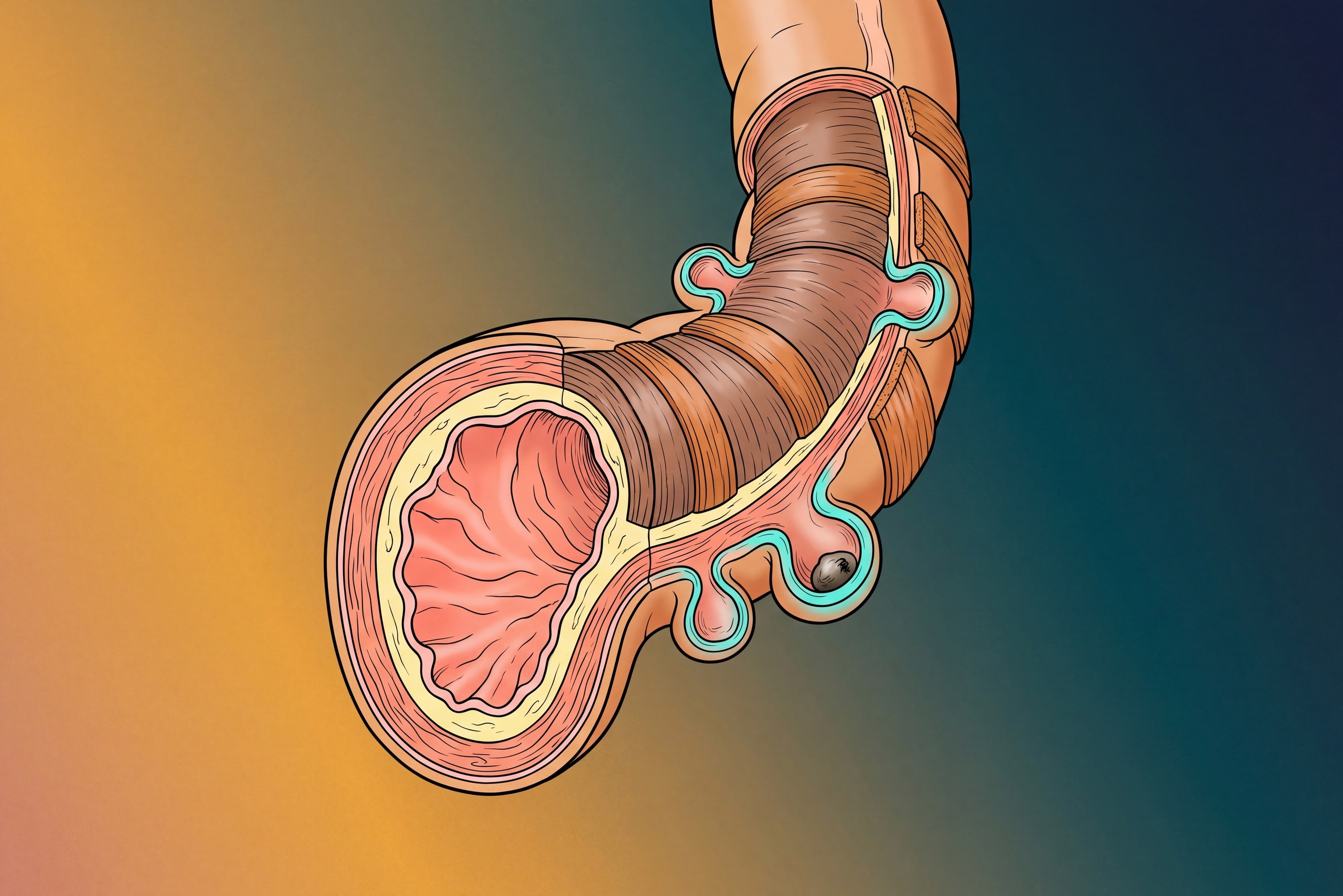
Xenia, 61, has known diverticula of the colon for about ten years and lives with almost daily bloating that starts in the morning and gets worse after meals, along with significant gas. Her colonoscopy and endoscopy came back normal, but her evening routine keeps pressure inside her colon high for many hours, which is why the diverticula dinner time connection sits at the center of the plan we recommended. If you recognize yourself in a morning when you wake up already bloated, in dinners that drag on late, and in a search for a better diverticulitis diet, Xenia's history has a lot in common with yours. We looked at what the research shows about diet for diverticulitis, the diverticulitis symptoms that the wrong meal timing brings on, and how diverticulitis triggers connect to meal schedule, and arrived at specific, individualized recommendations.

The method behind the case
In IBSyncrasy we go in depth into how meal rhythm and dinner time affect the gut in histories like Xenia's, and which changes are worth trying first. Buy IBSyncrasyWho is Xenia, and what does her history show?
Xenia, 61
Xenia is 61 and has lived for three years with gradually worsening gastrointestinal complaints that have become almost daily. Her main symptom is intense bloating in the abdomen that starts on waking and gets worse after meals, along with significantly increased gas.
Normal colonoscopy, known diverticula
We did a colonoscopy and endoscopy, with no notable findings. From her history we already know she has had diverticula for about ten years, with diverticulitis episodes around twice a year, which often seem to follow eating quinoa or nuts.
A schedule built around late nights
Xenia's day starts at 8:00am, with her first meal around 11:00am and her second around 3:30pm. Dinner usually falls close to 10:30pm, and three times a week another snack follows around 1:00am, with sleep coming at either 11:00pm or 1:00am depending on the day. She describes eating quickly and in a rush, a pattern that, combined with these hours, keeps her gut busy almost until she falls asleep.
Surgeries and years of antibiotic use
Her surgical history includes a hysterectomy last year, removal of an ovarian cyst, and removal of a breast cyst. Her medication history includes past use of isotretinoin for acne for about six months, plus extensive antibiotic use throughout her life, a detail that matters when we look at the current state of her microbiome.
Weight, medication, and body mass index
Xenia weighs 77 kg at a height of 1.52 m, for a body mass index of 33.3. She is on tirzepatide for weight and metabolic regulation, venlafaxine, metformin, and thyroid hormone. This picture, combined with her meal schedule, is the starting point for the recommendations that follow.
Why does the bloating persist when the basic tests are clear?
Xenia's colonoscopy and endoscopy came back normal, with no new structural findings beyond the diverticula already known. That rules out more serious structural causes. It still leaves open why the bloating has become almost daily over the past three years.
Her history explains more than the tests do
The picture changes when you combine it with the rest of her history. The diverticula have been there for about ten years, her body mass index is 33.3, and her history includes extensive past antibiotic use, which often leaves the microbiome more vulnerable to dysbiosis. None of these change on a colonoscopy, but together they make the colon more sensitive to what happens around meals and sleep.
Meal rhythm affects the morning bloating
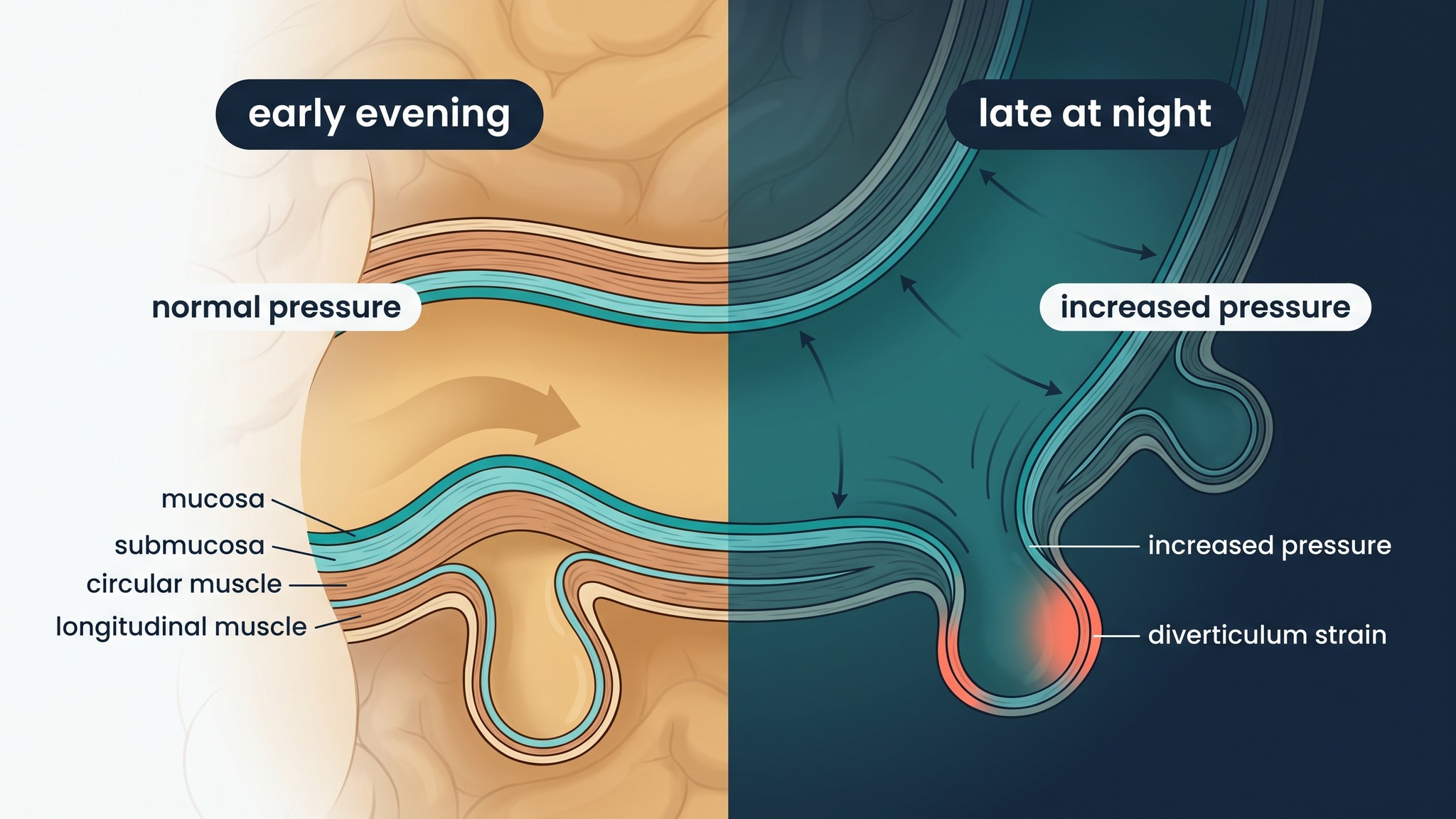
In our experience, we often see that morning bloating connects less to breakfast and more to what happened in the hours before. Gut motility naturally slows in the evening, as the rate of food propulsion drops and melatonin rises, the hormone that prepares the body for sleep[4]. With dinner close to 10:30pm and a midnight snack around 1:00am three times a week, Xenia's food gets very little processing time before this normal slowdown begins, which leaves more substrate for fermentation and gas by the next morning.
Someone has had diverticula for years, but the intense bloating only started in the last three years. How does that happen?
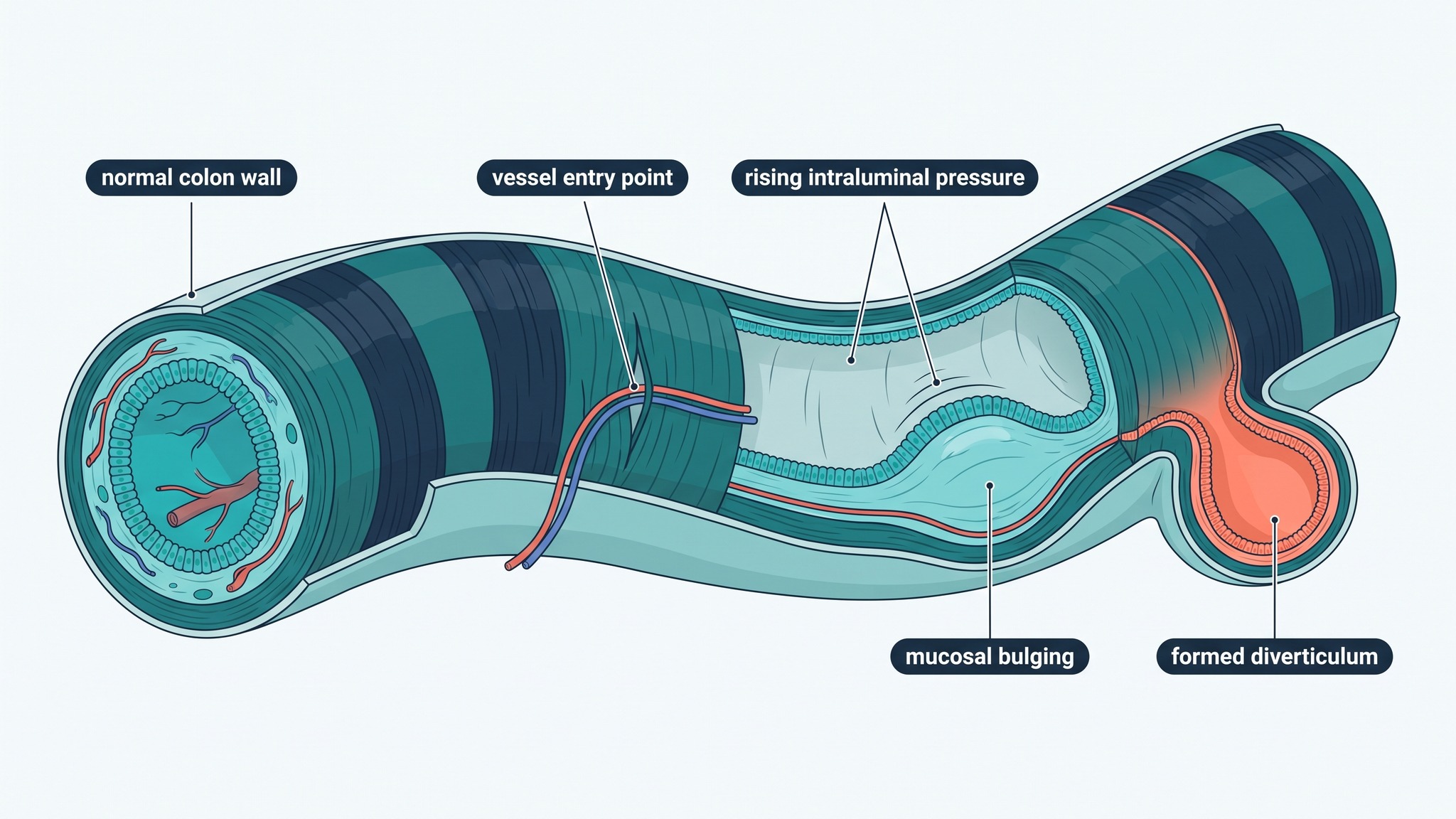
Diverticula on their own often stay silent for years, with no symptoms at all. Bloating usually shows up once something else is added around them, like a change in weight, meal rhythm, or sleep quality, that raises pressure or changes motility right at the spot where they sit. In cases like this, the search for a cause usually turns to these surrounding factors.
What do we expect the new tests to show?
The colonoscopy, the endoscopy, and the diverticula history give a clear structural picture. We still needed an answer for why the bloating has become almost daily. We recommended two additional tests that had never been done before, aimed at seeing what's happening at the level of the microbiome and the broader nutritional picture.
The stool PCR will show whether dysbiosis lies behind the chronic bloating and gas, while the extended blood panel will reveal any deficiencies that may affect gut motility and food tolerance. Together, the two results will show whether any targeted addition is needed beyond the changes to her meal schedule.
What we recommend for the diverticula dinner time connection
Xenia's plan includes nine recommendations in total, but the most important ones concern one common point, meal timing and the gap between dinner and sleep. That's where the most direct connection to her bloating and her diverticula seems to sit.
Cut off dinner by 8 to 8:30pm
The diverticula dinner time connection shows up clearly in Xenia's schedule, with dinner around 10:30pm, sometimes later. We recommended moving it gradually, by 15 to 20 minutes every 3 to 4 days, until it consistently ends by 8 to 8:30pm. Gut motility naturally slows after 8:00pm, as melatonin begins to rise and food propulsion drops in pace[4]. A dinner that arrives late in this window stays inside the colon for more hours, keeping pressure higher right at the spot where her diverticula sit. In people with a very short gap between dinner and sleep, the risk of gastroesophageal reflux has been recorded at up to seven times higher than in those who leave at least four hours[1]. In Xenia's history, with known diverticula and diverticulitis episodes around twice a year, this extra gap looks like one of the simplest points to intervene on.
If someone moves dinner earlier, how soon should they expect to see a difference in the bloating?
Usually the first change shows up within two to three weeks, as the body adjusts to the new feeding window and gut motility adapts to the new rhythm. The fuller picture around diverticula dinner time, with fewer diverticulitis episodes, takes longer and is usually assessed over months, alongside the rest of the changes in the plan.
Cut out food after midnight completely
Xenia described a midnight snack around 1:00am about three times a week, usually whatever she found on hand. We recommended cutting it out completely, with no exceptions. When food enters the colon during the hours when its motility is at its lowest, the available substrate for fermentation by the flora grows, which raises gas production and pressure inside the lumen[4]. With a history of extensive antibiotic use that has already strained her microbiome, this nighttime load is more likely to end in dysbiosis and even more intense morning bloating, the same bloating she wakes up with.
How much the risk rises as dinner gets closer to bedtime
Fujiwara et al., 2005, American Journal of Gastroenterology. 147 patients with gastroesophageal reflux disease versus 294 controls, OR 7.45 (95% CI 3.38 to 16.4), p<0.0001.
Anyone with diverticula should cut out quinoa and nuts completely.
In a prospective study of 29,916 women with a mean follow-up of 13.9 years, eating nuts, seeds, and peanuts carried a similar risk of diverticulitis across intake levels, with an adjusted hazard ratio of 1.07 between the highest and lowest quartile of intake[2]. In Xenia's history her flares coincided with quinoa or nuts, which points to possible individual sensitivity in her particular case.
Lose weight slowly and steadily
At a height of 1.52 m and a weight of 77 kg, Xenia's body mass index is 33.3. We recommended very slow, steady weight loss, with no sharp cuts, especially because she is already on tirzepatide for weight and metabolic regulation. Extra body weight adds pressure in the abdomen, crowds the colon, and changes the geometry inside which gas gets distributed, which visually enlarges the bloating even when the amount of gas is the same. In women with obesity, the risk of diverticulitis and diverticular bleeding is measurably higher than in women of normal weight[3].
Move bedtime to before midnight
Xenia describes going to sleep at 11:00pm four nights a week and around 1:00am the other three, alongside the midnight snack. We recommended a steady shift of bedtime earlier, by 15 to 20 minutes every 3 to 4 nights, until she consistently falls asleep before midnight, with a fixed wake time of 8:00am so the internal clock stays steady. Limited or irregular sleep is linked to lower leptin and higher ghrelin, two hormones that increase appetite and favor eating late[5]. In a history with dinners already running late and a midnight snack, a steadier, earlier sleep schedule reinforces the rest of the changes to her schedule.
The plan also includes some secondary changes that support the same reasoning. Skipping sweets or fruit in the afternoon cuts a second sugar wave that increases fermentation and gas, gentle folding and compression exercises for the abdomen help move trapped gas along, three minutes of diaphragmatic breathing before each meal calms the nervous system before eating, one vigorous weekly workout appears to be linked to a lower risk of complications from diverticula, and small, targeted courses of probiotics in November-December and April-May support the microbiome during the periods when she's more exposed to viral digestive infections. Together, these make up a diet for diverticulitis built on several small, realistic interventions around the same axis of time and pressure.
How do we expect these changes to help?
The whole set of changes targets the same point, the time window between the last meal and sleep. An earlier, smaller dinner, no midnight snacking, gradual weight loss, and steadier sleep together lower the pressure the colon takes on exactly during the hours when its motility is lowest, right at the spot where Xenia's diverticula sit.
What we've seen in similar histories
In histories with a similar pattern, we've seen morning bloating ease gradually within a few weeks of moving dinner earlier, with the clearest difference once the midnight snack is cut out completely. The drop in diverticulitis episodes takes longer and is assessed alongside the stool PCR and extended blood panel results, so the plan adjusts equally to Xenia's actual data and her history[4].
Your own schedule may have a measurable connection to the bloating
In the assessment we look at your meal timing and the markers missing from your own picture, the way we did in Xenia's case.
Frequently asked questions
Diverticula are small pouches that form in the wall of the colon, usually in the sigmoid colon, where the wall is weaker around the points where small blood vessels enter it. Having them is called diverticulosis, and it often causes no symptoms for years.
Gut motility naturally slows down in the evening. A dinner that falls too close to bedtime leaves food in the colon for more hours, keeping pressure higher right at the points where diverticula sit and favoring more fermentation and gas.
In a large prospective study of 29,916 women (Barlowe et al., 2025), the risk of diverticulitis was similar between women who ate nuts, seeds, or peanuts often and those who rarely did. Some people notice on their own that specific foods line up with their flares, so tracking your own pattern is worth more than a blanket restriction.
As a general guideline, a dinner that wraps up by 8 to 8:30pm leaves enough time before bed for pressure inside the colon to drop. The exact time always adjusts to each person's sleep schedule.
No, diverticula are a permanent structural change in the colon wall and stay in place. Diet and meal timing affect how often symptoms or flares show up around them.
References
- Fujiwara Y, Machida A, Watanabe Y, Shiba M, Tominaga K, Watanabe T, Oshitani N, Higuchi K, Arakawa T (2005). Association between dinner-to-bed time and gastro-esophageal reflux disease. American Journal of Gastroenterology, 100(12), 2633-2636.
- Barlowe T, Anderson C, Nichols HB, Salvador AC, Sandler RS, Sandler DP, Peery AF (2025). Diet and Risk for Incident Diverticulitis in Women: A Prospective Cohort Study. Annals of Internal Medicine, 178(6), 788-795.
- Strate LL, Liu YL, Syngal S, Aldoori WH, Giovannucci EL (2009). Obesity increases the risks of diverticulitis and diverticular bleeding. Gastroenterology, 136(1), 115-122.
- Duboc H, Coffin B, Siproudhis L (2020). Disruption of Circadian Rhythms and Gut Motility: An Overview of Underlying Mechanisms and Associated Pathologies. Journal of Clinical Gastroenterology, 54(5), 405-414.
- Spiegel K, Tasali E, Penev P, Van Cauter E (2004). Brief communication: Sleep curtailment in healthy young men is associated with decreased leptin levels, elevated ghrelin levels, and increased hunger and appetite. Annals of Internal Medicine, 141(11), 846-850.