How a weak migrating motor complex sets the stage for SIBO
Every 90 to 120 minutes between meals, a quiet housekeeping wave sweeps bacteria and leftover food out of the small intestine. When it weakens, SIBO often follows close behind.
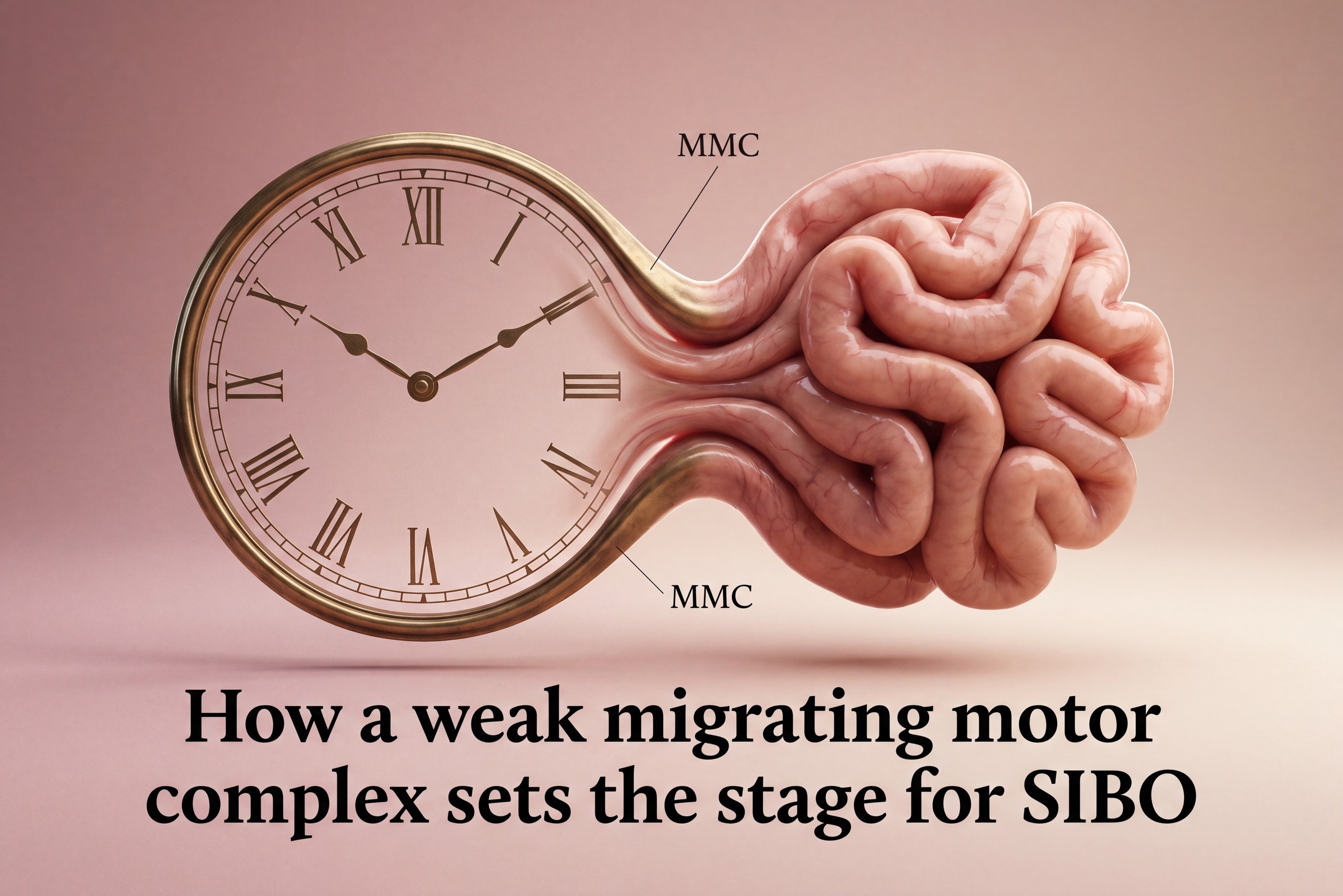
What is the migrating motor complex, and why does your gut need it?
The migrating motor complex, known for short as the MMC, is the small intestine's own housekeeping wave: a recurring cycle of muscle contractions that clears leftover food, debris, and bacteria out of the gut once digestion has finished. It runs on a loop during fasting, between meals and overnight, and switches off the moment you eat again.
The signal starts in the brainstem and travels down the vagus nerve to the enteric nervous system, the gut's own web of neurons. From there, specialized cells in the small intestine called motilin M-cells release the hormone motilin in rhythmic pulses, and each pulse triggers a new sweep. Reviews of the mechanism describe this pathway as one of the gut's most reliable internal clocks.
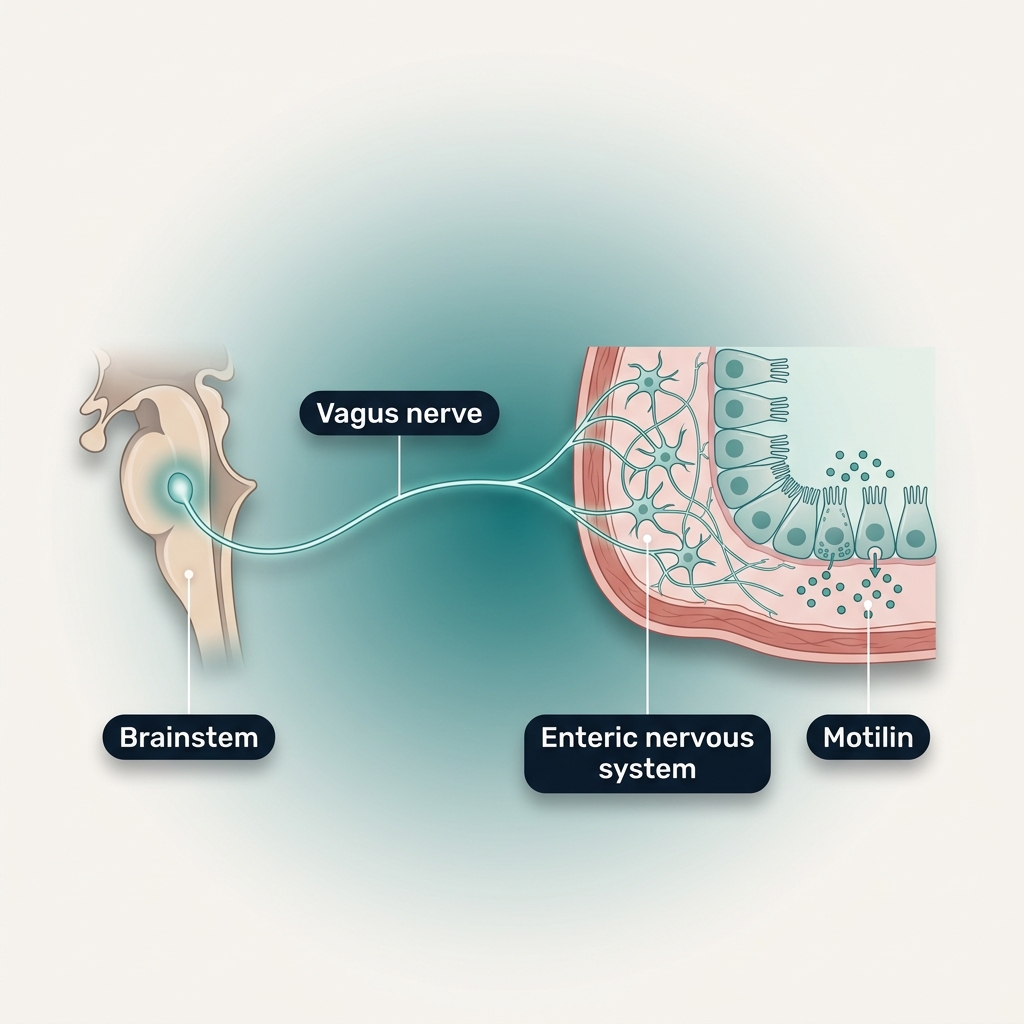
Think of it as your gut's overnight cleaning crew. Give the workers a proper rest between shifts, and the sweep runs on schedule. Cut those gaps short, and debris starts to pile up.
How does one migrating motor complex cycle actually unfold?
A single MMC cycle moves through four distinct phases, each with its own job, before the pattern resets and starts again. Studies that track fasting motility around the clock put a fresh phase III sweep at roughly once every 87 minutes on average, though the exact rhythm varies from person to person.
Brainstem and vagus start the cycle
A signal from the brainstem travels down the vagus nerve to the enteric nervous system, priming the small intestine for its next sweep.
A quiet resting phase
For roughly 40 minutes, contractions in the small intestine almost stop, and the gut sits quiet before the next active phase begins.
Irregular contractions build up
Random, low-amplitude contractions appear and grow more frequent over about 50 minutes, building toward the strongest push of the cycle.

The sweeping wave
For 5 to 10 minutes, powerful, regular contractions travel the full length of the small intestine at peak strength, pushing leftover food, debris, and bacteria ahead of them.
A short taper back to rest
Contractions fade quickly, often too briefly to record, before the pattern resets and phase I begins again.

A meal switches off the cycle
Eating ends the fasting rhythm and switches the gut into fed mode, pausing the MMC until digestion finishes and the next cycle can start.

How long does one complete cycle actually take?
A full cycle from phase I through phase IV runs about 84 to 112 minutes on average, with the sweep itself, phase III, lasting only a small fraction of that time. Deloose and colleagues' review of the mechanism places the typical gap between meals at 90 to 120 minutes, close to the 137-minute mean interval recorded in the original human description of the pattern.
| Phase | Typical duration |
|---|---|
| Phase I, quiet rest | About 40 minutes |
| Phase II, contractions build | About 50 minutes |
| Phase III, the sweep | 5 to 10 minutes |
| Phase IV, quick taper | Brief, often too short to record |
| Full cycle, phase I to IV | 84 to 112 minutes on average |
STUDY The interval between phase III sweeps averaged 137 minutes in fasting healthy adults, and infusing the hormone motilin shortened that interval to 46 minutes. Vantrappen et al., 1979, Motilin and the interdigestive migrating motor complex in man, Digestive Diseases and Sciences.
STUDY A duodenal meal containing as little as 150 kilocalories was enough to switch the gut from the fasting pattern into the fed pattern, ending the current interdigestive cycle. Ouyang et al., 1989, Caloric content of a meal affects duration but not contractile pattern of duodenal motility in man, Digestive Diseases and Sciences.
Why does a stalled migrating motor complex lead straight to SIBO and IBS?
A weak or stalled migrating motor complex is one of the most consistent motility findings behind small intestinal bacterial overgrowth. Without regular sweeps, food residue and bacteria settle in the small intestine, building up right where they cause the most trouble. The original human description of this pattern already linked an absent or disordered cycle to bacterial overgrowth of the small intestine, decades before SIBO became a familiar diagnosis.
STUDY Phase III sweeps occurred only 0.7 times per recording in people with IBS and an abnormal lactulose breath test, compared with 2.2 times in healthy controls, and each sweep also ran shorter. Pimentel et al., 2002, Lower frequency of MMC is found in IBS subjects with abnormal lactulose breath test, suggesting bacterial overgrowth, Digestive Diseases and Sciences.
This pattern lines up with what shows up in practice: patients whose SIBO keeps returning after treatment usually have an underlying motility problem sitting behind it. Clearing bacteria without restoring the sweep behind it tends to bring only temporary relief.
Ready to look at your gut's actual rhythm?
IBSyncrasy walks through exactly this kind of motility testing and rebuilding, chapter by chapter, alongside the rest of the gut-hormone picture. Buy IBSyncrasyHow do everyday habits quietly retrain your migrating motor complex to fail?
Most people never learn that their gut runs on a clock, so they never learn to protect it either. Like a muscle that needs regular use to stay strong, the MMC needs real, uninterrupted fasting gaps to complete its full four-phase cycle, and several everyday habits quietly cut those gaps short.
| Habit | How it interrupts the cycle |
|---|---|
| Eating too fast | Swallowing large amounts of air and poorly chewed food ramps up early digestive work and shortens the fasting window before the next sweep. |
| Eating in front of a screen | Distracted, stressed eating tends to stretch meals out and blur the line between snack and full meal, so the gut rarely gets a clean start to its clock. |
| Grazing throughout the day | Frequent small snacks keep restarting the fed pattern, so a full four-phase cycle rarely gets the chance to finish. |
| Eating late at night | A late dinner shortens the overnight fast, the single longest natural window the MMC has to run several full cycles. |
| Sipping tea or coffee between meals | Even a small caloric or acidic load between meals can be enough to interrupt an in-progress cycle before phase III arrives. |
Which medical conditions and medications quietly disable the migrating motor complex?
Beyond daily habits, several medical conditions and common medications slow or block the MMC directly, and each one raises the risk of SIBO through the same basic mechanism: fewer or weaker sweeps, more time for bacteria to build up.
| Condition or drug | What the research found |
|---|---|
| Hypothyroidism | Over half of one study group with overt hypothyroidism tested positive for SIBO on a glucose breath test, and a newer study found more than double the risk of SIBO compared with people who had normal thyroid function. |
| Gallbladder removal (cholecystectomy) | Phase III sweeps became less frequent and traveled through the duodenum at roughly half their normal speed after surgery. |
| Anticholinergic drugs (such as atropine) | Blocking the muscarinic receptor pathway that atropine acts on altered the normal transition between MMC phases in a randomized human trial. |
How much does removing the gallbladder slow the sweep down?
The duodenal portion of phase III normally travels at about 16.2 centimeters per minute. After cholecystectomy, that speed drops to roughly 8.4 centimeters per minute, close to half its usual pace, and the sweep itself also becomes less frequent.
Duodenal phase III propagation speed
Perdikis et al., 1994, American Journal of Surgery. Converted from 0.27 and 0.14 cm/s.
One patient's story shows how these disruptors often stack together in the same person. One SIBO case built on exactly this combination of hypothyroidism, a prior cholecystectomy, and near-constant grazing throughout the day.
STUDY In a group of 50 patients with a history of overt hypothyroidism, 54 percent tested positive for small intestinal bacterial overgrowth on a glucose breath test. Lauritano et al., 2007, Association between hypothyroidism and small intestinal bacterial overgrowth, The Journal of Clinical Endocrinology and Metabolism.
STUDY Antral phase III frequency dropped from 3.2 to 2.5 cycles per minute after cholecystectomy, and duodenal propagation speed slowed from 0.27 to 0.14 centimeters per second. Perdikis et al., 1994, Altered antroduodenal motility after cholecystectomy, The American Journal of Surgery.
STUDY In a randomized trial of 26 healthy volunteers under continuous manometry, blocking the muscarinic receptor pathway with atropine altered the normal transition between phases of the migrating motor complex. Halim et al., 2015, Nitric oxide regulation of migrating motor complex, Acta Physiologica.
What actually helps you rebuild a healthy migrating motor complex?
Rebuilding a healthy MMC starts with giving it the same thing it needs by design: real, uninterrupted gaps between meals. Aim for roughly four to five hours between meals during the day and let the overnight fast run its full course, since that stretch gives the cycle the most room to complete several full sweeps in a row.
Slower, undistracted meals let the fed pattern end on schedule, and cutting back on grazing and between-meal drinks gives phase III sweeps the space they need to actually occur. Herbal antimicrobial protocols can help clear an existing overgrowth, and pairing that work with real motility support is what keeps the numbers down afterward. Fixing the underlying dysbiosis usually calls for a structured, sequenced approach across several weeks.
Give the migrating motor complex the fasting windows it was built to run, and much of its housekeeping work takes care of itself.
Ready to give your gut the rhythm it needs?
IBSyncrasy walks through motility testing, SIBO treatment, and the daily habits that keep your MMC running the way it should.
Frequently asked questions
The migrating motor complex is a cycle of muscle contractions that sweeps leftover food, debris, and bacteria out of the small intestine during fasting. A signal from the brainstem travels down the vagus nerve, and motilin released from specialized gut cells triggers each new sweep roughly every 90 to 120 minutes between meals.
Eating any food switches the gut into fed mode and pauses the MMC until digestion finishes, and a meal with as little as 150 kilocalories is enough to do it. Hypothyroidism, gallbladder removal, and anticholinergic drugs such as atropine also slow or disrupt the cycle, along with habits like grazing, late-night eating, and rushed meals.
A weak or absent MMC lets food residue and bacteria linger in the small intestine, and bacterial counts climb in the segment where SIBO develops. People with IBS and SIBO show measurably fewer and weaker phase III sweeps than healthy controls in published research.
MMC dysfunction on its own produces few noticeable symptoms, but its downstream effects show up clearly: bloating, gas, abdominal discomfort, and altered bowel habits are common once bacterial overgrowth or gastroparesis develop. A doctor typically diagnoses the underlying condition through breath testing or motility studies, since the MMC itself is rarely measured directly outside a research setting.