Low Faecalibacterium prausnitzii: what raises it back up
A low Faecalibacterium prausnitzii result on a stool test is one of the most common findings after antibiotics, a gut infection, or years of low-fiber eating. Here is what this butyrate-producing bacterium actually does, why it drops, and what raises it back up.
What a low Faecalibacterium prausnitzii result actually means
Faecalibacterium prausnitzii is one of the most abundant bacteria in a healthy gut, and a low Faecalibacterium prausnitzii reading on a stool panel means exactly what it sounds like: this species is scarcer than it should be. Most people see this name for the first time on a PCR-based stool test, the kind that counts specific species by their genetic material, skipping the step of growing them in a dish. I pushed labs to add PCR detection to stool panels well before it became standard practice, specifically because species like this one die within minutes of contact with oxygen, disappearing long before traditional stool culture can grow them.
That distinction matters. Culture-based testing misses Faecalibacterium prausnitzii almost by definition, so a normal-looking stool culture from a few years ago says little about where this species actually stands today. A PCR panel flagging it as low now is simply new information from a more sensitive test.
Why this one species carries so much weight in the gut
Faecalibacterium prausnitzii earns its reputation from a single molecule: butyrate, one of the short-chain fatty acids it ferments dietary fiber into, and the one colonocytes, the cells lining the colon, use as their preferred fuel. Everything downstream, from a sealed gut lining to a calmer immune response, traces back to that one metabolic step.
How it keeps the gut lining sealed
Butyrate does more than feed colon cells. It blocks an enzyme called HDAC inside those cells, which switches on a gene that calms an inflammatory signaling pathway known as Wnt/JNK and lowers production of the inflammatory messenger IL-8. In colitis models, restoring Faecalibacterium prausnitzii brought back a tight-junction protein called claudin-2 and reduced gut permeability that had opened up after early-life stress. That combination of sealed tight junctions and calmer inflammatory signaling is what gut barrier integrity depends on at the cellular level.
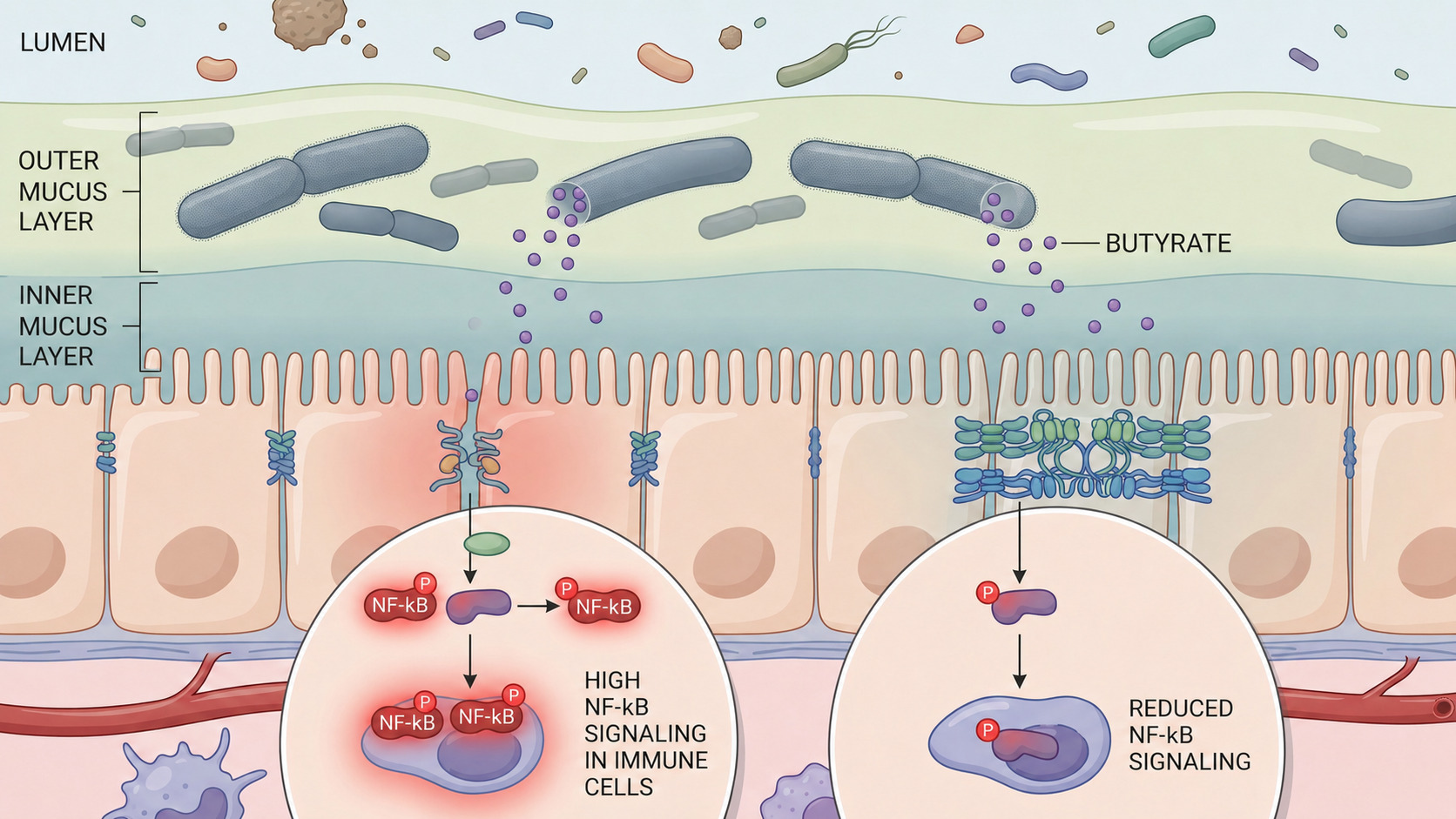
STUDY Supernatant from Faecalibacterium prausnitzii blocks activation of NF-κB, a master switch behind gut inflammation, inside intestinal epithelial cells grown in the lab, and mice given the bacterium showed less severe colitis. Sokol et al., 2008, Faecalibacterium prausnitzii is an anti-inflammatory commensal bacterium identified by gut microbiota analysis of Crohn disease patients, Proceedings of the National Academy of Sciences.
How it optimizes the mucus layer and feeds other bacteria
Faecalibacterium prausnitzii relies on a narrower set of fibers than some of its neighbors, specializing instead in acetate cross-feeding: it absorbs acetate released by other bacteria, combines it with its own butyryl-CoA, and produces butyrate as the result, a reaction that supplies a major share of the gut's overall total, and one that depends entirely on having the right neighbors present.
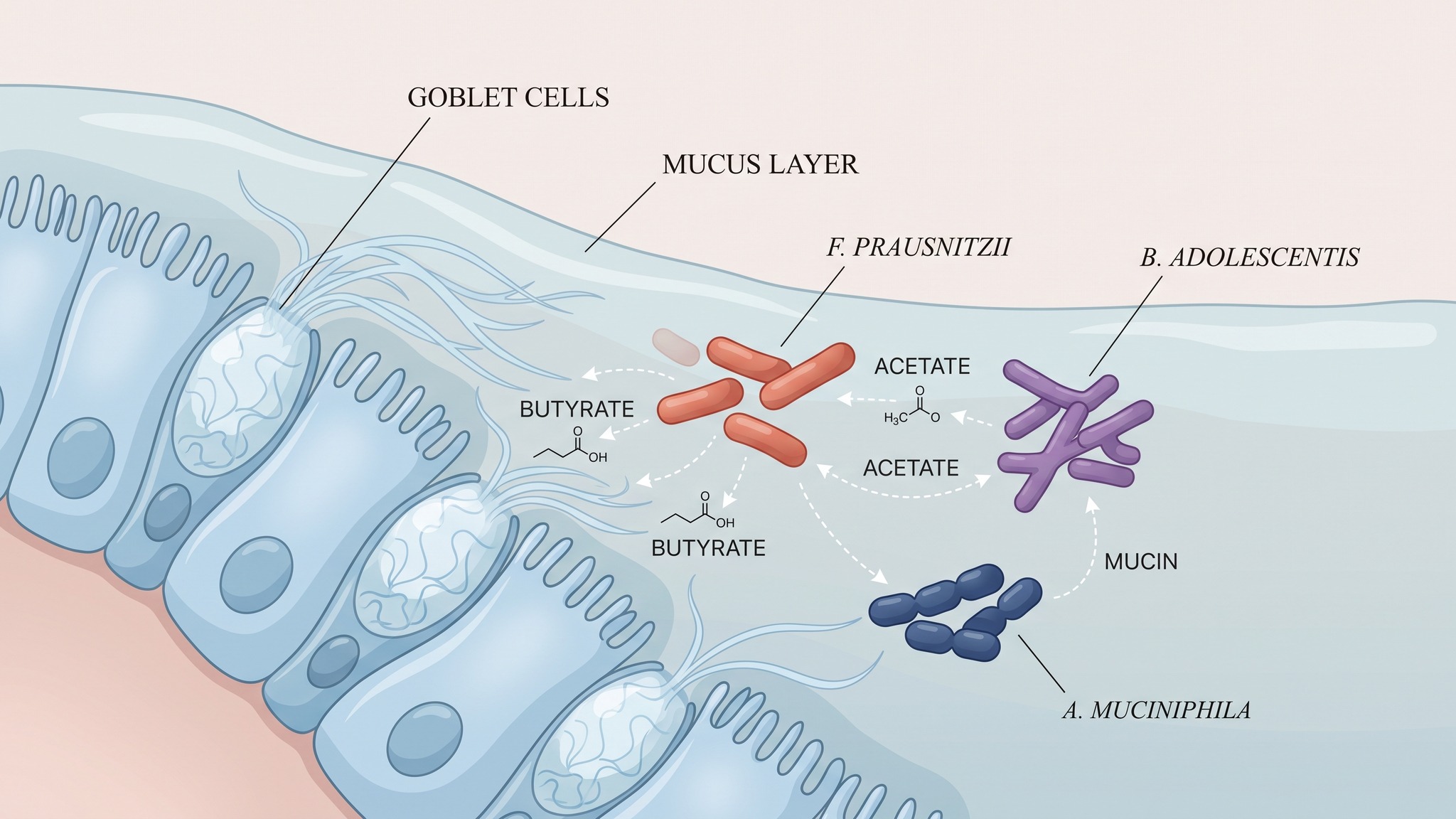
STUDY Growing Faecalibacterium prausnitzii together with Bifidobacterium adolescentis roughly doubled its butyrate output compared with growing it alone, because the two species exchanged acetate directly. Rios-Covián et al., 2015, Enhanced butyrate formation by cross-feeding between Faecalibacterium prausnitzii and Bifidobacterium adolescentis, FEMS Microbiology Letters.
A single missing bacterial species starts to look a lot less minor once you notice it sits at the center of six unrelated conditions at once.
The same cross-feeding also helps preserve normal mucus production when Faecalibacterium prausnitzii is grown alongside mucus-degrading bacteria, softening what would otherwise be a thinning of the protective mucus layer.
The conditions where researchers keep finding it low
Crohn's disease and ulcerative colitis are the two conditions most consistently linked to a drop in Faecalibacterium prausnitzii, but they are far from the only ones. A 2014 meta-analysis pooling 11 studies and 1,180 people found an average of 6.79 log10 CFU per gram of stool in people with inflammatory bowel disease, against 7.58 log10 CFU per gram in healthy controls, with the gap wider in Crohn's disease than in ulcerative colitis.
STUDY People with inflammatory bowel disease carried significantly less Faecalibacterium prausnitzii than healthy controls, 6.79 versus 7.58 log10 CFU per gram of stool, with a larger drop in Crohn's disease than in ulcerative colitis. Cao, Shen & Ran, 2014, Association between Faecalibacterium prausnitzii Reduction and Inflammatory Bowel Disease: A Meta-Analysis and Systematic Review of the Literature, Gastroenterology Research and Practice.
| Condition | What's observed |
|---|---|
| Crohn's disease and ulcerative colitis | Lower counts than healthy controls in the pooled 2014 meta-analysis (11 studies, n=1,180), with a larger drop in Crohn's disease. |
| Irritable bowel syndrome | Lower levels reported in some IBS subtypes, tracking with symptom severity. |
| Obesity and type 2 diabetes | Levels run lower and inversely track body mass index, rising again after weight loss. |
| Psoriasis and atopic dermatitis | Reduced levels reported in these skin-barrier conditions. |
| Depression | Lower abundance reported compared with non-depressed controls. |
| Colorectal cancer | Reduced fecal abundance reported versus healthy controls. |
The last four rows come from a single 2023 review that pulls together the current literature across all of these conditions in one place, and the primary studies behind each one are worth checking individually for full context.
Faecalibacterium prausnitzii in inflammatory bowel disease vs healthy controls
Cao, Shen & Ran, 2014 (11 studies, n=1,180). The shaded band is an illustrative range added around the pooled IBD mean for visual clarity; the accessible text reported point estimates only, without a confidence interval. The reference line (right) marks the healthy-control mean.
Every disease category covered in this article shows the same pattern
Based on the 6 conditions in the table above (Langella et al., 2023; Cao, Shen & Ran, 2014).
See the fuller picture
The pattern across these conditions is consistent, but a stool report only tells you where things stand today. IBSyncrasy walks through the testing and retesting protocol that turns a single low result into an actual recovery plan.
Buy IBSyncrasyWhat pushes Faecalibacterium prausnitzii down, and antibiotics lead the list
Broad-spectrum antibiotics are the most consistent cause of a sudden drop in Faecalibacterium prausnitzii, especially the ones built to hit anaerobic bacteria, since this species only survives in a strictly oxygen-free environment in the first place. In a mouse model, antibiotic treatment combined with Clostridioides difficile exposure collapsed the intestinal community, and adding back Faecalibacterium prausnitzii together with a prebiotic protected the gut lining that antibiotic-driven gut dysbiosis and infection had damaged together.
STUDY Faecalibacterium prausnitzii given together with a prebiotic protected intestinal health in mice exposed to both antibiotics and Clostridioides difficile, compared with antibiotic exposure alone. Roychowdhury et al., 2018, Faecalibacterium prausnitzii and a Prebiotic Protect Intestinal Health in a Mouse Model of Antibiotic and Clostridium difficile Exposure, Journal of Parenteral and Enteral Nutrition.
One finding points the other way and is worth knowing: as the meta-analysis above notes, one trial found that the antibiotic rifaximin was associated with a rise in Faecalibacterium prausnitzii, a reminder that the effect depends heavily on which antibiotic and which bacteria are involved.
If your gut symptoms started or got worse right after a course of antibiotics, that timing usually points to a real cause in a lot of cases.
The foods and fibers that feed it back up
Faecalibacterium prausnitzii lives strictly inside the gut, as a strict anaerobe that dies within minutes of touching oxygen, so fermented foods, probiotic capsules, and anywhere outside the gut are off the table for it. What you can eat are the specific fibers that feed the Faecalibacterium prausnitzii already living in your colon, and a handful of them have real trial data behind them.
The fibers with trial data behind them
Inulin is the best-studied. In healthy volunteers given 10 grams a day for 16 days, Faecalibacterium prausnitzii rose from 10.3% to 14.5% of total gut bacteria, a jump large enough to matter. The same fiber is naturally concentrated in chicory root, Jerusalem artichoke, garlic, and the white part of a leek.
STUDY Ten grams of inulin a day for 16 days raised Faecalibacterium prausnitzii from 10.3% to 14.5% of total gut bacteria in healthy volunteers. Ramirez-Farias et al., 2009, Effect of inulin on the human gut microbiota: stimulation of Bifidobacterium adolescentis and Faecalibacterium prausnitzii, British Journal of Nutrition.
Faecalibacterium prausnitzii share of total gut bacteria
Ramirez-Farias et al., 2009, British Journal of Nutrition. n=12, 10g inulin/day.
Arabinoxylan, the fiber concentrated in wheat bran and oat bran, and resistant starch, found in cooked-and-cooled potatoes, rice, and green bananas, both raised short-chain fatty acid producers including this species in a randomized crossover trial in people with metabolic syndrome. Faecalibacterium prausnitzii is also the only known bacterial genus that can convert avenanthramides, the polyphenols unique to oats, into their more anti-inflammatory form, a trait unique to this genus among gut bacteria.
For a broader list beyond these two fibers, the wider set of gut-friendly foods is worth a look too.
A real question from someone who just got this result
I've had bloating and loose stools on and off for two years. My GI-MAP just came back and my Faecalibacterium prausnitzii is basically at the bottom of the range. Does that actually explain my symptoms, or is it just one number among hundreds on that report?
It's one number among hundreds, and a genuinely meaningful one. Faecalibacterium prausnitzii sitting at the bottom of the range on a GI-MAP is a real signal about reduced butyrate production, and butyrate is directly tied to bloating, motility, and gut lining strength. It rarely explains two years of symptoms by itself, though. Think of it as one solid clue pointing toward reduced fiber fermentation, and possibly a fiber intake or motility issue sitting behind it, alongside other pieces of the fuller picture.
One low marker rarely tells the whole story by itself. If your test raises more questions than it answers, walking through the full panel together usually does.
Book an appointmentWhy timing the recovery matters: what fasting studies show
Giving the gut a longer break between meals appears to help Faecalibacterium prausnitzii recover, though the strongest human data comes from a supervised week-long fast, a different pattern from a daily 16:8 schedule. In 13 overweight adults who completed a monitored week of calorie restriction, 600 to 800 kilocalories a day, followed by six weeks of follow-up, both overall microbial diversity and Faecalibacterium prausnitzii itself increased significantly between the second and third measurement points.
STUDY Microbial diversity rose from 15.5 to 23.0 DGGE bands, and Faecalibacterium prausnitzii increased significantly, in 13 overweight adults who completed a supervised week-long fast followed by six weeks of follow-up. Remely et al., 2015, Increased gut microbiota diversity and abundance of Faecalibacterium prausnitzii and Akkermansia after fasting: a pilot study, Wiener klinische Wochenschrift.
Microbial diversity before and after a supervised week-long fast
Remely et al., 2015, Wiener klinische Wochenschrift. DGGE band count as a proxy for overall microbial diversity in 13 overweight adults. Faecalibacterium prausnitzii itself also rose significantly over the same period (p=0.03).
That is a structured, medically supervised fast, a different pattern from a daily eating window. Still, it lines up with the broader pattern in systematic reviews of intermittent fasting and the gut microbiome: longer stretches without food tend to favor short-chain fatty acid producers like this one over species that prefer constant fuel.
Why every patient's recovery clock runs at a different speed
Two people can follow the exact same fiber and fasting protocol and land in completely different places three months later, because starting bacterial counts, diet history, and how recently antibiotics were used all set a different baseline for each gut. In one study, patients whose Faecalibacterium prausnitzii recolonized after treatment were more likely to stay in remission from ulcerative colitis than patients whose levels stayed low, which is exactly why retesting matters more than guessing.
Colonization by this species tracked closely with staying in remission, in patients followed over time. The only way to know whether Faecalibacterium prausnitzii is actually recovering is to measure it again, on the same type of test, at a reasonable interval.
One patient's post-infectious IBS case followed the same logic: slow, individual bacterial recovery, tracked and adjusted month by month starting from the very first retest, which is the throughline of that recovery story.
A real question from someone whose gut never fully recovered
I got food poisoning about eight months ago and my gut has never fully gone back to normal. My latest stool test shows low levels of Faecalibacterium prausnitzii. Is that just going to stay low forever now, or does it actually come back on its own eventually?
It can come back, though "on its own" is doing a lot of work in that question. After an infection like that, the gut community that grows back is often a different mix than before, especially for a slow-growing, oxygen-sensitive species like Faecalibacterium prausnitzii. Fiber intake, how recently you've used antibiotics, and general gut motility all shape whether it rebounds in months or stays flat for years. Eight months without a clear improvement is a reasonable point to retest and actually check what is really going on.
Eight months of guessing is long enough. Retesting after a real gut infection is how you find out whether things are actually moving, or just stuck.
Book an appointmentWhat actually moves the number on your next test
The pattern by now is simple: broad-spectrum antibiotics and a low-fiber diet push Faecalibacterium prausnitzii lower, while specific fibers, adequate meal spacing, and time bring it back up, at a pace that is different for every gut. The only way to know which stage you are actually in is to look at the number again on a real test.
Ready to stop guessing and start tracking your gut recovery?
IBSyncrasy lays out the testing, fiber, and retesting sequence that turns one low stool marker into an actual, measurable recovery plan.
Frequently asked questions
It means this butyrate-producing species is scarcer than expected, usually picked up on a PCR-based stool panel. On its own it points to a pattern worth investigating further, and it is consistently linked to lower gut barrier strength and shows up across several studied conditions.
Not in a usable form. It is a strict anaerobe that dies within minutes of touching oxygen, so fermented foods and standard probiotic capsules offer no living dose of it. What actually helps is feeding the Faecalibacterium prausnitzii already living in your gut, mainly through specific fibers.
Inulin-rich foods such as chicory root, Jerusalem artichoke, and garlic have the clearest trial data. Wheat bran and oat bran (arabinoxylan) and resistant starch from cooled potatoes, rice, or green bananas also support it.
Most broad-spectrum antibiotics, especially those that target anaerobic bacteria, lower it. Rifaximin is a documented exception, associated with a rise in this species, which shows the effect depends on the specific antibiotic.