Can gut bacteria cause prostatitis?
Yes, at least in part. Gut bacteria and prostatitis are linked through bacterial reservoirs, barrier leaks and endotoxin traffic, and two Mendelian randomization studies now call the relationship causal. Here is what the evidence shows, mechanism by mechanism.
Can gut bacteria really cause prostatitis?
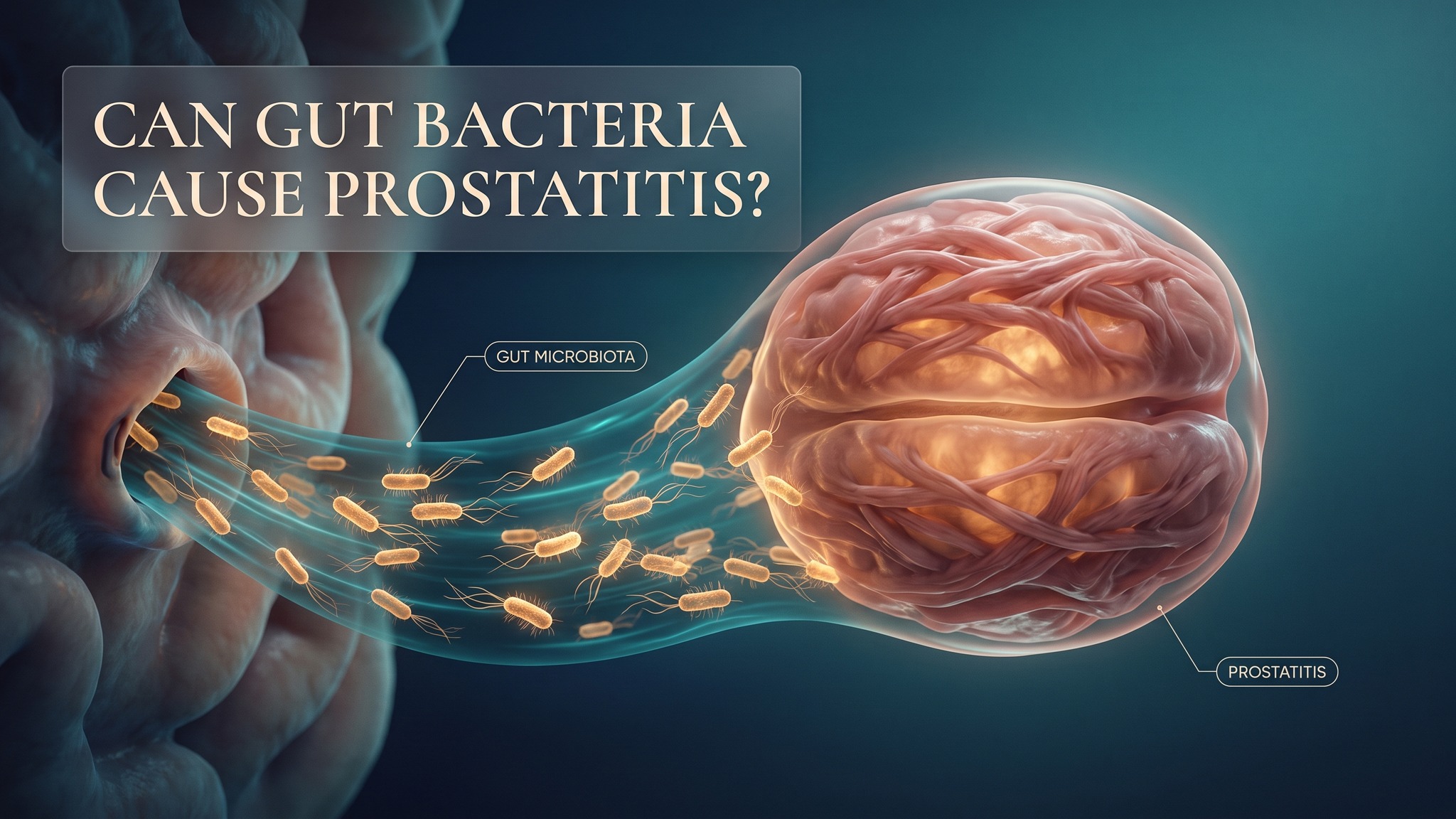
Yes, and the strongest evidence no longer comes from association studies alone. Gut bacteria and prostatitis are tied by a simple anatomical fact: the organisms that infect the prostate gland, mostly Escherichia coli, Enterococcus and Proteus from the Enterobacteriaceae family, live permanently in the large intestine. When the gut barrier weakens or stomach acid defense fails, these bacteria reach the urinary tract and, from there, the prostate. Treating only the prostate while the intestinal reservoir stays intact turns therapy into a revolving door.
This is exactly what played out in one of my most instructive cases. Nick, a 45-year-old bar manager, spent a full year with chronic prostatitis before his bowel joined in. Night after night he got up to urinate, then bloating and a constant feeling of incomplete evacuation took over. Five doctors, a colonoscopy, a gastroscopy and a stack of blood tests later, nobody had connected the two. His stool panel finally told the story: Klebsiella and Morganella overgrowth, markers of infectious inflammation, and a near-total absence of protective flora, all of it fed for years by chronic periodontitis seeding his intestine and by heavy antibiotic use that had flattened his stomach acid.
Nick, 45, bar manager
One year of chronic bacterial prostatitis, then functional gut symptoms on top. Intense social and professional life, no diagnosis after visiting one urologist, two gastroenterologists and two general practitioners.
Two systems flaring together
Night-time urination several times per night, genital discomfort that kept returning stronger, painful bloating, loose stools and a permanent feeling of incomplete evacuation. Every prostatitis flare arrived with a bowel flare.
A gut under occupation
Elevated secretory IgA and eosinophil protein X pointing to infectious inflammation, Klebsiella and Morganella overgrowth with histamine production, probiotic sterility, and diverticula acting as dysbiosis pockets.
Gut first, prostate follows
Three staged courses of targeted antimicrobials, then a potent prebiotic formula and expanded night fasting five days per week. Six weeks later: no bloating, no pain, no diarrhea, and no prostatitis recurrence.
Nick's case holds the lesson of this whole article. Prostatitis and the gut symptoms that accompany it have to be treated together, or neither one stays quiet for long.
How are gut bacteria and prostatitis connected?
The connection between gut bacteria and prostatitis runs along three documented routes. First, direct seeding: gut microbes migrate to the urinary tract and prostate through shared anatomy, lymphatic channels and circulation. Second, chemistry: dying Gram-negative bacteria release LPS, an endotoxin that slips through a weakened barrier and drives body-wide inflammation. Third, immune tone: an imbalanced microbiota pushes the immune system toward a pro-inflammatory Th17 profile whose effects reach distant organs, the prostate included.
The LPS route deserves a closer look, because it is the one most men have never heard of. Lipopolysaccharide is a structural fat of the outer membrane of Gram-negative bacteria, and even tiny amounts in circulation switch on inflammatory signaling. In a landmark experiment, a high-fat diet raised circulating endotoxin and triggered metabolic inflammation in mice, a state researchers now call metabolic endotoxemia. A dysbiotic, permeable gut leaks this endotoxin daily, and the prostate, already a low-flow and immune-sensitive organ, pays the bill. Reviews of the field describe migration of gut bacteria into prostatic tissue as a plausible trigger for both acute flares and chronic inflammation of the prostate.
Which bacteria push prostatitis risk up or down?
Association studies cannot answer that question, but genetics can. Two-sample Mendelian randomization uses inherited variants as natural experiments, stripping away most confounding. In 2024, two independent groups ran this analysis for prostatitis, and their results overlap in a way that is hard to ignore: the same bacterial taxa keep appearing on the risk side of both datasets.
Gut taxa that shift prostatitis risk (Mendelian randomization)
Shen et al., 2024, BMC Medical Genomics: two-sample MR, 1,859 prostatitis cases and 72,799 controls. Bubble size reflects estimate precision.
STUDY Analyzing 196 microbial taxa against 1,859 prostatitis cases and 72,799 controls, researchers found four gut taxa that raise prostatitis risk and five that lower it, with methane-producing archaea on the protective side. Shen et al., 2024, Preliminary study of the effect of gut microbiota on the development of prostatitis, BMC Medical Genomics.
A second team confirmed the pattern from the opposite direction. Their bidirectional analysis kept a stable causal signal for Gastranaerophilales even after strict multiple-testing correction, and extended the map to benign prostatic hyperplasia and prostate cancer, where specific gut taxa emerged as a candidate risk factor. Prostatitis, in other words, rarely travels alone.
How do you know if prostatitis is caused by bacteria?
The only honest answer is laboratory proof: a positive culture from urine, semen or expressed prostatic secretions, ideally taken before any antibiotic. The National Institutes of Health classification splits prostatitis into acute bacterial prostatitis, chronic bacterial prostatitis, chronic pelvic pain syndrome (once called nonbacterial prostatitis) and asymptomatic inflammatory prostatitis. Symptoms alone cannot separate these four, because pelvic pain, urinary urgency, weak flow and a bladder that never feels empty appear in all of them. And because gut bacteria and prostatitis travel together so often, even a negative culture does not end the conversation.
- Prostatitis
- Prostatitis is inflammation of the prostate gland. Depending on cause and course, it presents as an acute bacterial infection with fever and chills, a chronic bacterial infection with recurring flares, or a chronic pain syndrome in which no pathogen is ever cultured.
Biofilms explain much of the confusion. Bacteria hiding deep inside prostatic ducts and around prostatic calculi can produce sterile cultures while symptoms persist, which is one reason semen cultures remain underused. It is also why repeating blind antibiotic courses backfires: every round strips protective flora and widens the very dysbiosis that feeds the reservoir.
Every prostatitis is a bacterial infection that needs one more antibiotic.
Most diagnosed cases are chronic pelvic pain syndrome without a proven pathogen. Unnecessary antibiotic courses disturb the gut, urinary and seminal microbiota and raise the odds of recurrence.
Which gut bacteria feed prostate inflammation, and what feeds them?
The bacteria behind gut bacteria and prostatitis are not exotic invaders. They are ordinary intestinal residents that multiply when we feed them the wrong substrates, and retreat when we feed their rivals. Sugar, refined starch, artificial sweeteners and broken sleep all leave measurable fingerprints on the very taxa that genetic studies have tied to prostatitis.
| Bacterium or daily habit | What feeds it and why your prostate cares |
|---|---|
| Escherichia coli and other Enterobacteriaceae | Refined sugar and low-fiber, ultra-processed eating favor pro-inflammatory gut taxa. This is the same family that forms the intestinal reservoir reseeding the urinary tract and prostate. |
| Klebsiella and Morganella | Potent starch fermenters and histamine producers, exactly the overgrowth found in Nick's stool panel. Starch-heavy plates are their favorite substrate. |
| Artificial sweeteners | Saccharin-type sweeteners shift the whole community toward glucose-intolerance-promoting taxa, even when sugar itself is absent. |
| Erratic sleep and night shifts | Disrupted circadian rhythms flatten the daily oscillations of the microbiota and tilt metabolism toward inflammation, no diet change required. |
| Prevotella (protective ally) | Thrives on vegetables and fiber. Men with chronic pelvic pain syndrome carry less of it, so a fiber-poor plate starves a defender. |
| Methanobacteriaceae (protective ally) | Methane-producing archaea linked to lower prostatitis risk in genetic data. Slow-transit, fiber-fed guts favor them. |
The sugar story is the best documented. A high intake of sugar tilts the balance toward pro-inflammatory bacteria and away from the producers of short-chain fatty acids, a pattern I broke down in my article on sugar and the gut microbiome. Artificial sweeteners are not a free pass either: saccharin-type compounds altered the microbiota toward glucose intolerance in mice and in a human cohort. And erratic sleep flattens the daily rhythms of the microbial community, which promotes metabolic imbalance even when the diet stays the same.
What does chronic pelvic pain syndrome feel like for men?
Chronic pelvic pain syndrome feels like a heaviness or burning that settles between the sit bones, behind the pubic bone, in the testicles or along the penis, and refuses to leave for months. Sitting becomes an endurance test, ejaculation can hurt for hours afterward, and urinary frequency blurs into the low-grade anxiety of always scanning for the nearest toilet. Many men describe a flare rhythm they cannot explain until someone asks about their bowel: the bad pelvic weeks track the bloated, irregular ones. The syndrome accounts for the great majority of prostatitis diagnoses, and visceral pain pathways shared between colon and prostate are a prime suspect. This is where gut bacteria and prostatitis meet without any infection at all.
I see this intertwining constantly. One man I wrote about in my article on IBS symptoms in men began treatment for his prostatitis with a potent antibiotic course. His urinary symptoms improved, and then his bowel fell apart: unpredictable stools, cramps, a permanent residual feeling after defecation. The antibiotics had hit the infection and stripped his gut in the same blow, which is why the two conditions need one coordinated plan rather than two separate wars.
Men living with CP/CPPS worldwide
Song et al., 2025, Frontiers in Endocrinology: global prevalence estimate for chronic prostatitis/chronic pelvic pain syndrome.
How do gut bacteria and prostatitis affect testosterone?
The hormone cost of gut bacteria and prostatitis runs through inflammatory chemistry. Cytokines such as IL-1β and TNF-α, which are elevated in prostatic secretions during chronic prostatitis, suppress the hypothalamic-pituitary-gonadal axis, the command chain that orders the testis to make testosterone. The gut adds its own route: circulating LPS from a leaky barrier directly inhibits steroid production in Leydig cells. I mapped that gut-to-testis pathway step by step in my article on IBS and low testosterone.
STUDY In a prospective comparison, men with chronic prostatitis averaged 510 ng/dL of testosterone, and 14.3% of them were frankly hypogonadal with levels under 300 ng/dL, a pattern the authors attribute to cytokine suppression of the gonadal axis. Mondal et al., 2025, Understanding the impact of chronic epididymo-orchitis and chronic prostatitis on testicular volume, testosterone levels, semen quality and sexual function, Cureus.
The traffic flows in both directions. The prostate is an androgen-dependent organ, so hypogonadism can be a cause as well as a consequence of its inflammation. In a cohort of middle-aged men, those with hypogonadal symptoms carried chronic prostatitis two and a half times more often (17.0% versus 6.7%). Low desire, flat energy and heavy morning fatigue in a man with prostatitis are not a separate problem. They are the same fire, seen from the hormonal side.
Can probiotics help with prostatitis?
Yes, as part of a gut-first plan rather than a stand-alone fix. Few questions capture the gut bacteria and prostatitis loop better than this one. The logic is the reservoir theory in reverse: if intestinal dysbiosis keeps seeding the prostate, rebuilding the intestinal community should slow the seeding. Clinical data now support that reasoning, especially when a multi-strain probiotic follows a gut-selective antimicrobial such as rifaximin.
Gut-targeted treatment versus placebo in prostatitis with IBS-D
Castiglione et al., 2024, Diseases: rifaximin seven days per month for three months, followed by the De Simone Formulation probiotic.
STUDY In men with inflammatory prostatitis plus diarrhea-predominant IBS, rifaximin followed by the De Simone Formulation improved prostatitis and bowel symptom scores in 68.7% and 62.5% of patients, versus 3.3% and 5% on placebo, and cut seminal IL-6 from 32.4 to 11.3 pg/mL. Castiglione et al., 2024, Inflammatory prostatitis plus IBS-D subtype and correlation with immunomodulating agent imbalance in seminal plasma: novel combined treatment, Diseases.
The same group had already reported symptom relief with rifaximin plus VSL#3 years earlier, and the microbiome rationale reaches further back.
STUDY The first gut microbiome comparison in this field found significantly different intestinal communities in men with chronic pelvic pain syndrome versus controls, including lower counts of anti-inflammatory Prevotella. Shoskes et al., 2016, Analysis of gut microbiome reveals significant differences between men with chronic prostatitis/chronic pelvic pain syndrome and controls, The Journal of Urology.
None of this replaces a urologist when fever or urinary retention appears, and acute bacterial prostatitis still needs proper antibiotics. But for the man stuck in the relapse loop, the question is no longer whether the gut matters. It is whether anyone has treated it yet.
IBSyncrasy
IBSyncrasy tells Nick's full story and more cases like it: the testing sequence that finds the intestinal reservoir, the antimicrobial and prebiotic staging that closes it, and the maintenance habits that keep prostatitis and IBS from coming back. Written for patients, detailed enough for their doctors.
Buy IBSyncrasyFrequently asked questions
Evidence says yes, as an adjunct. In a controlled study of men with inflammatory prostatitis plus IBS-D, rifaximin followed by the De Simone Formulation probiotic improved prostatitis symptom scores in 68.7% of patients versus 3.3% on placebo, and lowered inflammatory markers in seminal plasma. Probiotics alone are no substitute for antibiotics in acute bacterial prostatitis, but they help rebuild the gut community that keeps reseeding the prostate.
Only cultures can answer that: urine, semen or expressed prostatic secretions, ideally collected before antibiotics. Sudden fever and chills point to acute bacterial prostatitis, while recurring flares with the same organism suggest chronic bacterial infection. Persistent pain with negative cultures usually means chronic pelvic pain syndrome, where gut dysbiosis still plays a role. And if flares keep returning, remember that gut bacteria and prostatitis often form a cycle that cultures alone do not capture.
That is exactly what the reservoir theory describes. Uropathogens such as E. coli and Enterococcus persist in the intestine, and a permeable, inflamed gut lets them re-enter the urinary tract after each treatment. Two Mendelian randomization studies now support a causal role for specific gut taxa in prostatitis risk, which is why gut-first protocols reduce relapses.
Indirectly, yes. High sugar intake shifts the microbiota toward pro-inflammatory taxa and away from protective producers of short-chain fatty acids, and artificial sweeteners create their own dysbiosis. Since gut bacteria and prostatitis are linked through these microbial shifts, what feeds your gut ends up mattering to your prostate.