New biomarker links fibromyalgia and gut microbiome
Fibromyalgia is usually diagnosed clinically, only after other conditions have been ruled out. New studies show elevated neurofilament light chain in the blood of people with fibromyalgia, a real marker of nerve fiber damage. The gut enters the picture because its dysbiosis appears to trigger this exact damage, through inflammation and the vagus nerve.
How do fibromyalgia and gut microbiome connect through the nervous system?
Fibromyalgia and gut microbiome seem like two completely unrelated topics, yet the gut communicates directly with the nervous system through the vagus nerve, inflammation, and substances the bacteria themselves produce. When this communication breaks down, the effect travels all the way to the brain and the nerves, exactly where the new fibromyalgia biomarker now shows up.
This is one of the levers that determines how severe the nerve damage becomes, now measurable in the blood, inside a multifactorial condition.
I've had a fibromyalgia diagnosis for two years, but for the last six months I've also been dealing with bloating and an irregular gut every day. Is that a coincidence, or could one be feeding the other?
It's less of a coincidence than you'd think. Fibromyalgia and the gut microbiome communicate through the vagus nerve and inflammation, so a disrupted gut can genuinely feed the pain in both directions. Bloating and an irregular gut aren't just another symptom sitting next to fibromyalgia, they can be part of the same mechanism. Treat them as one problem with a shared starting point, and start there.
Same starting point
Your gut and your fibromyalgia may share the same mechanism. IBSyncrasy shows you how to see it as one problem, step by step. Buy IBSyncrasyWhy is fibromyalgia usually diagnosed clinically?
Fibromyalgia diagnosis today rests on symptom criteria, tender points, and ruling out other conditions, a purely clinical process. The doctor takes the history, checks pain at specific points on the body, and rules out rheumatoid arthritis, lupus, or other conditions that look similar. The process can take years, especially when symptoms shift in intensity from month to month.
A real biological marker would change this completely. It would give something measurable for a condition that, until now, has relied almost entirely on clinical judgment.
What do the 2026 studies show about neurofilament light chain in fibromyalgia?
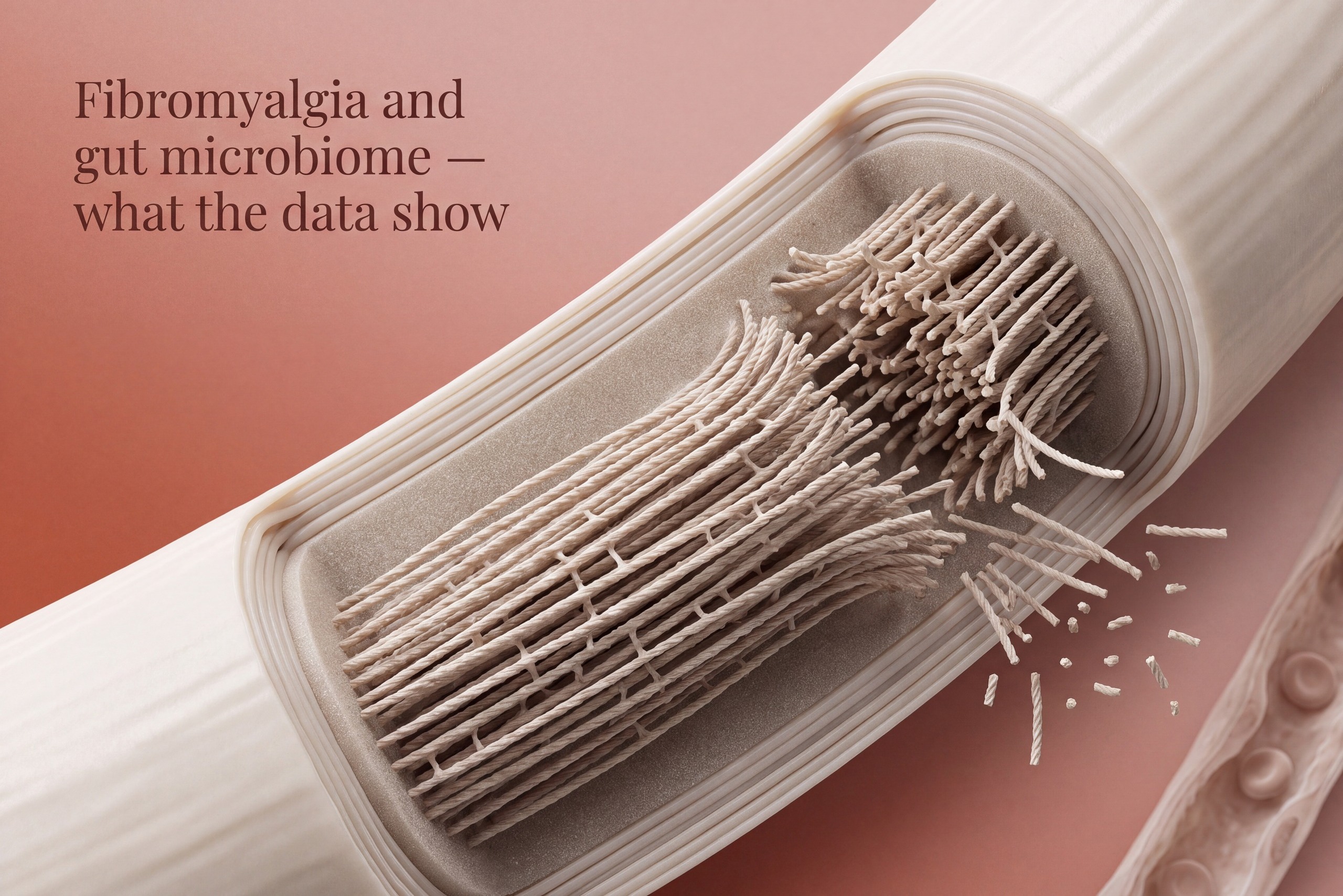
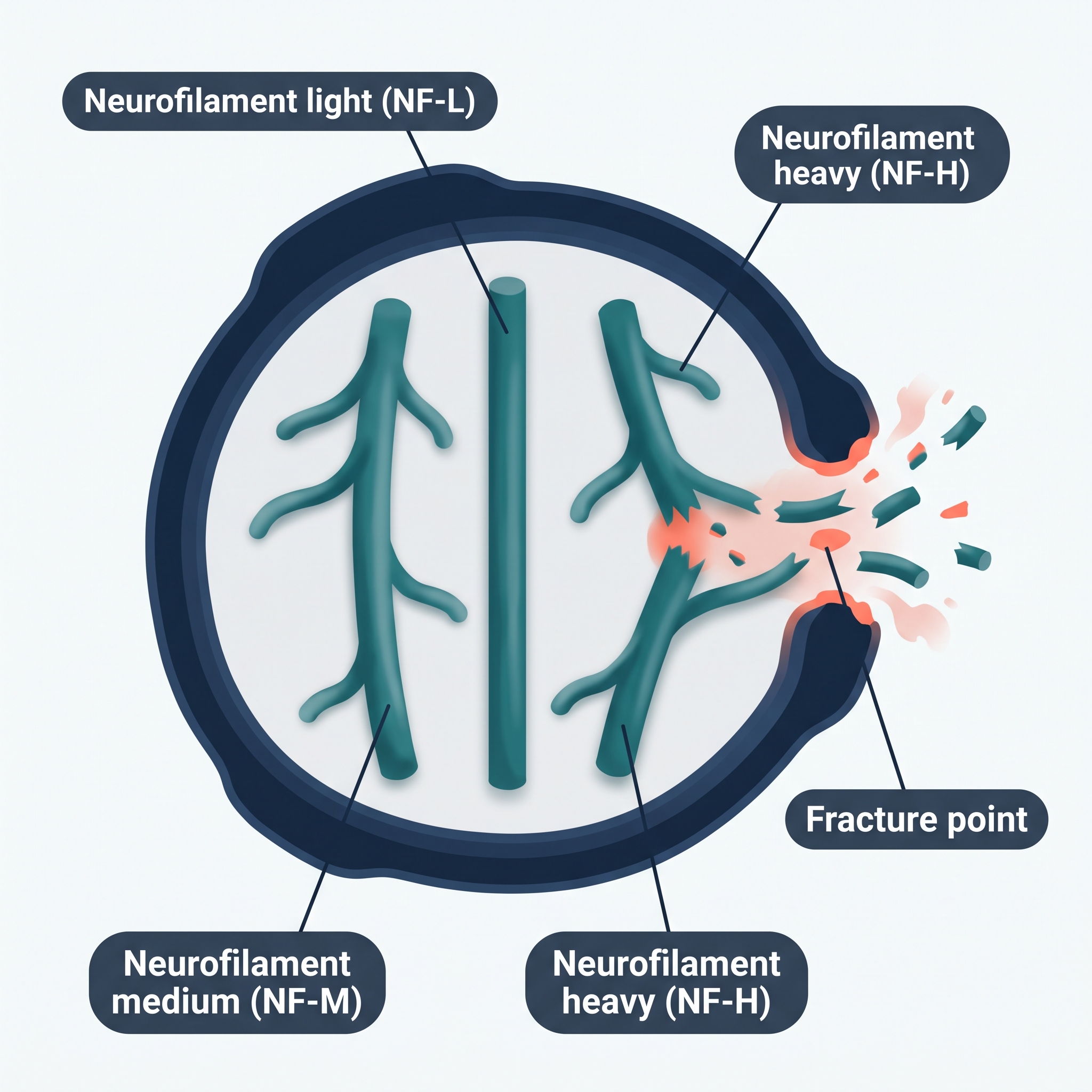
Neurofilament light chain is a protein that supports the internal skeleton of nerve fibers. When a fiber is damaged, it releases fragments into the blood, and two recent 2026 studies found elevated levels specifically in people with fibromyalgia.
What the Bari team found
Ruggieri and colleagues measured plasma from 33 women with fibromyalgia and 22 age-matched controls, and found consistently higher neurofilament in the fibromyalgia group, regardless of disease severity or duration. In a follow-up study by the same team in 2026, the value also correlated with dysfunction in both the central and peripheral nervous system. A large Oxford study separately found similarly elevated levels in 60 people with fibromyalgia, in the same range as small fiber neuropathy.
STUDY Elevated plasma neurofilament in 33 women with fibromyalgia versus 22 controls, unrelated to disease severity. Ruggieri et al., 2025, Plasma neurofilament light chain in fibromyalgia, European Journal of Pain.
STUDY Neurofilament correlated with central and peripheral nervous system dysfunction in fibromyalgia. Ruggieri et al., 2026, Neurofilament light chain in fibromyalgia, European Journal of Pain.
STUDY In 60 people with fibromyalgia, serum neurofilament was elevated in the same range as small fiber neuropathy, a recognized neuropathic condition. Fundaun et al., 2026, Serum neurofilament light chain in fibromyalgia, Pain Reports.
These findings support fibromyalgia as a neurogenic disorder and suggest serum neurofilament as a possible biomarker of nerve strain in chronic pain, although it is not a specific marker of peripheral nerve damage or cognitive dysfunction.
How accurate is a blood test for fibromyalgia today
Neurofilament isn't the only blood test under investigation. Researchers at Ohio State used Raman spectroscopy on blood samples and distinguished fibromyalgia from rheumatoid arthritis, lupus, and osteoarthritis, with accuracy, sensitivity, and specificity reaching 100%. It's a different technology from neurofilament, but it shows clearly that an objective blood test for fibromyalgia is getting closer to reality fast.
STUDY Using surface-enhanced Raman spectroscopy on blood samples, researchers distinguished fibromyalgia from other rheumatic diseases with 100% accuracy, sensitivity, and specificity. Bao et al., 2024, Early diagnosis of fibromyalgia using surface-enhanced Raman spectroscopy, Biomedicines.
What mechanisms link gut dysbiosis to nerve fiber damage?
Dysbiosis travels through several pathways at once. Lipopolysaccharides, the vagus nerve, short-chain fatty acids, the stress axis, and chronic immune activation together form a network that ends up at the same place, the nerve fiber.
The lipopolysaccharide and vagus nerve pathway
When the gut's barrier function loosens, lipopolysaccharides from bacteria such as Escherichia coli cross into circulation more easily, activate the TLR4 receptor, and trigger the release of inflammatory cytokines. At the same time, the vagus nerve itself carries TLR receptors on its surface, so it senses microbial signals directly and carries that information to the brain, changing how pain gets processed.
The short-chain fatty acid pathway
Bacteria such as Faecalibacterium prausnitzii and Akkermansia muciniphila produce short-chain fatty acids that keep microglia, the brain's immune cells, calm. When these bacteria decline, microglia lose part of that regulating influence and can stay in a state of low-grade inflammation for a long time. This exact type of chronic neuroinflammation is now considered responsible for part of the damage that neurofilament captures.
| Mechanism | What changes with dysbiosis |
|---|---|
| Gut barrier permeability | Lipopolysaccharides cross into circulation more easily and activate TLR4, triggering neuroinflammation. |
| Vagus nerve | The signal to the brain changes character, affecting how pain gets processed. |
| Short-chain fatty acids | A decline in Faecalibacterium prausnitzii and Akkermansia muciniphila leaves microglia less regulated. |
| Stress axis | Dysbiosis disrupts cortisol, reinforcing central sensitization. |
| Chronic immune activation | Ongoing IL-6 and TNF-α production keeps the nervous system on alert. |
Which bacteria and their byproducts have been linked to neurofilament light chain?
No study yet links one specific bacterium directly to neurofilament levels in people with fibromyalgia, the field is too recent for something that specific. There is something closer, though, an animal study that links the microbiome itself directly to nerve fiber damage.
Cai and colleagues transferred gut microbiota from women with fibromyalgia into germ-free mice, and the mice developed pain along with reduced skin innervation, exactly the type of damage neurofilament measures in blood. When they replaced the microbiota with a healthy one, the pain dropped significantly.
STUDY Transplanting gut microbiota from fibromyalgia patients into germ-free mice caused pain and reduced skin innervation, while replacing it with healthy microbiota reversed the effect significantly. Cai et al., 2025, The gut microbiota promotes pain in fibromyalgia, Neuron.
At the compositional level, studies also find reduced microbial diversity and an altered Firmicutes-to-Bacteroidetes ratio in people with fibromyalgia, along with differences in genera such as Prevotella, exactly the dysbiosis profile that favors the mechanisms in the previous section.
STUDY Human studies describe reduced microbial diversity and an altered Firmicutes-to-Bacteroidetes ratio in fibromyalgia, along with differences in genera such as Prevotella. Erdrich et al., 2020, Determining the association between fibromyalgia, the gut microbiome and its biomarkers, BMC Musculoskeletal Disorders.
After a course of antibiotics for a urinary tract infection last year, my fibromyalgia got a lot worse and I started reacting to foods I used to eat just fine. Could those be connected?
They very well could be. A course of antibiotics hits the microbiome hard, reduces beneficial bacteria such as Akkermansia, and opens space for more inflammatory populations, exactly the changes linked to worse fibromyalgia and new food intolerances. That timing deserves real attention. Write down when the intolerances started relative to the treatment, it helps a lot with the next step.
Can a healthy gut microbiome improve fibromyalgia symptoms?
Yes, and there's already human data on it. In the same study as the mice, an open-label clinical trial with microbiota transplant in women with fibromyalgia was linked to less pain and better quality of life.
A systematic review separately found that probiotic and prebiotic interventions reduced pain, cognitive symptoms, and neuroinflammation in studies related to fibromyalgia, while a separate study linked microbiome composition directly to the severity of day-to-day symptoms.
STUDY A systematic review of interventions found that probiotics and prebiotics reduced pain, cognitive symptoms, and neuroinflammation in conditions related to fibromyalgia. Dipalma et al., 2025, Modulating the gut microbiota to target neuroinflammation, cognition and mood, Nutrients.
STUDY Microbiome composition in women with fibromyalgia correlated directly with the intensity of clinical symptoms. Lopez de Coca et al., 2026, Exploring gut microbiota alterations and their associations with clinical symptoms in fibromyalgia, Scientific Reports.
What does this mean in practice when you're looking for a fibromyalgia solution?
In practice, the relationship between fibromyalgia and the gut microbiome earns a real place in the conversation, as an actual mechanism with measurable outcomes. The same pattern of dysbiosis and barrier leakage shows up elsewhere in the body too, and addressing gut barrier permeability is often where that pattern becomes visible first.
The gut-brain axis carries this signal well beyond digestion, another example of how far a signal that starts in the gut can travel. A structured gut dysbiosis protocol gives that imbalance a clear order of testing and diet changes to work through.
If you're dealing with fibromyalgia alongside an unstable gut, start by tracking both together for two weeks, day by day. That record is the first real evidence for whether they move together.
Looking for what connects your gut to fibromyalgia?
IBSyncrasy shows step by step how dysbiosis keeps symptoms going long after the original trigger has passed, through complete clinical case studies.
Frequently asked questions
It's a protein that supports the internal skeleton of nerve fibers. When a fiber is damaged, it releases fragments into the bloodstream, and this can be measured with a simple blood test.
Neurofilament is still being studied as a research marker. A different method, Raman spectroscopy, has already shown accuracy close to 100% in controlled studies, an important step toward a future routine test.
Studies show that the microbiome influences the intensity of pain and nerve damage, as one factor within a multifactorial condition.
The first step is to track both together for a few weeks, to see if they move in parallel. From there, an appointment can look at whether they belong to the same clinical pattern.