How to increase secretory IgA naturally and make it last
Low secretory IgA shows up quietly, in a lab result or a pattern of colds that keeps repeating. Here is what actually raises it, and how long it takes to hold.

What sIgA actually is, and why it behaves differently from the IgA in your blood
How to increase secretory IgA is the practical question once you understand what this antibody actually does. Secretory immunoglobulin A, or sIgA, is the immune system's first line of defense at your gut lining and other mucosal surfaces throughout your body, and it behaves nothing like the IgA measured in a routine blood test.
Structurally, sIgA is an IgA antibody built for durability: two IgA units joined by a J chain and wrapped in a protective secretory component that shields it from being broken down in the harsh environment of your digestive system, so it survives long enough to actually do its job right where it is needed.
Blood IgA circulates quietly and rarely causes symptoms by itself. sIgA, by contrast, is produced locally by plasma cells in your gut wall and released straight into the mucus layer, where it traps bacteria, viruses and food antigens before they ever reach the tissue underneath.
Roughly three to five grams of sIgA are secreted into the gut lumen every single day, more than any other antibody in the body combined. That volume alone shows the importance of sIgA to everyday gut health, since nothing else in your immune system works at that scale, continuously, without triggering inflammation. Daily sIgA production of that size depends on steady raw materials and a calm nervous system, which is exactly why it responds so well to the right inputs. In practice, this is one of the more overlooked findings on a stool test, buried past everything that gets circled first.
Where sIgA sits in your gut wall
Picture your intestinal wall as a stack of layers, from the outer muscle down to the single cell lining that faces everything you eat. sIgA lives at the innermost layer, inside the mucus coat, which is exactly where the fight against a given pathogen actually happens.
A cross-section of your gut wall
From the outer wall to the mucus coat where sIgA does its work
Tap each ring to see what happens there
Outer covering
The outermost layer, a thin sheet wrapping the intestine and facing the abdominal cavity.
sIgA vs serum IgA, what is actually different
The confusion between sIgA and serum IgA is common enough to deserve its own picture here. The two share a name, but almost nothing else about where they work or what they are built to do.
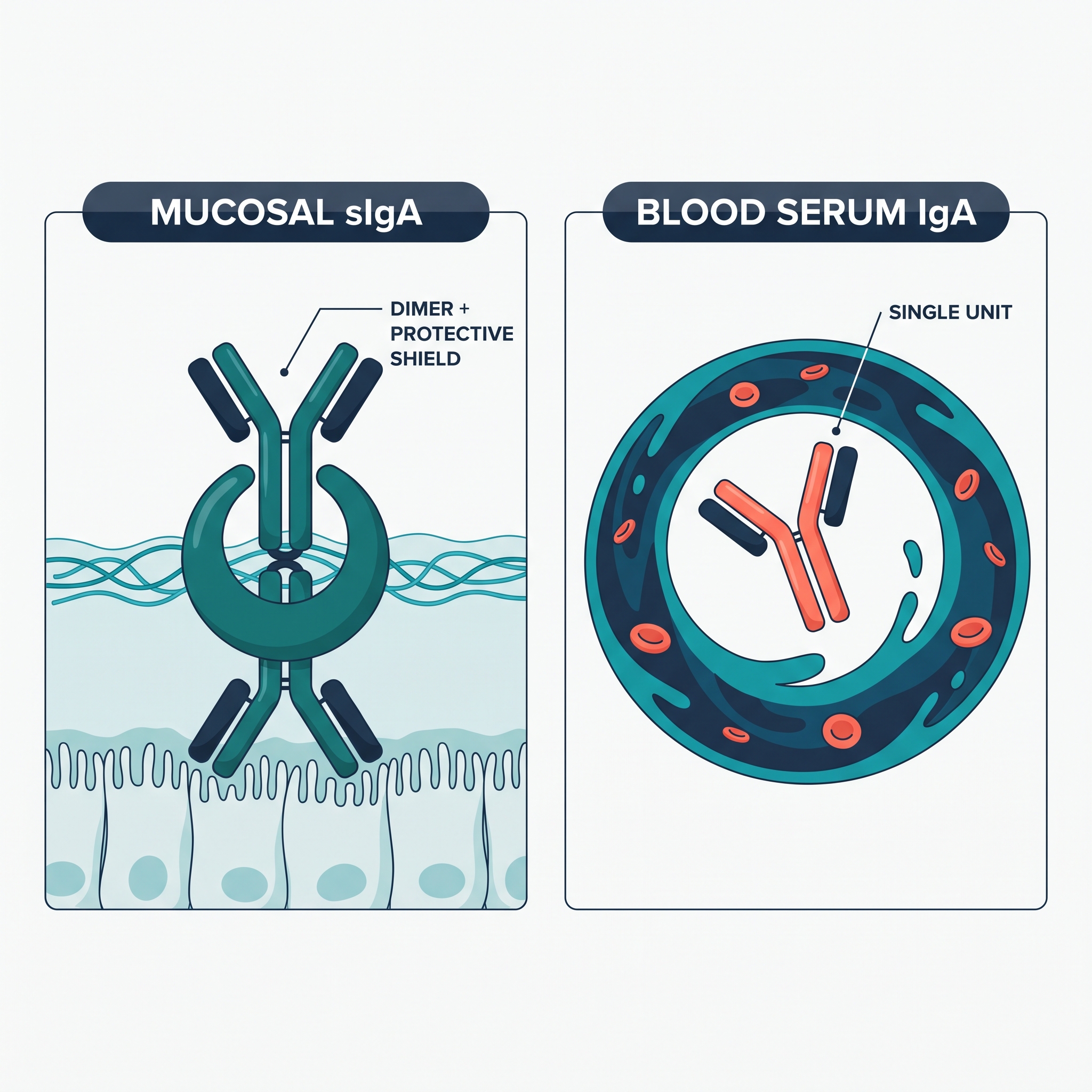
GI-MAP stool or a salivary test, where should you actually measure sIgA
There are two practical ways to measure sIgA, and they answer slightly different questions. A stool test, most often run as part of a comprehensive stool panel, reflects sIgA production specifically in your gut. A salivary test reflects mucosal immunity closer to your mouth and airways, and it is the version used in most of the exercise and stress research on sIgA.
A stool test that reports sIgA measures an immune marker directly, which sets it apart from a stool culture, built specifically to identify pathogens. If your goal is genuinely to understand your own mucosal defenses, the stool version is the one that matters most.
What a low sIgA result actually means for your gut
When sIgA levels are low, it points to your mucosal defenses being under strain right now, a functional signal that responds well to the right intervention. Low secretory IgA levels describe where things stand today, and today's number can change with the right plan.
- Low secretory IgA
- A result below your lab's reference range, indicating reduced antibody output in your gut. On its own, low levels of sIgA describe a functional state that responds to the right plan.
This distinction matters because it changes what you do next. A single result showing low sIgA levels is a prompt to look for the specific driver behind it: stress, dysbiosis, diet, or an active infection.
A reading of high sIgA is worth a second look, since it often reflects your gut actively fighting something in real time. Elevated sIgA levels can sometimes track with an active infection, a recent food reaction, or ongoing gut inflammation, more than with long-term protection. Persistently high levels of sIgA are worth mentioning to your practitioner, the same way a persistently low result is. Measuring sIgA levels in the gut directly is what actually tells you which direction you are dealing with, high or low, and either way, tracking down the root cause matters more than the single number on the page.
What actually drives sIgA down, from ongoing stress to a history of antibiotics
There is rarely one single explanation among the causes of low sIgA. The single most common cause of low sIgA I see in my own practice is a stacked history: repeated antibiotics on top of ongoing stress, sometimes with a very restrictive diet layered on top of both. In functional medicine, sIgA is treated as a marker to interpret in context, never a number to chase in isolation.
What converges on low sIgA
Chronic stress and cortisol
Elevated cortisol levels are one of the clearest, most consistent findings tied to a drop in mucosal antibody output. Chronic stress directly changes your immune response in your gut, and protracted psychological stress is specifically associated with lower salivary IgA1.
STUDY In a study of 113 university students, higher perceived stress was linked to lower salivary IgA1 levels, with loneliness and depression separately affecting how the antibody was transported to the surface. Engeland et al., 2016, Psychological distress and salivary secretory immunity, Brain, Behavior, and Immunity.
A history of antibiotics
Antibiotics are necessary and often life-saving, but a heavy or repeated history of them is one of the most reliable drivers behind low sIgA levels I encounter. Beyond clearing the infection they were prescribed for, they also reshape the gut microbiome that sIgA output depends on.
STUDY In mice given a therapeutic dose of ampicillin for 14 days, gut permeability increased, tight-junction proteins fell to half of control levels, and secretory IgA in the colon mucosa decreased alongside the shift in gut bacteria. Shi et al., 2018, Structural and functional alterations in the microbial community and immunological consequences in a mouse model of antibiotic-induced dysbiosis, Frontiers in Microbiology.
Low-fiber, high-meat diets and the mucus layer
This is the pattern I see most often in practice: someone comes in after several rounds of antibiotics, has also been eating a strict carnivore or very low-fiber diet for months, and their sIgA is close to the floor of the reference range. The two causes tend to arrive together, and the mechanism connecting them is the mucus layer itself.
Fiber feeds the bacteria that build mucus. Without it, some of those same bacteria, including Akkermansia muciniphila, switch to eating the mucus lining instead, which physically thins the layer sIgA depends on and leaves less surface area to trap pathogens in the first place.
Akkermansia abundance under fiber deprivation (mouse model)
Desai et al., 2016, Cell (gnotobiotic mouse model, relative abundance)
STUDY In a gnotobiotic mouse model, dietary fiber deprivation shifted the gut microbiota toward mucin degradation, eroding the colonic mucus barrier and increasing susceptibility to a mucosal pathogen. Desai et al., 2016, A dietary fiber-deprived gut microbiota degrades the colonic mucus barrier and enhances pathogen susceptibility, Cell.
This pattern, heavy antibiotic use layered onto a very low-fiber diet, is common enough that it turns up throughout real patient histories. One case study on the site follows a nurse with almost undetectable sIgA after years of antibiotics and constant hospital exposure, whose mucosal immune system only recovered once the underlying dysbiosis was addressed directly.
I've had three rounds of antibiotics this year for sinus infections, and for the past two months I catch every cold going around my office before anyone else does.
That pattern is honestly one of the more common ones I see. Multiple antibiotic courses in a short window reshape your gut bacteria well beyond just clearing the infection, and that reshaping is closely tied to how much secretory IgA your gut produces. Less of the right bacteria generally means less material to support sIgA output, which leaves you catching everything that goes around. It is worth checking sIgA on a stool panel to see what is actually going on.
Not every low sIgA story looks the same
Mary's case is one of many like it: chronic infections, years of antibiotics, and mucosal defenses that stopped protecting her. The same case-by-case approach that rebuilt hers is mapped out in detail in IBSyncrasy. Buy IBSyncrasyThe everyday signs of a struggling mucosal immune system
Low sIgA levels rarely announce themselves directly. Instead, they tend to erode gut health in small, cumulative ways: an immune response that seems to lose more often than it should, and a cluster of everyday gut symptoms that build up over time.
- Frequent colds or sinus infections that never fully clear
- New or worsening food sensitivities, especially to foods you used to tolerate fine
- IBS-type symptoms: bloating, loose stool, or unpredictable bowel habits
- Fatigue that feels disconnected from how much sleep you are actually getting
- A history of recurrent urinary tract or respiratory infections
A practical plan for how to increase secretory IgA, step by step
Once you know your likely drivers, the plan to increase sIgA levels is fairly concrete. sIgA may respond faster to some interventions than others, which is exactly why pairing the right levers matters more than piling on supplements.
Supplements: colostrum, glutamine, vitamin A and zinc
None of this works identically for everyone. What corrects one person's sIgA levels in six weeks may barely move someone else's, because the underlying cause is different for individuals with low sIgA, even when the lab number looks the same.
- Bovine colostrum, in a dose your practitioner has actually reviewed
- Glutamine, to support the gut wall directly
- Vitamin A and zinc, tested directly through labwork
- A targeted probiotic chosen for your specific gut
- Prebiotic fiber, added gradually if your gut is currently reactive
Vitamin A does real, direct work here: gut dendritic cells use it to direct B cells toward IgA production in the first place, and animals deficient in vitamin A simply stop generating IgA-secreting cells in the small intestine. Zinc plays a similar structural role, and zinc-deficient models show a clear drop in intestinal secretory IgA that partially reverses with repletion. Glutamine adds a third lever, increasing SIgA abundance in the gut in controlled studies through both immune and microbiota-dependent pathways.
Salivary IgA after 2 weeks of bovine colostrum, randomized trial
Mero et al., 2002, J Appl Physiol (athletes, double-blind, n=30)
STUDY In a double-blind trial, athletes who took 20 grams of bovine colostrum daily for two weeks showed a significant 33 percent increase in salivary IgA compared with placebo. Mero et al., 2002, IGF-I, IgA, and IgG responses to bovine colostrum supplementation during training, Journal of Applied Physiology.
Targeted probiotics and prebiotic fiber
A healthy gut microbiome does much of the work behind sIgA output. The strongest approach is to balance sIgA levels through several smaller, complementary levers together, giving your gut bacteria what they need to keep antibody output steady. Long term, the goal is to support healthy sIgA levels through diet and lifestyle as much as through supplements.
Stress, sleep and time-restricted eating, not restrictive fasting
Managing ongoing stress belongs on this list as much as any supplement, since unmanaged stress can decrease sIgA output even when the rest of your plan is dialed in. Consistent sleep and a moderate, time-restricted eating pattern, a normal eating window kept steady day to day, both support immune function throughout the gut. A 30-day human trial of moderate time-restricted eating showed a shift toward a younger immune profile and a reshaped gut microbiome, without the extended food deprivation that restrictive or prolonged fasting protocols involve.
STUDY In a 30-day trial of 16:8 time-restricted eating with balanced, calorie-appropriate meals, participants showed reduced immune senescence markers and a reshaped gut microbiome. Chen et al., 2024, Time-restricted eating reveals a younger immune system and reshapes the intestinal microbiome in human, Redox Biology.
| Works within weeks | Builds the foundation long-term |
|---|---|
| Bovine colostrum | Often the fastest mover on a retest, usually within four to eight weeks |
| Vitamin A and zinc | Correct a genuine deficiency quickly, but only help if you were actually low |
| Fixing dysbiosis and stress load | Rebuilds the base your gut needs to keep sIgA levels stable for good |
How long it actually takes to raise sIgA levels for good
A first retest can look encouraging within a few weeks, and that early increased sIgA number is a genuinely good sign, though full mucosal rebuilding takes real time on top of it. Genuine, lasting sIgA recovery generally takes longer than most people expect.
- 1
Weeks 1 to 2
Colostrum and stress management begin to show early salivary changes in some people.
- 2
Weeks 3 to 4
Digestive symptoms often ease first, before the lab number itself moves much.
- 3
Weeks 5 to 6
A repeat panel may show a first meaningful increase in sIgA, especially if colostrum and targeted probiotics were both used.
- 4
Weeks 7 to 8
Fewer infections and steadier energy become noticeable if the underlying drivers, stress, dysbiosis or diet, are genuinely being addressed.
My GI-MAP came back with sIgA right at the bottom of the reference range, and my practitioner told me to take colostrum for a month before we retest.
A month of colostrum is a reasonable first move, and plenty of people do see their retest number tick up a little in that window. A single higher number is genuinely encouraging, though it usually reflects the first stage of a longer process, especially when antibiotics, ongoing stress or a low-fiber diet caused the drop in the first place. Real, lasting secretory IgA production tends to need a longer runway, closer to three to six months, so it helps to treat that first retest as one early data point on the way there.
When low sIgA needs more than lifestyle changes
Most low sIgA responds to the plan above. It is worth involving a clinician directly if you are dealing with frequent, severe infections, a personal or family history that suggests an underlying immune issue, or a result that stays flat despite several months of consistent effort.
Immune exclusion, non-inflammatory antibody shielding of internal body surfaces, mediated principally by secretory immunoglobulin A.
How this compares to a similar-sounding condition
A low result on a gut-focused sIgA test describes a separate condition from Selective IgA Deficiency, a distinct blood-based primary immunodeficiency defined by a very low serum IgA level, affecting roughly one in every 300 to 3,000 people. If your blood IgA has never been checked and your history includes serious recurrent infections, that is a reasonable test to add.
STUDY Selective IgA deficiency is defined by a decreased serum IgA level with normal levels of other immunoglobulin isotypes, and most affected individuals remain asymptomatic and are identified only incidentally. Yel, 2010, Selective IgA deficiency, Journal of Clinical Immunology.
Not sure what is actually keeping your immune system down
A focused conversation about your history, your lab results and what is realistically driving your symptoms, so the next step actually fits your gut.
Frequently asked questions
The most reliable combination is bovine colostrum, targeted probiotics, adequate vitamin A and zinc, and glutamine, alongside fixing whatever is behind your low sIgA levels in the first place, most often ongoing stress, a history of antibiotics, or a very low-fiber diet. Moderate time-restricted eating and consistent sleep support the same process, and together they add up to genuinely better gut health over time. A first retest can improve within four to eight weeks, but full, lasting recovery usually takes three to six months.
Low secretory IgA levels tend to show up as frequent colds or sinus infections, new food sensitivities, IBS-type symptoms like bloating and loose stool, unexplained fatigue, and a history of recurrent urinary or respiratory infections. None of these are specific to sIgA on their own, which is why a stool test matters more than symptom-guessing.
Functional, gut-related low sIgA usually responds well to lifestyle and supplement changes, and most people see meaningful improvement. Symptoms and a first retest number tend to move faster, often within four to eight weeks. Full, stable sIgA recovery generally needs longer, closer to three to six months, and takes even more time if a predisposing factor like a tonsillectomy or lack of early breastfeeding is part of your history. Selective IgA Deficiency, the separate blood-based condition, is generally lifelong and managed long-term. This kind of layered recovery is exactly what functional medicine is built to sort through, one driver at a time.