Histamine intolerance and SIBO: The Two-Way gut connection
Histamine intolerance and SIBO trap millions in a vicious gut cycle. The bacteria behind small intestinal bacterial overgrowth can flood your system with histamine while shutting down the enzyme that clears it. Here is what the research shows, and why the usual antibiotic fix rarely lasts.
How are SIBO and histamine intolerance connected?
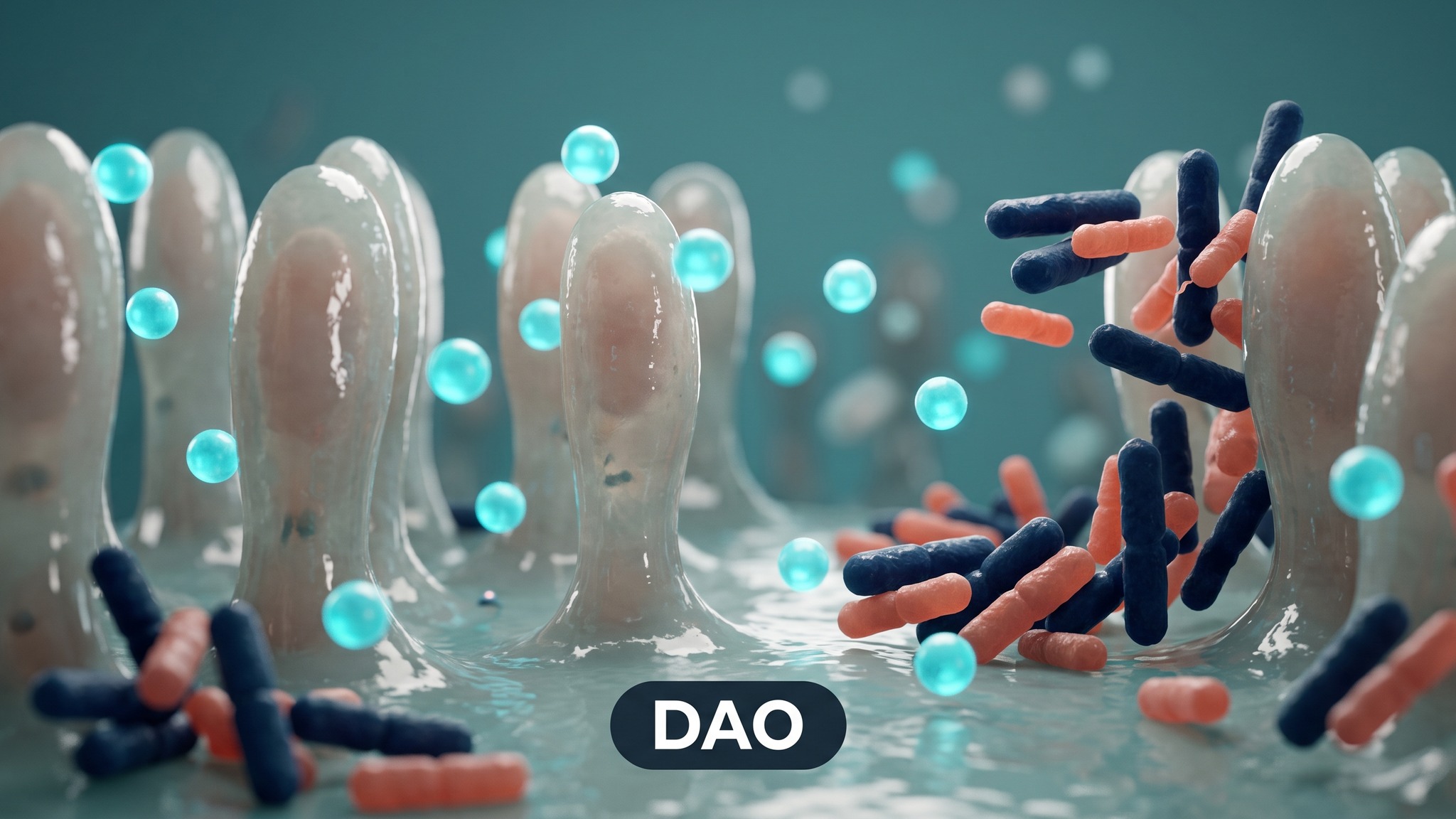
SIBO and histamine intolerance are connected through a double hit. The bacterial overgrowth behind SIBO includes species that produce histamine, and the inflammation it triggers suppresses DAO, the enzyme that helps break down histamine in the gut lining. Production goes up while clearance goes down.
Several of the gut bacteria that overgrow in the small intestine carry histidine decarboxylase, an enzyme that converts the amino acid histidine into histamine. Documented producers include Morganella morganii, Klebsiella aerogenes, Escherichia coli, Enterococcus faecalis, and certain Lactobacillus strains. These species increase histamine production right where food is absorbed. In a landmark 2022 study, researchers moved gut bacteria from IBS patients into germ-free mice and watched histamine production drive visceral pain signaling, with Klebsiella aerogenes named as the main producer.
A positive SIBO test in IBS depends heavily on the method
Pooled prevalence of a positive SIBO test in IBS by diagnostic method. Ford AC, et al. (2009), Clin Gastroenterol Hepatol.
How often the two conditions travel together depends on which test you believe. Across 12 studies, a positive lactulose breath test was found in 54% of IBS patients, versus 31% with glucose testing and only 4% with culture. A later meta-analysis of 50 studies placed SIBO at 38% of IBS patients, with odds 4.7 times higher than in healthy controls. Whatever the exact figure, bacterial overgrowth is common in precisely the people who report histamine symptoms. Patients with histamine intolerance also show a measurably different gut microbiome, with reduced diversity and fewer histamine-degrading Bifidobacteriaceae. Gut health and histamine tolerance rise and fall together.
STUDY Fecal microbiota from IBS patients with high urinary histamine produced large amounts of histamine in the lab, and Klebsiella aerogenes carrying a histidine decarboxylase gene variant was pinpointed as the key producer, abundant in three independent IBS cohorts. De Palma G, et al. (2022). Histamine production by the gut microbiota induces visceral hyperalgesia through histamine 4 receptor signaling in mice. Science Translational Medicine, 14(655). De Palma et al., 2022
Can histamine intolerance trigger SIBO in the first place?
Histamine intolerance can plausibly help trigger SIBO, mostly by disturbing the two systems that keep the small intestine clean: motility and stomach acid. The evidence here is mechanistic rather than trial-based, but four pathways keep showing up in the literature and in clinic.
The small intestine stays nearly sterile thanks to the migrating motor complex (MMC), a housekeeping wave that sweeps bacteria downward between meals. Histamine is an active signaling molecule in the enteric nervous system, and in excess it can disturb the coordinated contractions that drive this cleansing wave. When the wave weakens, bacteria linger, ferment food where they should not, and bacterial overgrowth becomes possible. Chronic mast cell activation adds pressure, because mast cells sit beside enteric nerves and release histamine plus inflammatory mediators that further slow transit.
Excess histamine signaling through intestinal H1 and H2 receptors can disturb peristalsis and the MMC, letting bacteria stagnate in the small intestine.
Activated mast cells release histamine and cytokines near enteric nerves, impairing the sweeping waves that clear bacteria between meals.
Common medications, including NSAIDs, reduce DAO activity and damage the gut barrier, creating conditions where histamine and bacteria both accumulate.
People with histamine issues often end up on antacids or PPIs. Stomach acid is a frontline defense, and lowering it raises the odds of bacterial overgrowth.
That last pathway has hard data behind it. A meta-analysis of 11 studies found that PPI users carried double the odds of SIBO, and the risk climbed further when diagnosis relied on culture. So the drugs many patients reach for when histamine flares, or when reflux starts, can quietly feed the next stage of the problem.
STUDY A wide-ranging review argues that histamine intolerance originates in the gut, where dysbiosis, mucosal inflammation, and reduced DAO activity interact, with gastrointestinal disease as the most common driver of low DAO. Schnedl WJ, Enko D (2021). Histamine Intolerance Originates in the Gut. Nutrients, 13(4), 1262. Schnedl & Enko, 2021
Which gut symptoms point to SIBO and histamine intolerance together?
The gut symptoms that most often point to the combination are bloating that builds after meals, bowels that swing between diarrhea and constipation, cramping abdominal pain, gas with visible distension, early satiety, and reflux. The telltale histamine signature is that these digestive symptoms flare after histamine-rich or fermented foods.
There is a reason the gut dominates the picture. The digestive tract carries a dense concentration of histamine receptors, so excess histamine registers first as nausea, cramps, diarrhea, or constipation. SIBO adds its own layer, because bacterial fermentation produces hydrogen, methane, or hydrogen sulfide gases that stretch the bowel wall. In a 2025 meta-analysis of intestinal methanogen overgrowth, bloating affected 78% of patients and abdominal pain 65%.
Fermentation leads
Bloating and gas within 30 to 90 minutes of eating, distension that worsens through the day, diarrhea or constipation, positive breath test. Symptoms track carbohydrate intake more than histamine content.
Reactions lead
Flushing, hives, headache, racing heart, or a blocked nose after histamine-rich foods, often with diarrhea. Symptoms track the histamine load of the meal, not just its fermentable carbs.
What are the root causes of SIBO?
SIBO starts when the gut's self-cleaning defenses fail, and the most proven trigger is a bout of food poisoning. A meta-analysis of 45 studies found that roughly one in ten people develops IBS within a year of infectious gastroenteritis, and bacterial overgrowth is a core mechanism behind it.
The stomach normally kills incoming bacteria with acid, the MMC sweeps survivors downstream, and the ileocecal valve stops colonic bacteria from backing up. Anything that weakens these defenses opens the door: acid-suppressing drugs, abdominal surgery and adhesions, opioid painkillers, diabetes-related nerve damage, and conditions like scleroderma or celiac disease that paralyze motility. An earlier analysis put the odds of developing IBS after a gut infection at nearly six times higher.
What raises the odds: verified risk factors from meta-analyses
Odds ratios with 95% confidence intervals; reference line at OR 1. Thabane 2007; Lauritano 2008; Chen 2018; Ford 2009; Lo 2013; Su 2018.
Food poisoning can injure the enteric nerves and the MMC for years. About 10% of infected people develop IBS within 12 months, with SIBO as a leading mechanism.
Diabetes, hypothyroidism, scleroderma, and chronic stress all slow the cleansing waves of the small intestine, giving bacteria time to settle and multiply.
Acid is a sterilizer. PPIs, H2 blockers, atrophic gastritis, and bariatric surgery each remove that barrier and measurably raise SIBO risk.
Adhesions from surgery, strictures in Crohn's disease, diverticula, and a leaky ileocecal valve create pockets where bacteria pool and resist clearance.
STUDY Pooling 45 studies and more than 21,000 people, researchers found an IBS prevalence of 10.1% twelve months after infectious enteritis, a 4.2-fold risk increase in the first year, with protozoan infections carrying the highest risk at 41.9%. Klem F, et al. (2017). Prevalence, risk factors, and outcomes of irritable bowel syndrome after infectious enteritis: a systematic review and meta-analysis. Gastroenterology, 152(5), 1042-1054. Klem et al., 2017
A second meta-analysis confirmed the medication angle, finding that proton pump inhibitors moderately increase the risk of overgrowth across 19 studies. Notice what is missing from these lists: willpower, gluten, or one bad food. SIBO is a mechanical and neurological failure first, which is why diets and antibiotics alone so often disappoint, a point the rifaximin data makes painfully clear.
Why is rifaximin not a permanent solution for SIBO?
Rifaximin is not a permanent solution because it only flattens the bacterial overgrowth for a while. It does nothing for the failed motility, low stomach acid, or scar tissue that let bacteria accumulate in the first place. In the largest follow-up study, 43.7% of successfully treated patients relapsed within nine months.
Think of rifaximin as mowing a lawn without touching the roots. The drug stays inside the gut lumen, cuts down a broad share of the overgrown bacteria, and normalizes breath tests in about 70.8% of cases according to 32 studies and 1,331 patients. Impressive, until you look at symptoms. In the two TARGET trials that led to approval, adequate relief of global IBS symptoms was reached by 40.7% on rifaximin versus 31.7% on placebo. The drug beat a sugar pill by nine points.
Adequate relief of global IBS symptoms: rifaximin vs placebo
Pimentel M, et al. (2011), N Engl J Med. Bar height scaled for readability; percentages are exact.
Relapse after rifaximin: the nine-month curve
Recurrence of a positive glucose breath test after successful rifaximin treatment (n=80). Lauritano EC, et al. (2008), Am J Gastroenterol.
The relapse curve is not a failure of the drug so much as a failure of the model. Eradication without motility repair leaves the door open, and bacteria walk back in. The same study found that a prior appendectomy more than quintupled the risk of recurrence, and chronic PPI use more than tripled it. Methane-dominant cases fare even worse on rifaximin alone, because the archaea behind methane production usually need a second agent such as neomycin. And no antibiotic can rebuild a damaged migrating motor complex, which is the actual cleaning crew of the small intestine.
STUDY Among 80 patients whose breath tests normalized after rifaximin, recurrence reached 12.6% at three months, 27.5% at six months, and 43.7% at nine months. Older age, previous appendectomy, and chronic PPI use predicted relapse. Lauritano EC, et al. (2008). Small intestinal bacterial overgrowth recurrence after antibiotic therapy. Am J Gastroenterol, 103(8), 2031-2035. Lauritano et al., 2008
Do antihistamines help SIBO-related histamine symptoms?
Antihistamines can take the edge off histamine intolerance symptoms such as flushing, hives, itching, and headaches, but they do nothing to SIBO itself. They block the receptor, not the production. Symptoms usually return within hours of the last dose, because the bacteria in the small intestine keep making histamine.
There is also a catch that rarely gets discussed. H2 blockers like famotidine work by suppressing stomach acid, and stomach acid is one of the main defenses against bacterial overgrowth. Taken daily for months, an H2 blocker can quietly worsen the very problem it was meant to calm. A smarter bridge is diamine oxidase itself: patients with histamine intolerance show markedly lower DAO activity, with 7.04 U/mL versus 39.50 U/mL in healthy controls in one study.
Blocks the signal
H1 blockers calm flushing, hives, and headaches within an hour. Useful on flare days and for travel. The effect fades as the drug wears off, and nothing changes in the gut.
Lowers production
Treating SIBO, restoring DAO, and using a short low-histamine diet reduce how much histamine is made and absorbed. Slower, but it changes the trajectory instead of masking it.
DAO supplements carry early but encouraging evidence. In an open pilot study, four weeks of DAO capsules improved all 22 tracked symptoms, and symptoms crept back when patients stopped. Among 316 patients with suspected histamine intolerance, those with the lowest DAO who followed a histamine-free diet saw symptoms resolve and DAO rise as histamine levels fell, within 6 to 12 months. Antihistamines have their place, but the enzyme and the diet change the underlying math.
What are the treatment options for SIBO and histamine intolerance?
Treatment for SIBO and histamine intolerance works in layers: reduce the overgrowth, calm histamine while the lining heals, then restore motility so the problem cannot rebuild. The order matters as much as the tools, because clearing bacteria while DAO is still suppressed can temporarily worsen histamine symptoms.
| Intervention | What it does and when it fits |
|---|---|
| Low-histamine diet | Cuts incoming histamine for 4 to 8 weeks while treatment works. A bridge, not a life sentence. In 101 patients, a histamine-reduced diet measurably raised serum DAO, with histamine levels tracking compliance. |
| Targeted antimicrobials | Rifaximin for hydrogen-dominant SIBO, combination therapy for methane types, or botanical protocols. Clears the overgrowth so the lining can recover. |
| Strain-specific probiotics | Most Bifidobacterium strains degrade histamine or stay neutral. L. casei and L. bulgaricus can add to the load and are best avoided early on. |
| Prokinetics | Restart the migrating motor complex after eradication, the single most important step for preventing relapse. Options range from prescription agents to ginger-based support. |
| DAO support | DAO capsules before meals plus the cofactors the enzyme needs, including vitamin B6, vitamin C, and copper. Helps bring the histamine level down while the villi rebuild their own production. |
| Elemental diet | A predigested formula that starves bacteria completely for about two weeks. Reserved for stubborn or relapsing cases under supervision. |
Two practical warnings come up repeatedly in clinic. First, do not stack a strict low-histamine diet on top of a strict low-FODMAP diet for months. The overlap strips out so many foods that nutrition suffers, and nutrition is what rebuilds the mucosa and long-term gut health. Second, probiotics are not automatically safe here. The strains in many popular products, especially Lactobacillus casei and Lactobacillus bulgaricus, produce histamine themselves. Patients with histamine intolerance often feel worse on standard probiotics, and the mechanism behind that reaction is now well documented.
STUDY In an open-label pilot of 28 patients with histamine intolerance, four weeks of oral DAO supplementation before meals improved all 22 assessed symptoms significantly, and symptoms returned after discontinuation, supporting a causal role for DAO deficiency. Schnedl WJ, et al. (2019). Diamine oxidase supplementation improves symptoms in patients with histamine intolerance. Food Science and Biotechnology, 28(6), 1779-1784. Schnedl et al., 2019
How does functional medicine break the SIBO and histamine cycle?
Functional medicine breaks the cycle by treating SIBO and histamine intolerance as one connected gut health system with several entry points, not as two separate diagnoses. Instead of asking which pill kills which bug, it asks why the gut allowed overgrowth, why histamine clearance collapsed, and what keeps both going.
That starts with testing rather than guessing. A sensible workup maps three territories: the overgrowth itself (glucose or lactulose breath testing, with methane and hydrogen sulfide where available), the histamine side (serum DAO activity, and sometimes urinary histamine or its metabolites), and the terrain (a stool microbiome profile, celiac serology, thyroid function, and a full medication review). Each result changes the plan. A methane-positive breath test calls for different antimicrobials than a hydrogen-positive one, and a DAO of 7 U/mL argues for enzyme support while the mucosa heals. For a broader view of how these pieces fit into long-term gut microbiome care, the principles stay the same: measure, then act.
- 1
Find the entry point
History first: food poisoning, surgeries, PPI or opioid use, antibiotics, and stress load. Confirm with breath testing, DAO activity, and a stool microbiome profile before any treatment.
- 2
Remove the overgrowth
Targeted antimicrobials or botanicals matched to the gas pattern, paired with a short low-histamine diet so the histamine load falls while the bacteria clear.
- 3
Restart the cleaning waves
Prokinetics, meals spaced four to five hours apart, and vagal support restore the migrating motor complex, the step that decides whether SIBO stays gone.
- 4
Repair the lining and the enzyme
Zinc, glutamine, and the DAO cofactors B6, C, and copper support villi that must rebuild their own DAO production. This is where histamine tolerance returns.
- 5
Rebuild and retest
Strain-specific probiotics, gradual food reintroduction, mast cell calming, and a repeat breath test at eight to twelve weeks confirm the cycle is broken.
This framework explains why single-tool fixes disappoint. Diet alone cannot kill established overgrowth. Antibiotics alone cannot repair motility. DAO alone cannot stop bacteria from producing histamine. Patients with histamine intolerance who also treat their SIBO, and those who lower their histamine load while clearing the overgrowth, are the ones who stay well. If your story started with IBS that never fully made sense, this combined lens is often the missing piece. The full protocol, with the testing logic and the reintroduction order, is laid out in the SIBO and IBS chapter of IBSyncrasy.
Still chasing bloating that keeps coming back?
A structured workup with breath testing and DAO activity can show whether bacterial overgrowth and histamine are driving your symptoms, and what to fix first.
IBSyncrasy
If you are tired of guessing which food or supplement will set you off next, IBSyncrasy gives you the full map. Its dedicated SIBO and IBS chapter covers breath test interpretation, strain selection, prokinetics, and the exact sequence for calming histamine while you clear the overgrowth.
Get the IBSyncrasy bookFrequently asked questions
Hydrogen-dominant SIBO is the type most often linked to histamine intolerance, because many hydrogen-producing species also carry histidine decarboxylase, the enzyme that turns histidine into histamine. Klebsiella aerogenes, Morganella morganii, and Escherichia coli are documented producers. Methane-dominant overgrowth (IMO) mainly drives constipation and is less directly tied to histamine, though any chronic overgrowth can suppress DAO through inflammation.
Antihistamines help the symptoms but not the SIBO. H1 blockers can calm flushing, hives, itching, and headaches within hours, which makes them useful on flare days. They do not reduce bacterial histamine production, so symptoms return when the dose wears off. Daily H2 blockers deserve extra caution, because suppressing stomach acid removes a key defense against bacterial overgrowth.
Treatment layers three moves. Clear the overgrowth with targeted antimicrobials or botanicals matched to your gas pattern. Lower histamine with a short low-histamine diet and DAO support while the lining heals. Then restore motility with prokinetics so SIBO cannot rebuild, and reintroduce strain-specific probiotics that do not produce histamine.
Through a double hit. SIBO overgrowth includes bacteria that produce histamine, raising supply. At the same time, the inflammation it causes suppresses DAO, the enzyme that breaks histamine down, cutting clearance. Excess histamine then fuels more inflammation and dysmotility, closing a loop that keeps both conditions alive.
Because antibiotics flatten the overgrowth without repairing the reason it formed. In the largest follow-up study, 43.7% of patients relapsed within nine months of successful rifaximin treatment. Recurrence is driven by the untreated root cause: weak motility, low stomach acid, adhesions, or medication effects. Eradication plus prokinetics and root-cause work is what makes results last.