Psyllium for IBS: what the evidence shows
Real trial data explains why psyllium outperforms other fibers for IBS, and exactly how to start it without the bloating.
Does psyllium actually improve IBS symptoms?
Psyllium for IBS has more randomized trial evidence behind it than almost any other fiber supplement, and the numbers hold up under scrutiny. A 2014 meta-analysis pooling 14 trials in 906 people with IBS found that fiber supplementation lowered the relative risk of remaining symptomatic to 0.86 compared with placebo. Once the researchers separated fiber types, the picture got sharper still.
Soluble fiber, mainly psyllium, cut that risk further, to 0.83. Bran, an insoluble fiber, showed no significant benefit at all. That gap between fiber types is the whole story, and it is why lumping 'more fiber' together as one piece of advice misses the point.
Soluble fiber (psyllium) outperforms bran for IBS symptoms
Moayyedi et al. 2014, Am J Gastroenterol. RR = risk of remaining symptomatic vs placebo, lower is better. Reference line at RR 1.0.
STUDY Pooling 14 randomized trials in 906 patients with IBS, soluble fiber cut the relative risk of remaining symptomatic to 0.83, while bran showed no significant benefit over placebo. Moayyedi et al., 2014, The effect of fiber supplementation on irritable bowel syndrome, American Journal of Gastroenterology.
STUDY The American Gastroenterological Association's 2022 clinical practice update lists soluble fiber, not fiber in general, as an evidence-backed treatment for global IBS symptoms. Chey et al., 2022, AGA Clinical Practice Update on the Role of Diet in Irritable Bowel Syndrome, Gastroenterology.
How does psyllium work once it reaches your gut?
Psyllium husk, the outer seed coat of Plantago ovata, is built from a branched polysaccharide called arabinoxylan. When it meets water, that polysaccharide swells into a soft, cohesive gel that holds many times its own weight in liquid. That gel does most of the work, and it does it in four connected steps.
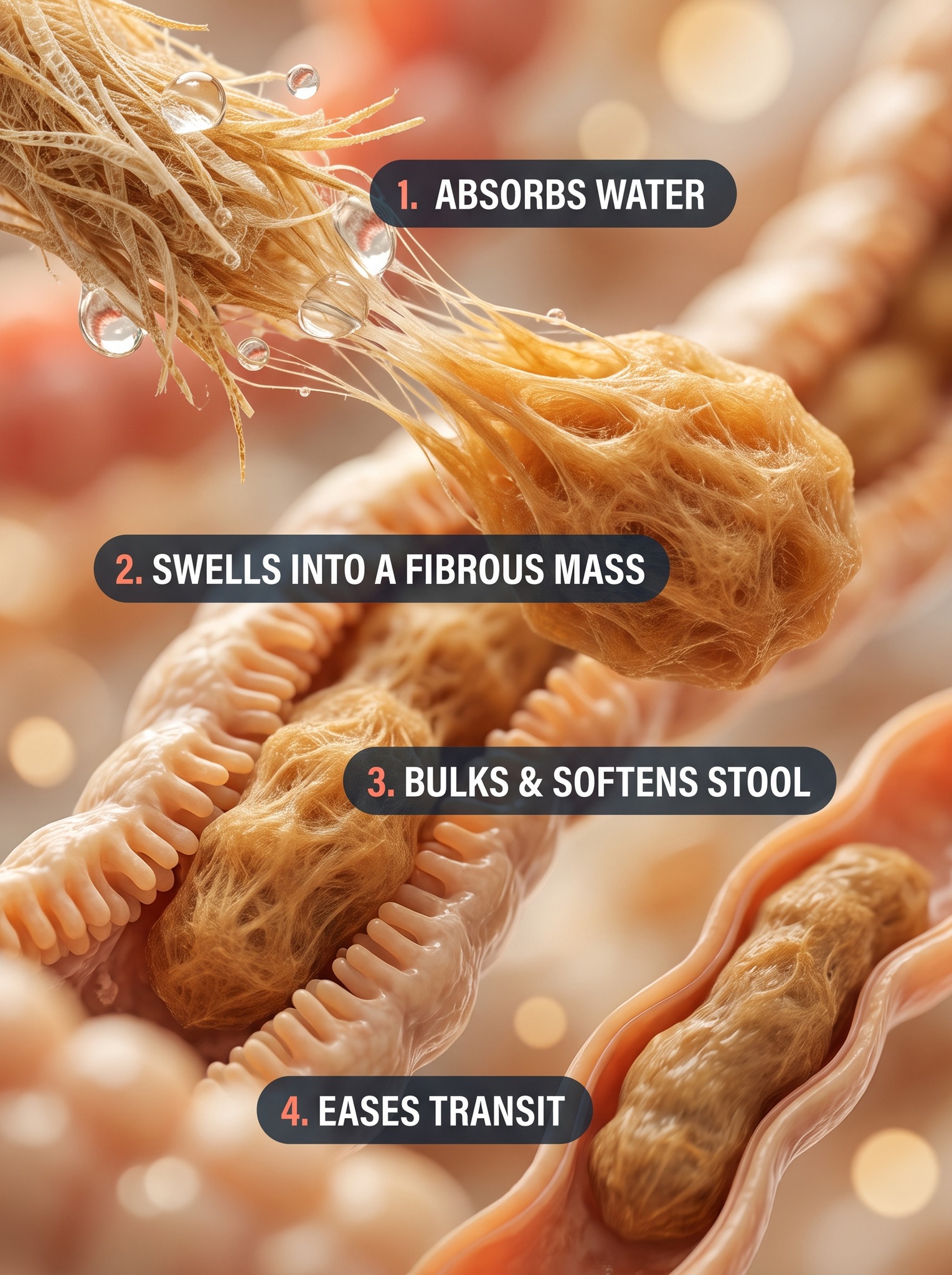
First, the fiber absorbs water in the small intestine. Second, it swells into that fibrous gel. Third, the gel adds soft, even bulk to stool and holds water inside the colon, which is why it can soften hard stool in IBS-C and firm up loose stool in IBS-D at the same time. Fourth, and this is the part most people never hear, psyllium is only lightly fermented by gut bacteria, so it does all of this with much less gas than short-chain, highly fermentable fibers like inulin or oligosaccharides.
STUDY In a crossover trial, psyllium increased colonic gas volume far less than inulin did, and combining psyllium with inulin reduced the gas response instead of adding to it. Gunn et al., 2022, Psyllium reduces inulin-induced colonic gas production in IBS, Gut.
In practice, this is the difference patients notice almost immediately. Switch someone from wheat bran or an inulin-based blend to psyllium, and the same fiber-related bloating that sent them looking for help in the first place usually eases within a matter of days.
Does psyllium for IBS work the same in IBS-C and IBS-D?
Yes, and that surprises most people who assume fiber only treats constipation. Psyllium's gel is water-holding in both directions: in IBS-C it softens and lubricates hard, sluggish stool, and in IBS-D it absorbs excess liquid and firms up loose stool, all without triggering the gas that highly fermentable fibers cause.
| IBS-C (constipation) | IBS-D (diarrhea) |
|---|---|
| The gel adds water-holding bulk that softens hard stool and shortens colonic transit time. | The same gel binds excess water in the colon, firming loose stool without hard blocking. |
| Works alongside your normal fluid intake, since the fiber needs water to do its job. | Keeps urgency steady, even where highly fermentable fibers like inulin tend to make it worse. |
| Backed by the largest trial base and most guideline recommendations for this subtype. | Fewer IBS-D-specific trials exist, but the mechanism supports it and it is commonly recommended. |
My gastroenterologist told me to try psyllium for my IBS-C, but I'm nervous because every fiber supplement I've tried before made my bloating so much worse within a day. Is psyllium going to do the same thing, or is it actually different?
Fair worry, and a common one. Most fiber that backfires fast is highly fermentable, like inulin or chicory root, so gut bacteria ferment it quickly and produce a lot of gas. Psyllium ferments far more slowly than those fibers, so it mainly holds water and adds bulk, producing much less gas along the way. Start at a small dose with a full glass of water and build up slowly over a week or two. Most people who reacted badly to other fibers find psyllium sits much more comfortably for IBS-C, as long as the dose ramps up gradually.
Which IBS pattern is actually yours?
IBSyncrasy walks through the real case patterns behind constipation-predominant and diarrhea-predominant IBS, and exactly where fiber fits into each one.
Buy IBSyncrasyHow do you start psyllium without the bloating everyone warns about?
Nearly all of the bloating blamed on psyllium traces back to two mistakes: too much fiber on day one, and too little water to carry it. Fix the dose and the water, and most of that reaction disappears within a few days.
- Start at about a teaspoon, roughly 3 to 4 grams, once a day, not the full label dose.
- Take it with a full glass of water, around 240ml, every single time.
- Increase gradually over one to two weeks until you reach your target dose.
- Spread the dose across two smaller servings instead of one large one.
- Take it consistently every day, not just on your worst symptom days.
- Give it a full two to four week trial before deciding whether it is working.
- Separate it from other medications by at least two hours, since the gel can slow their absorption.
- Choose plain husk or powder over flavored, sweetened blends if your gut is sensitive.
The bloating and gas that show up in the first few days are usually just the dose catching up with itself, something that settles quickly once the amount and water intake line up.
In my own practice, dose is by far the most common culprit. Patients start at the full label amount on day one, skip the water, and decide within 48 hours that psyllium disagrees with them. Cut the starting dose in half, double the water, and that reaction usually clears up within days.
Symptom relief with psyllium climbs over the first two months
Bijkerk et al. 2009, BMJ. Percentage of primary-care IBS patients reporting adequate symptom relief, n=275.
STUDY In a primary-care trial, 57% of patients on psyllium reported adequate symptom relief after one month compared with 35% on placebo, and the gap held through month two. Bijkerk et al., 2009, Soluble or insoluble fibre in irritable bowel syndrome in primary care, BMJ.
What does it mean when psyllium only gets you partway?
Fiber type matters more than fiber amount, and that cuts both ways. It is entirely possible to have too much of the wrong fiber and still end up with IBS symptoms, even on what looks like a healthy diet.
The right fiber mattered more than the amount, every time.
One of our own case studies shows the mirror image of everything above. A 23-year-old on a naturally high-fiber vegan diet developed severe bloating and loose stool after years of antibiotic use had thinned out her fiber-fermenting gut bacteria. The fiber she was eating was a highly fermentable plant type, landing on a microbiome too depleted to keep up with it, and that mismatch between fiber type and gut capacity produced the gas and pain.
If you have already tried psyllium correctly, low dose, full water, several weeks, and your symptoms are still stuck where they started, that result is genuinely useful information. It usually points to something underneath the fiber question: a motility problem like a sluggish migrating motor complex, or a deeper dysbiosis that needs its own sequence of fixes so fiber can finally do its job.
I bought psyllium capsules two weeks ago because a friend said they helped her IBS. I've been taking six capsules with my morning coffee, and honestly my stomach feels worse than before I started. Could psyllium capsules simply be the wrong choice for my gut?
Worth checking two things first: the coffee and the all-at-once dose. Caffeine speeds up gut transit, so pairing it with a fiber that needs time and water to swell properly can leave psyllium racing through faster than it can absorb liquid. Six capsules at once is also a big jump, and capsules alone give you far less water than a powder mixed into a full glass. Try splitting the dose to two or three capsules, twice a day, away from coffee, each with a full glass of water. Most people who feel worse on psyllium capsules improve once the timing and water catch up with the dose.
If timing and dosing fixes still leave you stuck, it is worth finding out what is really driving your symptoms.
Book an appointmentThe bottom line on fiber, IBS, and what actually helps
Psyllium for IBS is one of the few pieces of gut health advice with real, replicated trial data behind it. It works because of what it specifically is, a moderately fermented, gel-forming soluble fiber, and that specificity is the entire point. Start low, drink enough water, give it a few weeks, and it earns its place as a first, well-tested step. When it only gets you partway, that result is worth investigating on its own terms.
Still guessing which fix is actually yours?
Fiber helps most people some of the way. IBSyncrasy shows you the rest, case by case, using the same method behind these case studies.
Frequently asked questions
Briefly, yes, if you start too fast. A day or two of extra gas or bloating is common when the dose outpaces the water you are drinking with it. Cutting the starting dose and increasing water intake usually resolves this within a few days, and true intolerance to psyllium itself is uncommon.
Yes, for most people. Psyllium works as a gentle, bulk-forming fiber, a mechanical action very different from stimulant laxatives, so daily long-term use is standard and well-supported in the research. The main precautions are drinking enough water and separating it from other medications by a couple of hours, since it can slow their absorption.
No. The warning some people see refers to trace lead levels required on California's Proposition 65 labels, a threshold set far below any level shown to cause harm. The actual research on psyllium points toward digestive and metabolic benefits, backed by decades of clinical trials and reputable brands that are third-party tested.
The active fiber is the same. Metamucil is a branded psyllium husk product, and many versions include added sugar or artificial sweetener for flavor. Plain psyllium husk or powder gives you that same fiber in its simplest form, which matters if your gut reacts to added sweeteners.