Pseudomonas intestinal infection: what a high result actually means
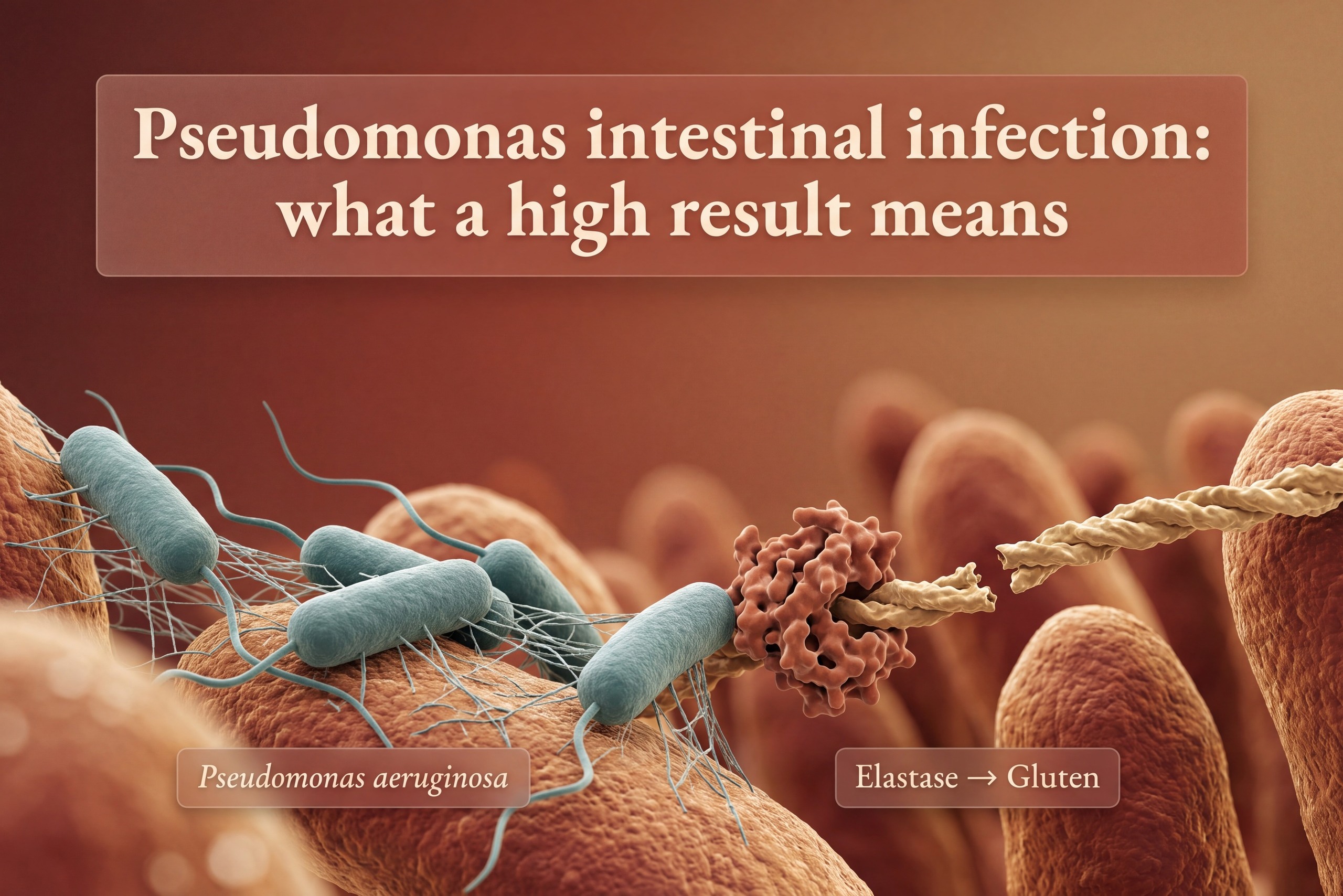
Pseudomonas aeruginosa is turning up more often on stool and duodenal testing in people with IBS. It is not always a fleeting visitor: this bacterium can colonize the small intestine, produce its own histamine, and even make gluten harder to digest through its own elastase enzyme. Here is what a high result actually means, and what it takes to bring it down.
How often does a pseudomonas intestinal infection turn up in IBS testing?
A pseudomonas intestinal infection is turning up far more often than most people expect once you actually test for it, especially in the small intestine of people with IBS. Molecular testing that samples both the duodenum and stool consistently finds Pseudomonas aeruginosa at levels many times higher in IBS patients than in healthy volunteers.
The most detailed look came from a Dutch team that collected duodenal mucosal brushings and stool from the same patients, then measured Pseudomonas aeruginosa with quantitative PCR in both sample types. The difference between IBS patients and healthy controls was not subtle.
STUDY In duodenal samples, P. aeruginosa reached 8.3% of clones in IBS patients against just 0.1% in healthy subjects. Stool told the same story, at 2.34% versus 0.003%. Kerckhoffs et al., 2011, Molecular analysis of faecal and duodenal samples reveals significantly higher prevalence and numbers of Pseudomonas aeruginosa in irritable bowel syndrome, Journal of Medical Microbiology.
Pseudomonas aeruginosa colonization, IBS vs healthy
Bar heights use a log scale for visibility given the wide range between groups (0.003% to 8.3%). Labels show the exact published percentages. Kerckhoffs et al., 2011, J Med Microbiol.
A separate Indian cohort found the same pattern from a different angle: P. aeruginosa showed up in nearly every IBS stool sample tested, compared with only a third of healthy controls. Two different labs, two different measurement methods, and the same conclusion. This bacterium is not a rare finding in IBS. It is closer to the rule than the exception, and it prefers the small intestine over the colon most other gut bacteria call home.
If a stool PCR panel is what brought you here, this companion analysis of a high Pseudomonas stool result breaks down exactly how to read a raised Pseudomonas marker on that kind of test.
How do you get pseudomonas bacteria in the gut in the first place?
You get pseudomonas bacteria in the gut mainly through two conditions arriving together: reduced stomach acid, and everyday exposure to the bacterium itself. On its own, stomach acid kills most Pseudomonas aeruginosa long before it reaches the small intestine.
Proton pump inhibitors change that equation. By suppressing acid production, PPIs remove the single biggest barrier this species has to crossing into the duodenum, and case histories in my own practice show this pattern repeatedly: a PPI course precedes the onset of small intestinal symptoms far more often than coincidence would explain.
Pseudomonas aeruginosa is common in soil and water, and pets are one of its most frequent household reservoirs. Dogs and cats can carry it in their ears and mouths without any obvious illness, then pass it on through ordinary daily contact. Once it reaches a gut with lowered acid defenses, it does not need much of a foothold to establish itself in the duodenum, well ahead of the large intestine most people picture when they think about gut bacteria.
Why does a Pseudomonas aeruginosa infection cause so many different symptoms?
A Pseudomonas aeruginosa infection causes such a wide symptom picture because the bacterium is not doing just one thing. It signals through histamine, breaks gluten down in a way that mimics celiac disease, and leaks LPS straight into a gut lining it has already started to loosen. Most patients get a mix of all three.
It produces its own histamine, and reacts to yours too
Pseudomonas aeruginosa carries histidine decarboxylase, the enzyme class that converts the amino acid histidine into histamine, and laboratory work has confirmed the bacterium genuinely produces histamine on its own, not just in theory. That histamine does not simply sit there. It acts on the same H1 and H2 receptors your own mast cells use to signal the gut, with H1 activation driving smooth muscle contraction and pain, and H2 activation ramping up gastric acid secretion and secretory diarrhea. Histamine also feeds back onto the bacterium's own chemoreceptors and pulls more Pseudomonas toward the source, the same TlpQ receptor system described in chemotaxis studies of this pathogen, which strengthens biofilm formation and makes the infection harder to clear.
Its elastase turns gluten into a problem, celiac or not
Pseudomonas aeruginosa secretes an elastase enzyme called LasB, and when this enzyme meets gluten in the duodenum, it cuts the protein into fragments your immune system was never built to ignore.
STUDY Duodenal Pseudomonas aeruginosa isolated from celiac patients degraded gluten through elastase activity into peptides that activated gluten-specific T cells from those same patients, while duodenal Lactobacillus from healthy controls broke the resulting peptides down further and reduced their immunogenicity. Caminero et al., 2016, Duodenal bacteria from patients with celiac disease and healthy subjects distinctly affect gluten breakdown and immunogenicity, Gastroenterology.
Pseudomonas can make gluten behave as if it triggers celiac disease, producing the same low-grade duodenal inflammation in someone whose celiac panel comes back completely clean.
It releases LPS and loosens the gut lining
As Pseudomonas aeruginosa numbers climb in the duodenum, its outer membrane sheds lipopolysaccharide, LPS, directly into the gut lumen. LPS binds to immune receptors on the intestinal wall and triggers an inflammatory response that loosens the tight junctions between epithelial cells, part of the same barrier-and-biofilm biology reviewed across this bacterium's broader infection profile. Once that barrier loosens, water and electrolytes move less predictably across it, which is a big part of why diarrhea, cramping, and irregular bowel habits show up together so often in these cases.
I have a problem with gluten, but no matter how many tests I've had, celiac disease has never been proven — not by duodenal biopsy, not by antibodies. So why does it still bother me? When I stop eating it, the bloating disappears.
Here's the twist: your tests are probably right, and your gut lining may be perfectly healthy. A Pseudomonas aeruginosa infection can cause this without damaging a single villus. Its elastase enzyme chops gluten into small fragments that look suspicious to your immune system — even though your own enzymes handle gluten just fine. Those fragments are then presented to the immune cells sitting in the lamina propria, which react as if gluten were an invader. No celiac required. Stop the gluten, the fragments stop, the bloating disappears — exactly your pattern. Treat the bacterium, and gluten often becomes tolerable again.
Which IBS symptoms actually track with a high Pseudomonas result?
Gluten trouble with perfect biopsies? There's a chapter for that
The Pseudomonas chapter in IBSyncrasy shows exactly how bacterial elastase rewrites gluten tolerance — and the protocol that fixes it. Buy IBSyncrasyThe symptoms that actually track with a high Pseudomonas result are rarely random. Once you can see the mechanism behind each one, the pattern usually makes sense fast.
Here is how the main complaints reported around a Pseudomonas-driven small intestinal infection map onto the biology above.
| Symptom | Why Pseudomonas causes it |
|---|---|
| Post-meal stomach discomfort | Duodenal colonization sits exactly where digestion begins, and reacts soon after eating |
| Bloating and burping | Fermentation byproducts, mainly ammonia and methane, from the bacterium's own metabolism |
| Gluten sensitivity, celiac panel negative | Elastase-modified gluten peptides trigger inflammation without celiac antibodies |
| Loose stools or diarrhea | LPS release loosens tight junctions and speeds up transit |
| Abdominal cramping or pain | Bacterial histamine acting on H1 receptors in gut smooth muscle |
| Fatigue | Chronic low-grade inflammation combined with nutrient malabsorption |
Not every symptom needs to be present for the pattern to be real. Many patients notice two or three of these clusters together rather than the full list, which is exactly what you would expect from a bacterium sitting mostly in the duodenum rather than spread evenly through the whole gut.
How often is Pseudomonas the dominant organism in small intestinal overgrowth?
Pseudomonas turns out to be the single most common organism recovered when small intestinal bacterial overgrowth is cultured directly from duodenal aspirate, rather than inferred from a breath test.
STUDY A 2025 Bangladeshi cohort cultured duodenal aspirate from 104 IBS patients and found SIBO in just over a third of them. Among the SIBO-positive samples, Pseudomonas was the most frequently isolated species, recovered in 78.9% of cases, ahead of every other organism identified. Alam et al., 2025, Small intestinal bacterial overgrowth in irritable bowel syndrome: frequency and microbiological insights from duodenal aspirate analysis, Fortune Journal of Health Sciences.
Most frequent organism in SIBO-positive IBS patients
Icon count rounded to the nearest whole icon out of 10. Exact published figure shown in val. Alam et al., 2025, Fortune Journal of Health Sciences.
That is worth sitting with. When clinicians actually go looking inside the small intestine instead of relying on indirect breath testing, Pseudomonas is not one option among many. It is usually the organism doing most of the damage.
What a real pseudomonas-predominant IBS case looked like in my clinic
A real pseudomonas-predominant IBS case usually starts the way Aspa's did: years of vague bloating that nobody connected to a specific cause, until targeted testing finally pointed at the small intestine instead of the colon.
Aspa came to me at 56, with a history that included more than 30 antibiotic courses for tonsillitis before she turned 12, and abdominal symptoms that had been quietly present since her teenage years. A short course of a proton pump inhibitor a few weeks before her symptoms sharpened was the detail that pointed me toward the duodenum rather than the colon.
Aspa, 56, mother of two
Two pregnancies delivered by C-section, over 20 kg gained in her second pregnancy, and a childhood marked by recurrent tonsillitis treated with more than 30 antibiotic courses before age 12. Bloating and constipation had been present since her teens but were dismissed as unremarkable.
A PPI course opened the door
A proton pump inhibitor prescribed weeks before her symptoms intensified lowered the stomach acid that would normally have kept Pseudomonas aeruginosa out of the small intestine. Regular contact with a family pet was the likely environmental source.
Colonization over 25 times baseline
16S rRNA stool testing recovered Pseudomonas aeruginosa at more than 25 times the baseline reading, alongside elevated eosinophil activation (EPX), elevated secretory IgA, and signs of probiotic sterility consistent with disrupted fermentation.
A two-part depletion and repair protocol
Treatment followed a dual principle: deplete the Pseudomonas population while repairing the duodenal damage the chronic low-grade inflammation had already caused. Antimicrobial dosing was paired with a 16-hour fasting window so the small intestine could genuinely rest, across a two-part schedule spanning several months.
Regular, urgency-free days within weeks
Within the first week, urgency and bloating had already eased. By two months she was tolerating a wider range of meals, including raw vegetables, with regular bowel movements, minimal gas, and noticeably higher energy.
In my experience, cases like this respond to a blend of antimicrobial agents given over enough weeks to matter, timed around a fasting window so the small intestine gets real rest between doses, paired with a strict gluten-free and very low sugar diet, and supported by targeted supplements that help repair small intestinal function while the bacterial load comes down. A single antibiotic course, rifaximin included, is rarely enough on its own to hold that result.
A stool test that flags Pseudomonas is not a diagnosis on its own. It is a clue that points toward the small intestine, not the colon.
See the full Pseudomonas chapter
Aspa's full case, and the treatment protocol behind it, has its own dedicated chapter in IBSyncrasy. Buy IBSyncrasyWhy a resistant pseudomonas infection rarely clears in one round of antibiotics
A resistant pseudomonas infection rarely clears in one round of antibiotics because this bacterium is unusually good at surviving them, in the gut just as much as in a hospital ward.
A 2023 Chinese surveillance study cultured Pseudomonas aeruginosa from stool in both ICU patients and healthy adults across ten provinces. Intestinal carriage was already more than twice as common in ICU patients, and carbapenem-resistant strains made up a much larger share of those isolates too.
Intestinal Pseudomonas aeruginosa, ICU vs healthy adults
Bar heights scaled proportionally to the largest value in the chart. Labels show exact published percentages. Hu et al., 2023, One Health Advances.
STUDY Among 2,605 fecal samples, intestinal Pseudomonas aeruginosa carriage reached 10.28% in ICU inpatients versus 3.99% in healthy individuals, and carbapenem-resistant strains made up 32.2% of ICU isolates versus 7.41% among healthy carriers. Hu et al., 2023, A comparative study of intestinal Pseudomonas aeruginosa in healthy individuals and ICU inpatients, One Health Advances.
Biofilm is a big part of why. Once Pseudomonas aeruginosa settles into a protected matrix on the gut lining, antibiotics struggle to penetrate that structure at all, which is exactly why a single short course so often reduces symptoms for a few weeks and then lets them creep back.
How can you get rid of Pseudomonas aeruginosa in the gut?
You get rid of Pseudomonas aeruginosa in the gut by treating it as a small intestinal infection with its own rhythm, not a generic dysbiosis problem you can fix with one supplement or one prescription.
The antimicrobial side works best as a blend rather than a single agent, run long enough to outlast the bacterium's biofilm defenses, and structured around meal timing rather than fought against it. The small intestine has its own housekeeping wave, the migrating motor complex, that sweeps debris and bacteria toward the colon between meals — and this guide to the migrating motor complex explains how that wave works and why constant grazing shuts it down.
Diet does real work here too. Gluten-free removes the substrate that elastase turns into an inflammatory trigger, and cutting refined sugar starves the fermentation that Pseudomonas and its neighbors both feed on. Very low sugar, not just lower, is the version that tends to move the needle.
Because Pseudomonas favors the duodenum, the small intestine usually needs direct support while the bacterial load comes down: targeted enzyme and mucosal-repair support for the segment that took the damage, rather than general probiotics aimed mainly at the colon.
When does a Pseudomonas aeruginosa infection turn into something more serious?
A Pseudomonas aeruginosa infection turns into something more serious when the bacterium moves out of the gastrointestinal tract altogether, most often through the bloodstream in someone whose immune defenses are already compromised.
The intestinal tract is considered the single most important reservoir for this translocation. Once this gram-negative organism crosses into the bloodstream, it can reach the urinary tract, catheters and central lines, the respiratory tract, even the eyes and skin, and in people with cystic fibrosis it is already one of the best documented respiratory pathogens there is. In hospital settings it ranks among the most common nosocomial pathogens, and antibiotic resistance is exactly why a hospital-acquired case can turn life-threatening so quickly.
STUDY Among 47 ICU episodes of Pseudomonas aeruginosa bacteremia, overall mortality reached 58.8%, with mechanical ventilation and ICU hospitalization among the strongest predictors of death. Vitkauskienė et al., 2010, Pseudomonas aeruginosa bacteremia: resistance to antibiotics, risk factors, and patient mortality, Medicina.
The risk factors that matter most
Immunocompromised hosts carry the highest risk by a wide margin, particularly people undergoing chemotherapy with chemotherapy-induced neutropenia, anyone with an indwelling catheter or central line, and patients already admitted to an intensive care unit. Further immunocompromise from any of these factors turns a small intestinal infection into a genuine morbidity and mortality concern rather than an IBS symptom pattern. For someone in good health with a normal immune system, gut inflammation from the same bacterium usually stays exactly where testing found it, in the small intestine, without turning into an abscess or a bloodstream emergency.
The bottom line on treating a Pseudomonas aeruginosa infection
The bottom line here is straightforward: a single high number on a stool or duodenal test matters, but it rarely tells the whole story on its own.
This bacterium behaves less like background dysbiosis and more like a small intestinal infection with its own biology: it makes its own histamine, it can turn gluten into a problem independent of celiac disease, and it protects itself with biofilm well enough that one antibiotic course usually is not the end of the story. Treating it properly means combining the right antimicrobial approach with the right diet and the right window of rest for the small intestine to actually heal.
If a pseudomonas intestinal infection is what your latest test turned up, that result is a starting point for a specific, fixable plan, not a life sentence.
Ready to treat your pseudomonas-predominant IBS?
IBSyncrasy has a full chapter on identifying and treating Pseudomonas aeruginosa overgrowth, built from real cases like Aspa's.
Frequently asked questions
Not in the way a cold or flu spreads person to person. Pseudomonas aeruginosa is common in soil, water, and pets, so household members can share the same environmental source without one person directly infecting another. What actually determines whether it establishes itself in the gut is stomach acid: low acid, often from PPI use, is what lets it settle in the small intestine.
Mild colonization can fluctuate on its own, but a level like the more than 25-fold rise seen in confirmed small intestinal cases rarely resolves without addressing the acid suppression or motility issue that let it establish itself in the first place.
Not automatically. The number matters less on its own than how it lines up with symptoms and other markers, such as elevated calprotectin, EPX, or secretory IgA. A high result with no symptoms and clean inflammatory markers is a different picture than the same number alongside bloating, gluten sensitivity, and post-meal discomfort.
Gluten and refined sugar are the two biggest dietary drivers. Gluten gives the bacterium's elastase enzyme a substrate to turn into inflammatory peptides, and refined sugar fuels the fermentation that lets Pseudomonas and related organisms overgrow.