Kill Proteus mirabilis naturally with real gut repair
Recurrent Proteus mirabilis UTIs are rarely bad luck. This bacterium keeps a quiet reservoir in your gut, and clearing the bladder with antibiotics alone leaves that reservoir untouched. Here is what actually reduces it, and in what order.
Killing Proteus mirabilis naturally starts with knowing why it keeps coming back
Killing Proteus mirabilis naturally means combining targeted natural remedies, like uva ursi and oregano oil, with targeted probiotics and gut mucosal repair, since an antibiotic aimed only at the urinary tract rarely stops UTIs caused by this organism for good. If you have already run one or two rounds of antibiotics and the UTI came back within weeks, that pattern itself is the clue.
Most natural remedy guides for a UTI treat the bladder as the whole story. For Proteus mirabilis specifically, that framing misses the part that actually explains recurrent UTIs. This bacterium is a normal, low-level resident of the human gut, and it only becomes a repeat problem when something lets it expand there. Clear the bladder without touching that gut population, and reinfection follows on its own schedule, no matter how many antibiotics are used to treat each flare.
The rest of this article works through the actual mechanisms behind UTI symptoms, the specific natural and herbal medicine compounds with published activity against Proteus mirabilis, and the order that gets the best results for UTI prevention in practice.
Why your gut is the real reservoir behind repeat Proteus mirabilis infections
Your gut is the real reservoir because Proteus mirabilis lives there as a low-level resident even in healthy people, and it can reseed the bladder long after a course of antibiotics has cleared an acute urinary tract infection. This pattern is exactly what a recurrent, bacterial Proteus mirabilis diagnosis usually reflects, and it shows up more often in people with specific risk factors, including diabetes, catheter use, kidney anatomy variations, and a history of repeated UTIs.
STUDY Proteus species typically colonize the human gut in combinations of P. vulgaris, P. mirabilis, and P. penneri, and the gut is recognized as the reservoir for this genus even though most research has focused on urinary tract disease rather than intestinal effects. Armbruster et al., 2018, Proteus spp. as Putative Gastrointestinal Pathogens, Clinical Microbiology Reviews.
STUDY In a longitudinal, multi-center cohort of patients with antibiotic-resistant UTIs, gut colonization by the same uropathogen tracked closely with whether the infection came back. Choi et al., 2024, Gut microbiome correlates of recurrent urinary tract infection: a longitudinal, multi-center study, EClinicalMedicine.
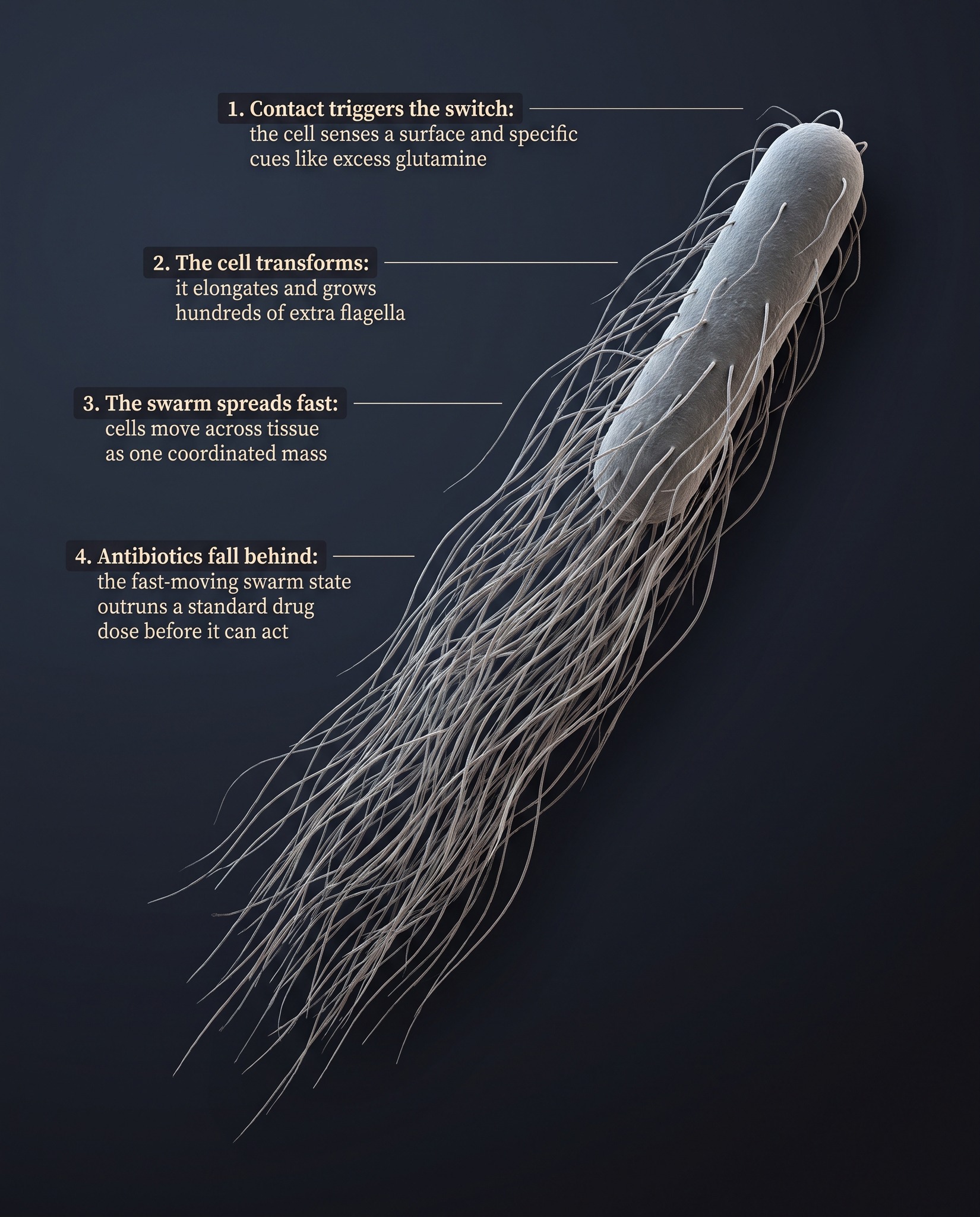
- Swarming
- The coordinated, rapid movement of a bacterial population across a surface. To swarm, Proteus mirabilis cells elongate dramatically and grow hundreds of extra flagella, switching from a short, slow-moving cell into a fast-moving, highly motile one.
Swarming spreads this pathogen quickly across the gut lining and the bladder wall, and swarm cells are measurably harder to clear with a standard antibiotic dose than the resting form, which is a major reason a single course so often falls short.
Its notorious ability to resist multiple antibiotics and to form urinary tract stones makes its treatment a long and painful process.
Other Proteus strains that act the same way
Proteus mirabilis causes most human infections, and two close relatives in the same genus share its swarming behavior. A Clinical Microbiology Reviews analysis names the other species that regularly colonize the human gut and cause disease.
Five specific mechanisms explain why Proteus mirabilis symptoms feel disproportionate
Five specific mechanisms explain the disproportionate symptoms, because Proteus mirabilis actively reshapes the gut and bladder environment around it. Each one below is a separate, published virulence factor behind these UTIs, and most patients are dealing with more than one at the same time.
Urease and ammonia
A potent urease enzyme splits urea into ammonia, which raises tissue pH, irritates the lining, and encourages the struvite crystals behind kidney stones and other urinary stones.
Swarming and biofilm
Swarm cells spread quickly across tissue and then build sticky biofilm communities that physically block antibiotics and immune cells from reaching the bacteria underneath.
Adhesins
MR/P fimbriae work like tiny grappling hooks, letting the bacterium latch onto the gut and urinary tract lining, resist being flushed out, and keep local inflammation simmering.
Toxins and LPS
Hemolysin punches holes in host cell membranes, while LPS from the bacterial surface triggers cytokine release, turning ordinary bloating or discomfort into pain that feels out of proportion, and left unaddressed can progress toward pyelonephritis, a kidney infection that needs prompt care.
Histamine release
Tissue damage and LPS provoke mast cells into releasing histamine, which adds urgency, burning, and pain sensitivity, especially in people who already react strongly to histamine.
I've had three UTIs with Proteus mirabilis in the last eight months, and each time the antibiotic works for a few weeks and then it's back. My urologist says my anatomy is normal. Could something in my gut actually be causing this?
That pattern, symptom-free for a few weeks and then back again, is a genuinely common Proteus mirabilis signature, and it points straight at the gut. This bacterium sits quietly there between UTIs, and each round of antibiotics clears the bladder without touching that reservoir. Clearing Proteus mirabilis naturally starts in the gut, well before the next prescription.
Find the reservoir behind the flare-up
IBSyncrasy walks through exactly how to test for and reduce a gut Proteus mirabilis population, step by step. Buy IBSyncrasyL-glutamine is the one supplement that can quietly fuel Proteus mirabilis swarming
L-glutamine is the one supplement that can quietly fuel Proteus mirabilis swarming, because this organism uses excess glutamine as a direct chemical signal to switch into its fast-moving, more resistant form.
STUDY Proteus mirabilis catheter-associated isolates initiate swarming in response to specific cues present in urine, and excess L-glutamine was identified as a required trigger for that switch. Armbruster et al., 2013, Initiation of Swarming Motility by Proteus mirabilis Occurs in Response to Specific Cues Present in Urine and Requires Excess L-Glutamine, Journal of Bacteriology.
STUDY Glutamine acts as a specific chemoattractant that initiates the cell differentiation behind Proteus mirabilis swarming, one of the earliest demonstrations of this mechanism. Allison et al., 1993, Cell differentiation of Proteus mirabilis is initiated by glutamine, a specific chemoattractant for swarming cells, Molecular Microbiology.
Most glutamine taken as a supplement is absorbed in small amounts, and the remainder travels on through the gut, exactly where a resident Proteus mirabilis population can put it to use.
None of this makes glutamine harmful on its own. It remains a well-studied, genuinely useful nutrient for gut lining repair in most people. The distinction that matters here is simple: pair it with an active Proteus mirabilis population, and the same nutrient that would normally support healing becomes fuel for the organism you are trying to reduce.
The drinks and compounds you need to kill Proteus mirabilis naturally
Uva ursi tea, also called bearberry, is the strongest single drink to reach for. A clinical isolate study found it has direct antibacterial activity against Proteus mirabilis, and it works best in exactly the alkaline urine this bacterium creates. Most cranberry products and cranberry extract capsules work through a different route, blocking the fimbriae E. coli uses to grip the bladder wall, with an older reputation partly resting on hippuric acid production, and Proteus mirabilis attaches with a different set of adhesins, so cranberry alone tends to underperform here even though it remains a useful remedy against other uropathogens.
A handful of other natural compounds used to treat Proteus mirabilis have real published activity, both in gut and in urinary tract contexts. In vitro work shows oregano oil achieving low inhibitory concentrations against Proteus mirabilis alongside effects on its swarming motility, and garlic extract helps inhibit its growth and biofilm formation. Among natural UTI treatment options and treatments for UTIs more broadly, this pair covers both prevention and treatment better than any single antimicrobial used alone. The table below lines these up next to the pharmaceutical antibiotics most often used for the same infection.
| Natural antimicrobials | Pharmaceutical antibiotics |
|---|---|
| Uva ursi / bearberry (arbutin), active against Proteus mirabilis and other Gram-negative uropathogens under alkaline conditions | Trimethoprim-sulfamethoxazole, a common first-line oral option |
| Oregano oil (carvacrol, thymol), disrupts bacterial membranes and affects swarming motility | Amoxicillin-clavulanate, covers many resistant strains |
| Garlic extract (allicin), helps inhibit growth and biofilm formation | Ciprofloxacin, used for more complicated infections |
| Berberine, broad antibacterial and anti-adhesive activity against uropathogens | Ceftriaxone, typically reserved for severe or resistant cases |
| Medical-grade manuka honey, reduces biofilm viability and blocks early attachment | Fosfomycin, a single-dose option for uncomplicated cases |
I keep reading that cranberry juice helps with UTIs, but every time I've tried it during a Proteus mirabilis flare it hasn't done anything. Am I doing something wrong, or does cranberry just not work against this specific bacteria?
Cranberry's mechanism explains the gap. It mainly works by stopping E. coli from gripping that lining, and Proteus mirabilis attaches with a completely different set of fimbriae, so cranberry alone often falls short here. Uva ursi and a handful of other compounds have stronger published evidence against Proteus mirabilis specifically, and pairing the right natural agent with gut-level support outperforms cranberry used alone.
How probiotics help you manage a Proteus mirabilis infection long-term
Probiotics help manage Proteus mirabilis long-term by competing for the same gut space and nutrients this organism relies on, which may help prevent the reservoir from rebuilding. Strain choice matters more than usual here, because probiotics vary widely in how well they fit the pattern behind these UTIs.
Some lactobacillus strains produce histamine themselves, which can add to the burning, urgency, and pain sensitivity that Proteus mirabilis already causes through its own histamine-releasing effect. Favoring bifidobacteria, or specific lactobacillus strains with published low-histamine profiles, avoids stacking two histamine sources on top of each other. If histamine-type symptoms flare after starting a new probiotic, pausing and switching strains is the practical next step.
The order that actually clears Proteus mirabilis for good
The order matters as much as the individual choices, because layering everything at once tends to work worse than running these five steps in sequence, giving the gut lining time to recover between rounds. Steps that reduce UTI frequency work best from the start, and that consistency is what lowers UTI occurrence over time.
- 1
Targeted antimicrobials
Start with the natural or pharmaceutical agents that match your case, chosen against confirmed testing results.
- 2
Targeted probiotics
Introduce low-histamine strains once the antimicrobial phase has reduced the bacterial load, to limit recolonization.
- 3
Abstain from glutamine and provoking food factors
Remove excess L-glutamine and other triggers that hand Proteus mirabilis the fuel it needs to swarm.
- 4
Optimize the gut mucosa
Rebuild the lining itself once the population is under control, so the environment stops favoring regrowth.
- 5
Run at least three treatment cycles
Repeat the sequence, since biofilm and antibiotic resistance mean single-round eradication is uncommon.
This mirrors the Proteus-predominant IBS case study: recurrent gut and urinary symptoms traced to the same swarming pathogen, resolved once a single protocol combined antimicrobial, probiotic, and mucosal-repair steps in the right order, as documented in a full case study on Proteus-predominant IBS.
Once you can see whether Proteus mirabilis is sitting in the gut, the urinary tract, or both, the five steps above turn from a general plan into a specific one. That specificity, treating and preventing at the same time, is what it takes to kill Proteus mirabilis naturally.
Ready to stop treating Proteus mirabilis one flare-up at a time?
IBSyncrasy maps the full protocol, testing, natural and pharmaceutical antimicrobials, probiotics, and mucosal repair, in the exact order that gets results.
Frequently asked questions
In mild, early cases some people reduce Proteus mirabilis with a targeted natural antimicrobial and gut repair alone. Once it is established and recurring, most cases respond best to a combined approach that pairs a natural antimicrobial or an antibiotic with probiotics and mucosal repair, run over several cycles.
Most cases need a window of about three months to meaningfully calm repeated UTIs and restore normal flora, typically across three separate treatment cycles for a stubborn UTI.
It is the same organism, and the gut is usually the reservoir behind it. Treating the urinary symptoms alone, without addressing the gut population, is a common reason UTIs from Proteus mirabilis keep recurring.
Uva ursi tea is the strongest option, since published research shows it directly inhibits Proteus mirabilis in alkaline urine, which is exactly the environment this bacterium creates. Cranberry juice works differently and mainly targets E. coli, so it tends to underperform here on its own. Pairing uva ursi with an oregano oil supplement covers more ground, since the two work through separate mechanisms.