Homocysteine levels in autism signal a methylation problem
An elevated homocysteine result in a child with autism reaches further than a routine cardiovascular checkup. The same MTHFR variant that can show up on a parent's own blood panel connects directly to a child's methylation cycle, creatine synthesis and folate transport.
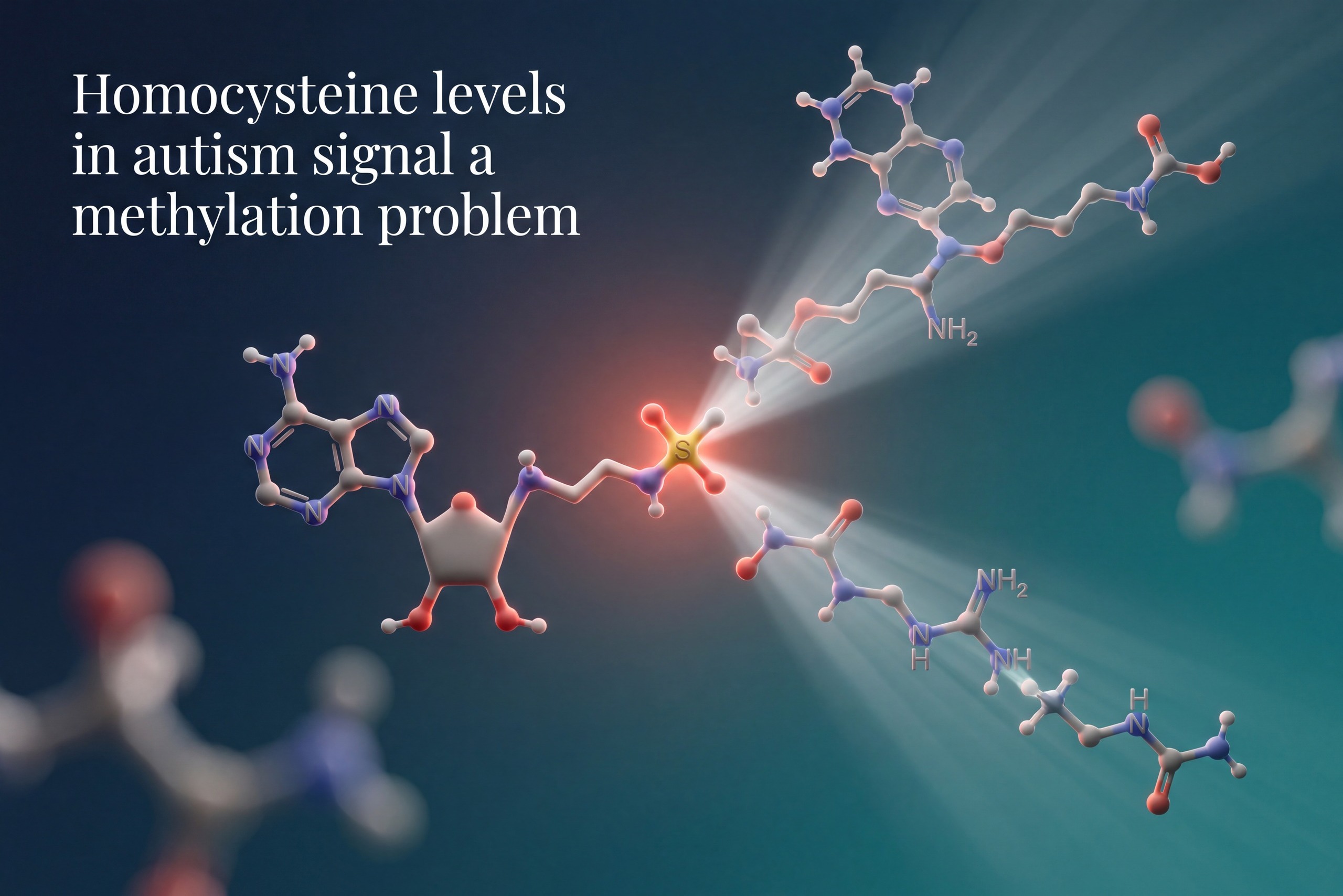
What does an elevated homocysteine result mean for your child?
Homocysteine is the byproduct made every time a cell spends S-adenosylmethionine, known as SAM, its main methylation currency. Every methyl transfer the body runs, from DNA repair to neurotransmitter production, leaves homocysteine behind as leftover waste inside normal homocysteine metabolism. In general medicine, a persistently high result is an established marker linked to endothelial strain and occlusive vascular disease, the reason a cardiologist orders it for an adult patient.
Pediatric reference ranges exist because high homocysteine levels at that age rarely come from decades of arterial wear. The single most common driver behind elevated homocysteine levels is a variant in the MTHFR gene, the enzyme responsible for recycling homocysteine back into usable methyl groups. MTHFR is also one of the findings clinicians look for once developmental delay and autism show up on the same chart. When the enzyme runs slow, the number on the page climbs regardless of how carefully the child eats.
So before comparing that result to anything cardiovascular, it helps to trace where it actually points.
Homocysteine levels in autism research go beyond cardiology
Homocysteine functions as a candidate diagnostic biomarker for autism spectrum disorder in its own right. A 2022 review in Frontiers in Molecular Neuroscience found a positive, linear (yes, linear) relationship between serum homocysteine and the likelihood of an autism spectrum disorder diagnosis. That relationship showed no plateau at the high end.
The same analysis reported strong discriminatory power. Homocysteine separated children with autism spectrum disorder from typically developing peers with 77% sensitivity and 89% specificity, at a cutoff of 6.69 micromoles per liter. In other words, researchers could tell with adequate confedence, which child is autistic and which isn't.
DIAGNOSTIC ANALYSIS Serum homocysteine distinguished children with ASD from typically developing children with an AUC of 0.899, 77% sensitivity and 89% specificity. Li et al., 2022, Interrelation between homocysteine metabolism and the development of autism spectrum disorder in children, Frontiers in Molecular Neuroscience.
CROSS-SECTIONAL STUDY Hyperhomocysteinemia was found in 13.4% of children with autism spectrum disorder, compared with 3.8% of controls. Gulati et al., 2024, Transmethylation and oxidative biomarkers in children with autism spectrum disorder, Journal of Autism and Developmental Disorders.
How closely does homocysteine track with autism severity?
The relationship also tracks with severity. Children with severe autism spectrum disorder showed higher median homocysteine levels, 8.24 micromoles per liter, than children with mild to moderate presentations, at 7.1 micromoles per liter.
Median homocysteine by autism severity
Median serum homocysteine by severity group, p=0.005. Li et al., 2022. Frontiers in Molecular Neuroscience.
That dose-response pattern points to a real mechanism. A 2009 study found that an MTHFR mutation raised homocysteine levels in children with ASD even when folate and vitamin B12 status looked normal on paper. The effect held independent of dietary intake.
MTHFR MTHFR gene variants were associated with elevated homocysteine in children with autism spectrum disorder independent of folate and B12 status. Pasca et al., 2009, One carbon metabolism disturbances and the C677T MTHFR gene polymorphism in children with autism spectrum disorders, Journal of Cellular and Molecular Medicine.
How an MTHFR mutation links a parent's blood panel to a child's homocysteine levels
MTHFR comes in two common variants that matter here, C677T and A1298C, and both are heritable, passed down at conception. A child who inherited an MTHFR mutation from each parent, or two copies of the same variant, carries a mechanism already in place. That mechanism predates diet, supplements or anything a parent did during pregnancy.
What C677T and A1298C actually do to the enzyme
The C677T variant makes the MTHFR enzyme thermolabile, meaning it loses folding stability (takes a less active form) at body temperature. In the homozygous form, enzyme activity drops to roughly 30% of normal, a steep enough cut that homocysteine recycling slows even with adequate folate on board.
A1298C produces a milder reduction on its own, though the two variants compound each other when a child carries both. Either MTHFR mutation is common enough in children with ASD that many clinics now check genotype alongside homocysteine metabolism as a matter of routine.
Two parents can hold the identical TT result on their own routine blood panel and walk away with opposite conclusions. One files it as a footnote from a physical exam. The other asks a single follow-up question, whether the same variant could be sitting in their child's genome too, and that question is often the one worth asking.
How creatine synthesis raises homocysteine levels
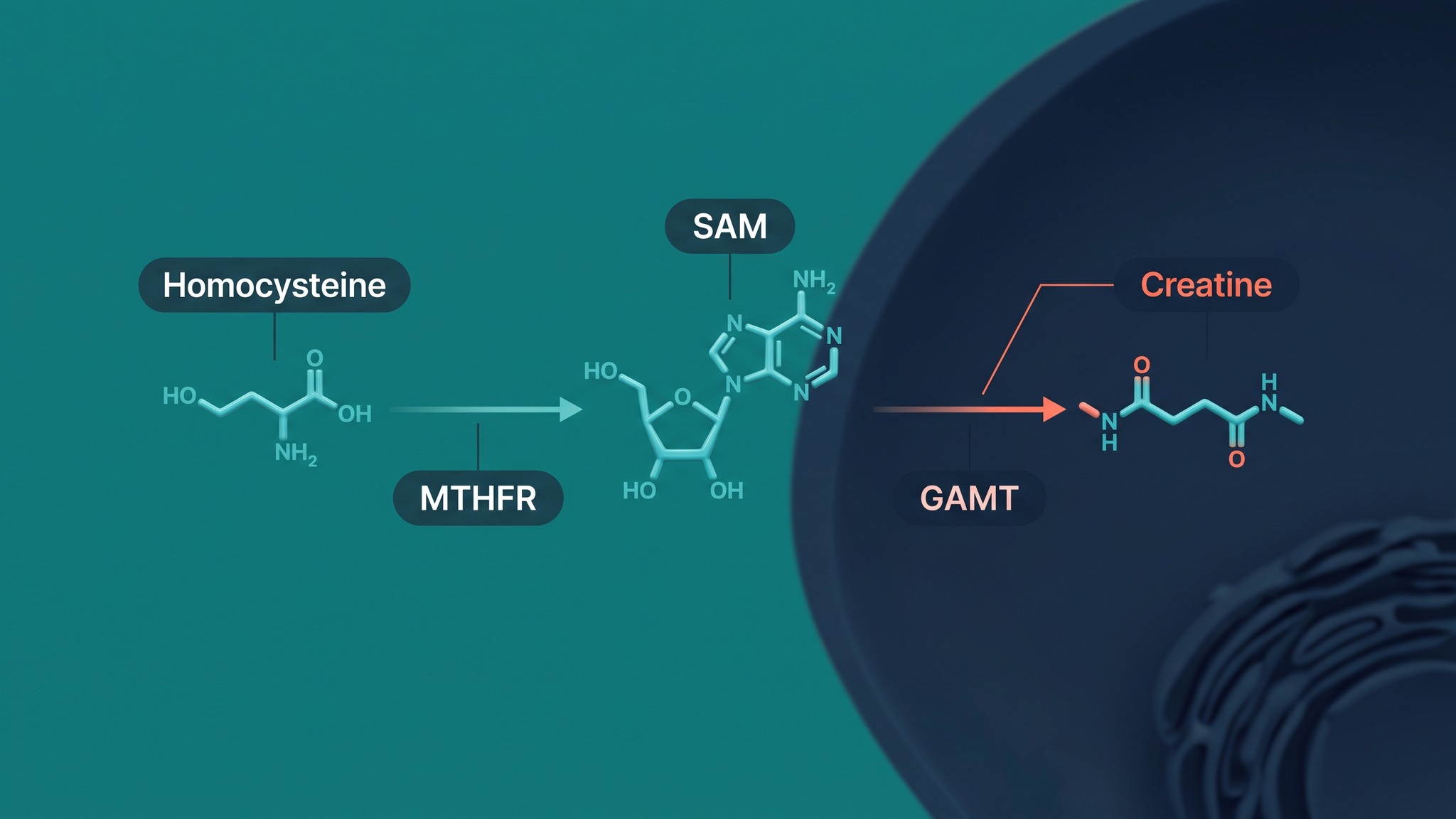
Creatine synthesis is a rarely-checked pathway that raises elevated homocysteine levels, and it belongs near the top of the list. Producing creatine from scratch runs through the enzyme GAMT, which pulls a methyl group directly from SAM, the same molecule the body needs to keep homocysteine levels in check. Research on creatine and autism rarely mentions this link, even though the biochemistry sits right underneath it.
The scale of that demand is larger than you would expect. Creatine synthesis accounts for approximately >40% of all the labile methyl groups SAM provides across the body. That single pathway competes directly with methylation reactions everywhere else, homocysteine clearance included. The same competing demand shows up in why a child's brain can run short on creatine in autism.
METHYL BUDGET Creatine synthesis accounts for approximately 40% of all the labile methyl groups provided by SAM in the body. Brosnan, da Silva and Brosnan, 2011, The metabolic burden of creatine synthesis, Amino Acids.

See how this same pathway plays out for your child
Autism and Learning: First time Every time walks through methylation, creatine and the biochemistry behind consistent skill-building, step by step. Buy the bookWhy this matters more if your remethylation pathway is already struggling
Dietary creatine intake feeds back on this system directly. When creatine arrives from food or a supplement, it suppresses AGAT, the first enzyme in the body's own synthesis chain. The body then simply stops manufacturing as much on its own.
That feedback loop is established, decades-old biochemistry. For a child whose MTHFR-driven remethylation is already running slow, the ongoing demand to manufacture creatine internally adds pressure to a system that is already behind. The same strain shows up in creatine deficiency and autism.
The clinical picture on homocysteine specifically is still catching up to the mechanism. A low-dose creatine trial lowered plasma guanidinoacetate, the AGAT product, exactly as the feedback model predicts, without a statistically significant drop in homocysteine itself in that particular sample. The biochemistry is sound, and the direct clinical signal is still being built study by study.
Why the FRAT test matters alongside MTHFR and creatine
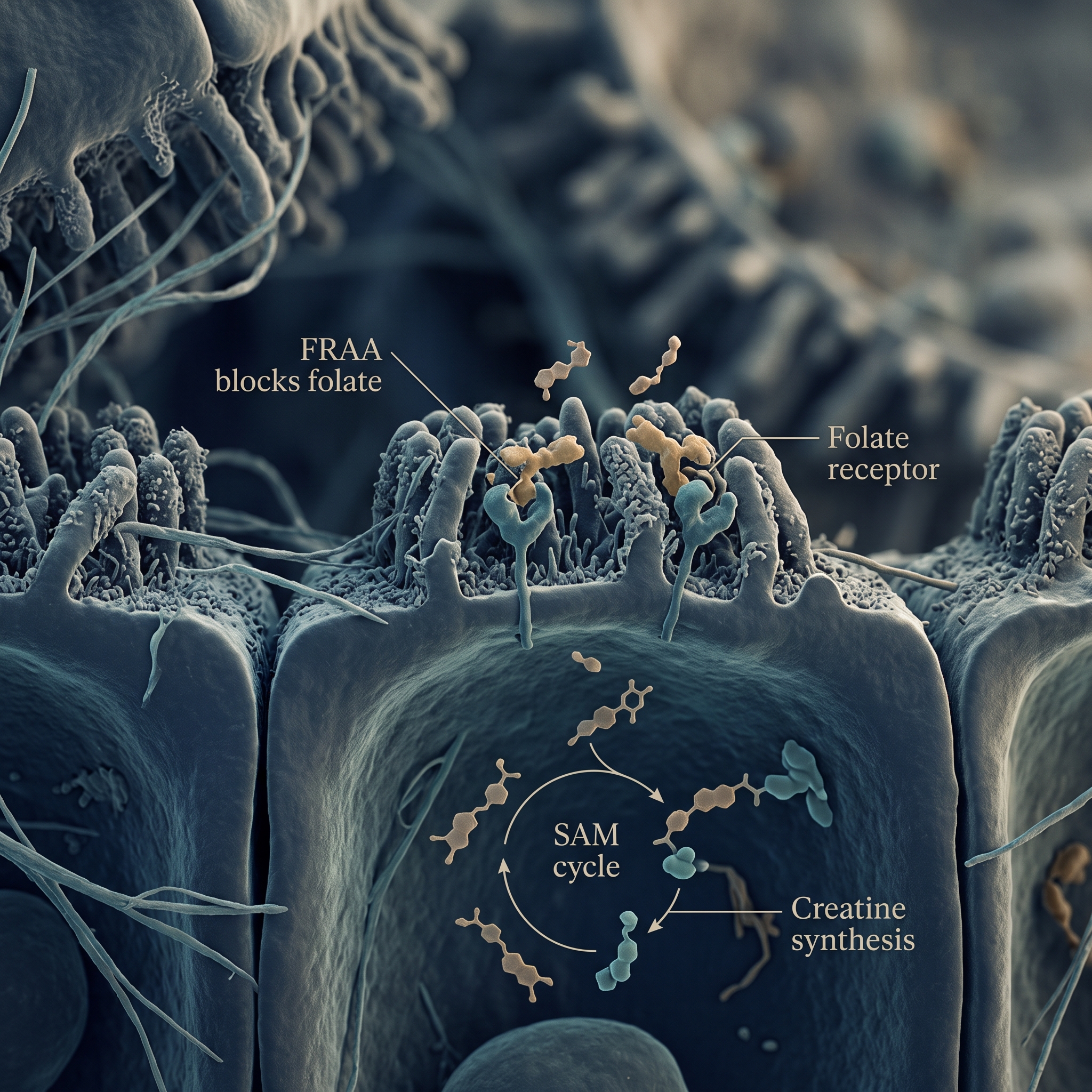
The Folate Receptor Autoantibody Test, known as the FRAT test, checks for antibodies that block folate receptor alpha, the transporter that carries folate across the blood-brain barrier. When those antibodies are present, folate intake and folate delivery to the brain stop being the same thing. This is a different question from a simple folate and vitamin B12 blood panel. It explains why B vitamin supplementation works best once the transport problem is addressed directly. That blind spot turns up often in children with ASD.
We found that there was a very high prevalence of FRAAs in the blood of children with autism and that some had low levels of folate in their central nervous system, just like the kids with CFD.
If folate receptor autoantibodies are blocking that door, folate passes through the gut without ever reaching the brain in the amount the methylation cycle needs. Folate receptor autoantibodies turn up across whole families, parents and unaffected siblings included, which is part of why the parent's own panel matters here too.
Folinic acid reaches the brain through a separate route entirely, bypassing that blocked door. A randomized trial found it improved verbal communication by 5.7 standardized points overall, and by 7.3 points in children who tested positive for folate receptor autoantibodies.
RANDOMIZED TRIAL Twelve weeks of folinic acid improved verbal communication by 5.7 standardized points overall, with a larger 7.3-point effect in folate receptor autoantibody-positive children. Frye et al., 2018, Folinic acid improves verbal communication in children with autism and language impairment, Molecular Psychiatry.
MTHFR slows the recycling side of the cycle. Creatine synthesis pulls a large share of the methyl supply toward a different job. Folate receptor autoantibodies can choke off new folate at the door. Three separate mechanisms, one shared bottleneck.
How to use MTHFR, creatine and FRAT test results together
None of this requires guessing. AGAT feedback inhibition is established, decades-old biochemistry, the part of this story that needs no further proof. Applying it specifically to MTHFR-positive parents and their autistic children is the open frontier, and that is exactly where the opportunity sits. Most published work on creatine and autism still treats the two as loosely connected footnotes, seldom naming the shared methyl-group mechanism.
A parent's own MTHFR mutation result, a child's homocysteine levels and creatine status, folate and vitamin B12 markers, and a folate receptor autoantibody screen often sit on the same lab requisition. Each one arrives as a separate line item. Read together, they describe one methylation system under a specific, nameable strain in children with ASD, the same logic behind why creatine may help autistic people. B vitamin supplementation, an MTHFR-informed dose of creatine, and a FRAT test turn research on creatine and autism into a practical checklist for one child.
The same GAMT-to-SAM link shows up again in how methyl B12 supports skill recovery after developmental regression, where the SAM-to-SAH ratio tracks directly with clinical improvement.
In practice, checking MTHFR genotype, creatine status and the FRAT test together could provide better insights into the child's methylation adequacy.
Turn three lab findings into one clear next step
Autism and Learning: First time Every time connects MTHFR, creatine and folate transport into a single practical pathway, so a parent's own labs and a child's biochemistry finally point the same direction.
Frequently asked questions
An MTHFR mutation, especially C677T or A1298C, is common enough in the general population that many parents carry one without knowing it. Research has linked these variants to elevated homocysteine levels specifically in children with ASD, independent of folate and vitamin B12 intake.
Yes. A 2022 review found a positive, linear relationship between serum homocysteine and the likelihood of an autism spectrum disorder diagnosis, with homocysteine separating ASD from typically developing children at 89% specificity.
Methylcobalamin, known as methyl B12, has the most direct trial evidence among B vitamin supplementation options studied in autism spectrum disorder. A randomized placebo-controlled trial found greater clinician-rated improvement with methyl B12 than placebo, and the response tracked with a better SAM-to-SAH ratio, the same methylation balance that connects folate and vitamin B12 to homocysteine levels.