Fibermaxxing and daily fiber intake for a sensitive gut
Why the same fiber that soothes one IBS subtype can inflate another, and how thickness and fermentation decide the outcome.
What is fibermaxxing and why did it go viral?
Fibermaxxing means eating the most fiber you can, often 40 grams a day or more, and for most adults it pays off. If your stomach answers with gas, cramps or harder stools, though, your body is giving you useful information. Some fibers suit your colon and others irritate it. So the real skill is picking the right ones. And because most people start from very little fiber, the trend begins from a real gap.
The trend on social media took off in 2025 as a friendly answer to restrictive diets. You eat more fiber through chia, beans, oats, psyllium drinks and fiber-rich smoothies, and you cut nothing. It also promises better gut health with food you already know. Meanwhile, the average American adult eats about 15 grams a day, while guidelines ask for 25 to 38. In fact, only around 5% of Americans reach that target.
Fiber is good for most people. Still, the trend treats every fiber as the same nutrient, and that is where a sensitive colon runs into trouble. A spoon of bran and a spoon of psyllium behave like two different foods once they reach your bacteria.
- Fiber maxxing (the trend)
- Eating the most fiber possible every day, usually well above the 25 to 38 grams that guidelines suggest, from whole foods, seeds and powders. It targets the fiber gap, yet it treats all fiber types as equal.
Is all dietary fiber the same?
Dietary fiber is the family of plant carbohydrates that pass your own enzymes untouched, and its members act very differently. Some thicken water into a soft paste. Others pass through almost unchanged, and some become fast food for colon bacteria. Beans, oats and berries all count as high-fiber foods, yet each one lands differently in the colon.
Soluble vs insoluble fiber is only half the map
The classic split sorts fibers by whether they dissolve in water. Soluble fiber dissolves and includes oat beta-glucan, psyllium and the pectin in fruits and vegetables. Insoluble fiber, such as wheat bran and the skins of nuts and seeds, stays intact and adds bulk. However, two soluble fibers can feel completely different in the same person, so this split predicts symptoms poorly.
Viscosity and fermentability decide your symptoms
Two other properties matter more in practice. Viscosity is how thick a fiber makes the fluid around it. Fermentability is how quickly colon bacteria break it down and release gas. For example, psyllium is highly viscous and barely fermented, so it holds water and softens stools with little gas. Inulin, by contrast, dissolves thin and ferments within hours.
Resistant starch sits in between. It is starch that escapes breakdown in the small intestine, found in green bananas, cooled potatoes and cooked-then-cooled brown rice. It ferments slowly, so it feeds bacteria with a gentler gas curve.
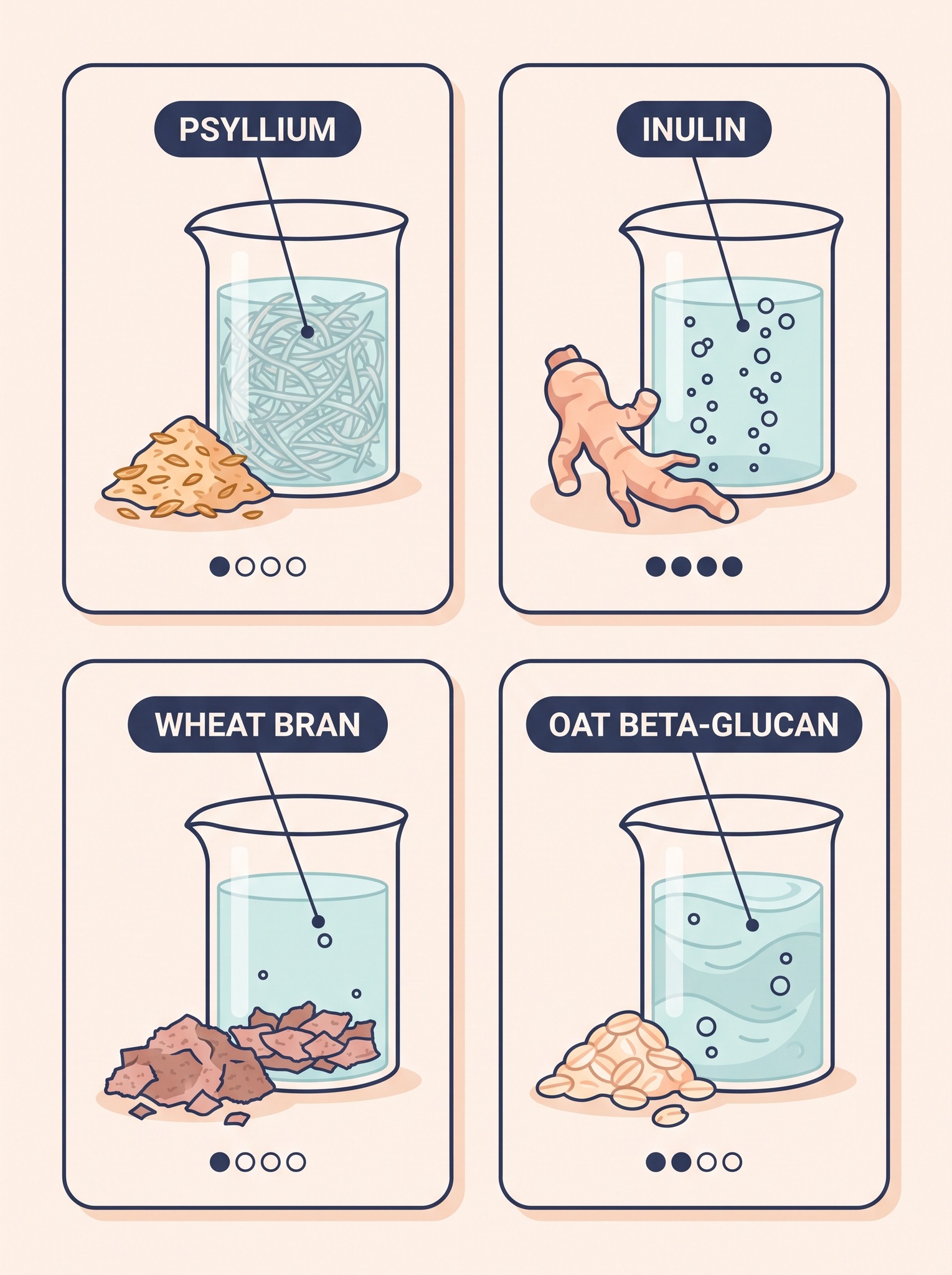
| Fiber and main sources | How it behaves in the colon |
|---|---|
| Psyllium husk (supplement) | Very viscous, low fermentation. Softens hard stools, firms loose ones, little gas. |
| Oat beta-glucan (oats, barley) | Viscous, moderately fermented. Lowers LDL cholesterol and slows glucose spikes after meals. |
| Inulin and FOS (chicory, onion, garlic, wheat) | Thin and fast fermenting. Strong prebiotic effect, with the most gas in IBS. |
| Wheat bran (whole grains cereals) | Insoluble, slowly fermented. Speeds transit in healthy people, often raises pain in IBS. |
| Resistant starch (cooled potatoes, green bananas) | Non-viscous, slow fermentation. A main fuel for butyrate-producing bacteria. |
| PHGG (partially hydrolyzed guar gum) | Low viscosity, slow and gentle fermentation. Usually well tolerated in IBS. |
Why does more fiber cause gas and pain?
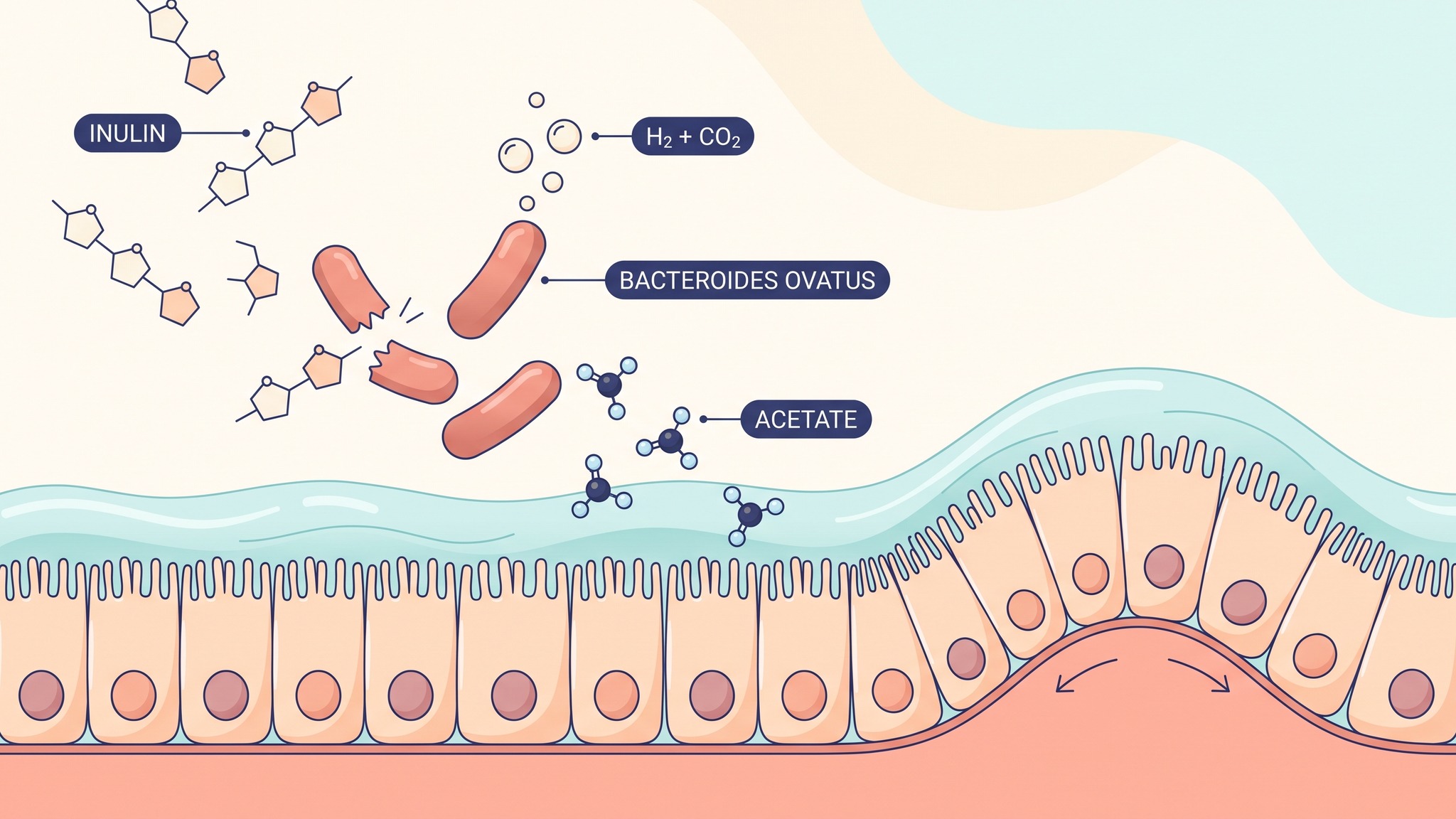
Fiber can cause bloating because colon bacteria ferment it and release hydrogen, carbon dioxide and, in some people, methane. The faster a fiber ferments and the bigger the jump in dose, the more gas builds up at once. So a sudden fiber overload can make you bloat. The digestive discomfort, cramps and tight waistband then show up two to four hours after a meal.
How colon bacteria turn fiber into gas
Bacteria split long fiber chains into sugars and ferment them for energy. The by-products are short-chain fatty acids, which feed the colon lining, and gases, which have to leave somewhere. In a 2022 MRI study from Nottingham, inulin sharply raised colonic gas in people with IBS. Adding psyllium to the same dose cut the breath hydrogen rise from 7,230 to 1,035 ppm-hours, and gas volume fell close to placebo.
STUDY In 19 people with IBS, psyllium taken together with inulin brought colonic gas down to placebo level and cut the peak breath hydrogen rise about sevenfold. Gunn et al., 2022, Psyllium reduces inulin-induced colonic gas production in IBS: MRI and in vitro fermentation studies, Gut.
Why a sensitive colon feels normal gas as pain
Pain depends on how the colon reads the gas. In a 2017 crossover trial with MRI, people with IBS and healthy volunteers made similar amounts of colonic gas after inulin. Yet 13 of 29 IBS patients developed symptoms, because their colon sensed the same stretch as pain. Doctors call this visceral hypersensitivity, meaning the nerves in the bowel wall fire at a lower threshold.
A 2026 trial from King's College London fits the same picture. When 41 adults with functional bloating took fructans or galacto-oligosaccharides for a week, roughly one in five reacted. Those who reacted already had more symptoms and a larger waist girth at the start. Also, if bloating persists even on low fiber, look at the other causes of abdominal bloating.
Why does the same fiber help one IBS subtype and hurt another?
Loading up on fiber helps or hurts depending on your IBS subtype. Each subtype has a different problem with water, speed and gas. A meta-analysis published this August in Gastroenterology pooled 16 trials with 1,293 patients. Overall, 52% responded to fiber and 44% to control. Psyllium raised the chance of response by 53%, while wheat bran did no better than control.
That study is only weeks old, and it answers a question many people ask after a failed bran experiment. So if bran did nothing for you, the fault lies with the fiber type. The four types of IBS explain why the same spoon lands so differently.
Psyllium beats wheat bran for IBS relief
Staudacher et al., Gastroenterology, online August 2026. RR = relative chance of clinical response vs control, higher is better. Reference line at RR 1.0.
Fiber supplementation, and psyllium specifically, leads to clinical response in IBS.
STUDY Across 16 randomized trials, psyllium raised the chance of clinical response in IBS by 53%, while wheat bran showed no benefit. Staudacher et al., 2026, Fiber supplementation in irritable bowel syndrome: a systematic review and meta-analysis of randomized controlled trials, Gastroenterology.
IBS-C and the psyllium vs bran split
In IBS-C, psyllium forms a thick, water-holding mass that softens hard stools and helps them move. Bran works differently. Its coarse particles irritate the lining and trigger water and mucus secretion, and a hypersensitive colon often reads that as cramping. For this reason, the American College of Gastroenterology recommends soluble fiber for IBS and advises against insoluble types.
IBS-C with methane (IMO)
Some people with IBS-C carry large numbers of methane-producing microbes, a pattern called intestinal methanogen overgrowth (IMO). These archaea, mainly Methanobrevibacter smithii, turn the hydrogen from fiber fermentation into methane. Methane itself slows the intestine. So for this group, more fermentable fiber means more fuel for methane and a slower colon.
STUDY Methane infused into the small intestine slowed transit by an average of 59% in an animal model, and methane-producing IBS patients showed higher contractile activity. Pimentel et al., 2006, Methane, a gas produced by enteric bacteria, slows intestinal transit and augments small intestinal contractile activity, American Journal of Physiology.
IBS-M, the subtype that changes week to week
Mixed IBS swings between hard and loose stools, sometimes within the same week. A fiber that firms loose stools on Monday can leave you blocked by Friday. Therefore, a low, steady dose of a viscous fiber such as psyllium or PHGG tends to work better than a big fermentable load. It buffers both extremes.
IBS-D and psyllium for diarrhea
Psyllium for diarrhea sounds odd, yet it works through the same water-binding effect. The thick matrix holds excess water in the colon, so loose stools firm up and urgency eases. Fast fermenters do the opposite in IBS-D. Their gas and acids pull water into the colon and speed things up. The vegan IBS case on this site shows a 23-year-old on a plant-rich diet. Her diarrhea settled only after her antibiotic-damaged bacteria were rebuilt.
I have IBS-D and started psyllium husk two months ago. For two weeks my stools were finally normal, but now they're sticky again and I get bloated every evening, even though I haven't changed the dose. Why did it stop working?
It happens a lot. Psyllium stays the same, but everything around it can shift. If you added oats, chia or a fibermaxxing smoothie along the way, the fermentable load went up and evening gas followed. Sticky stools also hint that fat or bile acids aren't absorbed well, and that needs its own check. So first look at what else changed on your plate. If nothing did, the pattern points to something underneath, like an overgrowth or a shift in your bacteria, and that's worth testing.
Which fiber fits your IBS subtype?
IBSyncrasy follows real patients through each IBS subtype and shows where psyllium, PHGG or a lighter fermentable load changed the outcome, case by case.
Buy IBSyncrasyWhich fibers are low in FODMAPs?
Low FODMAP fibers are the ones that feed bacteria slowly. Examples include psyllium, PHGG, oats, kiwifruit, small portions of chia and the resistant starch in cooled rice. FODMAPs are short-chain carbohydrates that ferment fast and pull water into the intestine. As a result, high-FODMAP fibers like inulin, FOS and GOS produce the most gas in IBS.
The practical trick is swapping, and it keeps your fiber intake up without the gas. PHGG is guar gum cut into shorter chains. It dissolves thin and ferments gently, and in a randomized placebo-controlled trial it eased IBS symptoms. Many fiber supplements, however, are built on chicory inulin, so the label matters more than the brand.
Gentler, low FODMAP fibers
- Psyllium husk, 1 to 2 teaspoons in a full glass of water
- PHGG, which dissolves in any drink
- Rolled oats, up to half a cup
- Kiwifruit, small portions of chia, cooled rice or potatoes
Fast fermenters, high FODMAP
- Inulin and chicory root fiber in bars and powders
- FOS and GOS from onion, garlic and wheat
- Beans, lentils and chickpeas in large portions
- Apples, pears and dried fruit in big servings
When does more fiber make constipation worse?
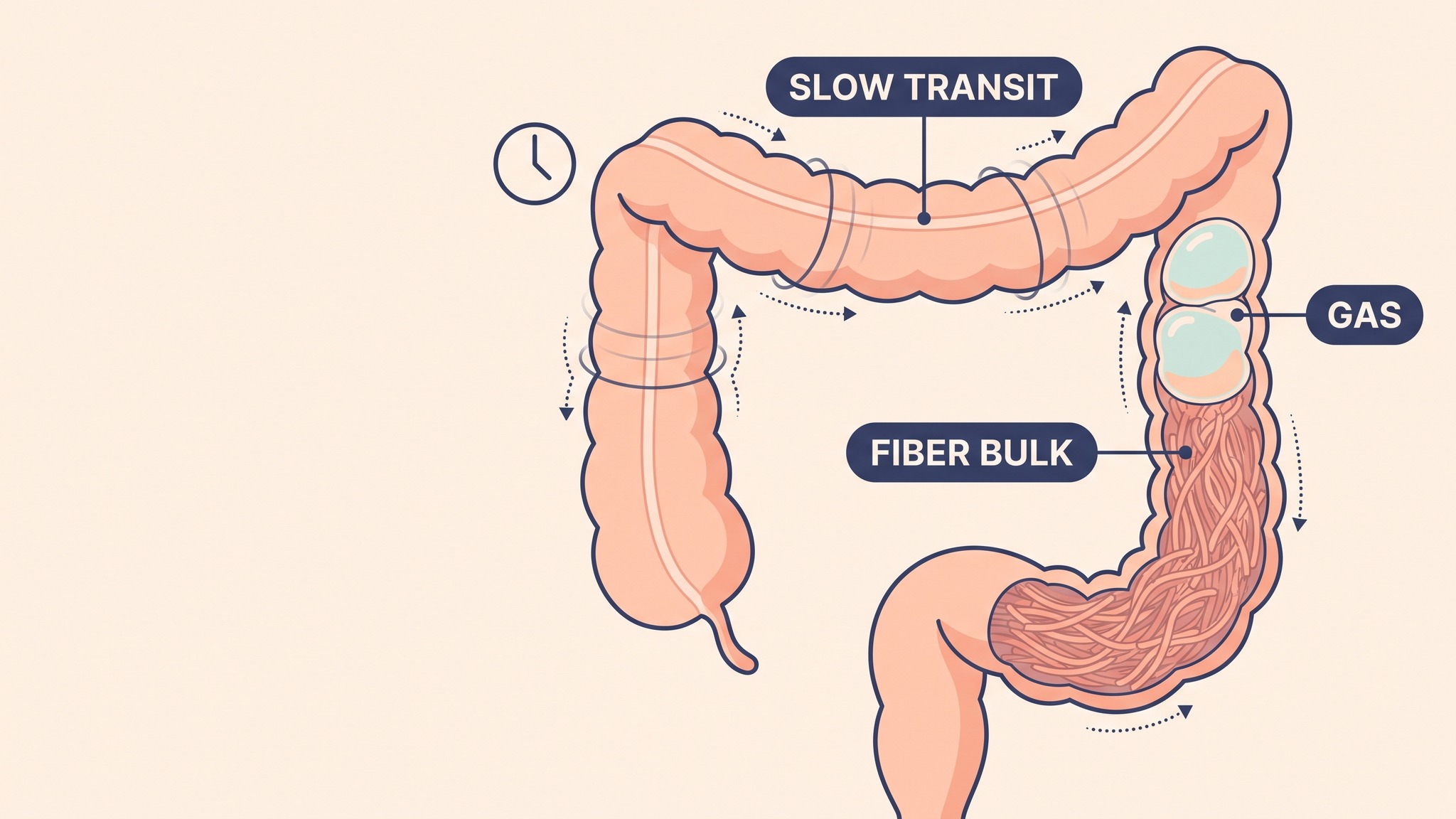
More fiber backfires when the colon itself moves slowly, a pattern called slow transit. Fiber adds bulk to stool, and that bulk helps only if the colon muscle can push it along. In a German study of 149 patients taking psyllium seed, only 20% of those with slow transit improved. Meanwhile, 85% of patients with normal test results improved or became symptom-free.
Slow transit and the fiber trap
In slow transit, the colon's contractions are weak or infrequent. Extra fiber then sits longer, ferments longer and makes more gas. So you end up both blocked and bloated. Drink plenty of water with any fiber, since viscous fibers without enough fluid can thicken into a plug. In rare cases, dry psyllium swallowed with too little water has caused a blockage in the esophagus or intestine.
Medications that slow your transit
Several common drugs slow the colon and turn a normal fiber dose into a problem. If you take any of these, a big jump in fiber can deepen the slowdown.
I've been on amitriptyline for a year and I've always been a bit slow. After seeing fiber videos online I went up to about 40 grams a day with chia and bran. Now I only go every four days and my stomach feels like a brick. Should I keep pushing through?
Ease off for now. Amitriptyline slows the colon, and 40 grams of chia and bran hands that slow colon a heavy load. That's why it feels like a brick. Fibermaxxing assumes more bulk means more movement, which holds only when the muscle keeps up. Scale back to your old amount, keep water high, and swap the bran for a small dose of psyllium. If you still go every few days after that, a transit check makes sense before adding anything else.
Going every few days despite more fiber? We can map your transit, your medications and your bacteria, and find the fiber your colon can use.
Book an appointmentWhat does your colon gain when fiber fits?
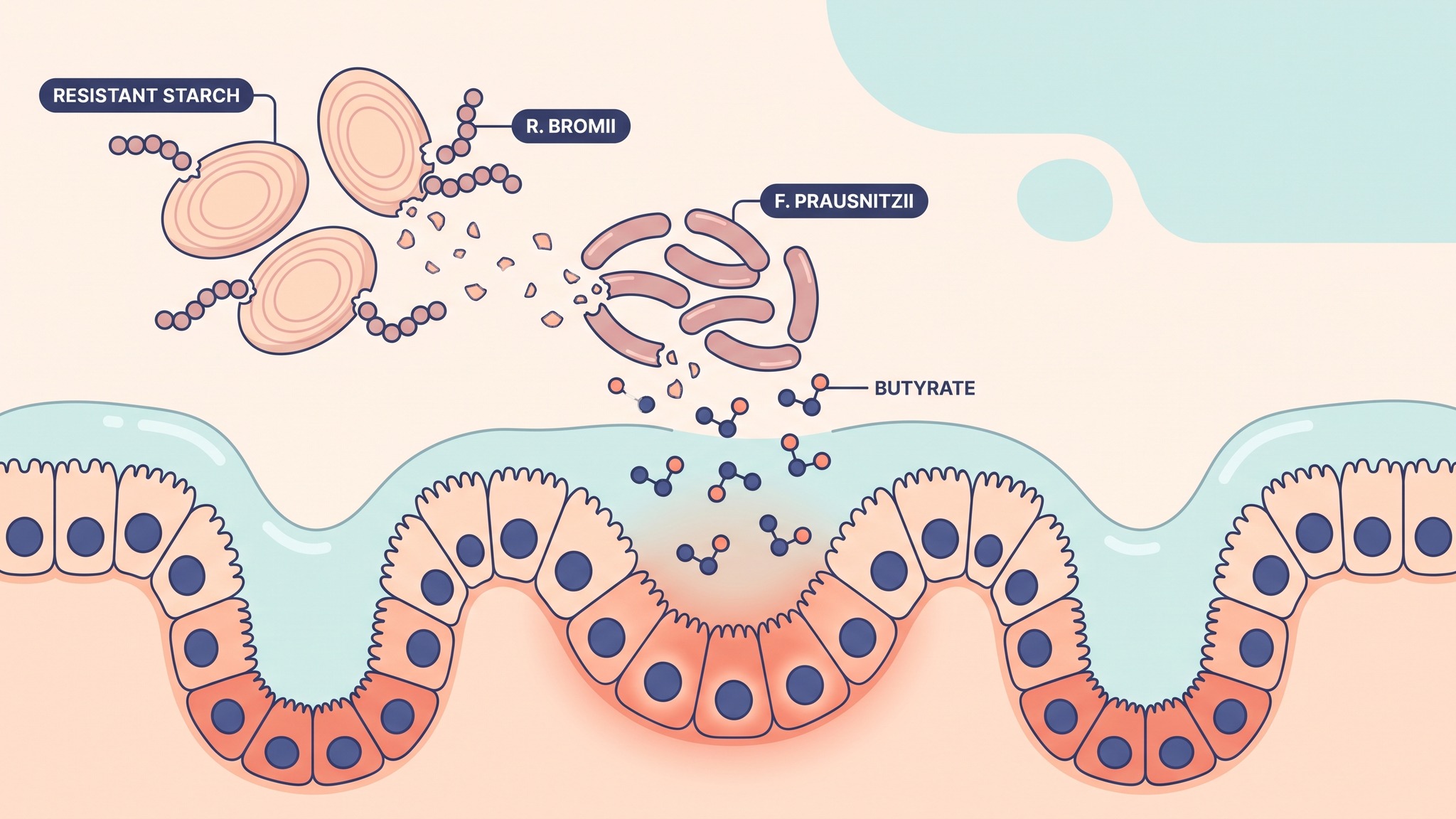
When a fiber suits you, colon bacteria turn it into short-chain fatty acids (SCFAs), mainly acetate, propionate and butyrate. Butyrate is the main fuel of colonocytes, the cells that line the colon, and it helps keep the junctions between them tight. That is where the health benefits of fiber begin.
Resistant starch is a favorite source. Specialist bacteria such as Ruminococcus bromii break it down, and partners like Faecalibacterium prausnitzii turn the fragments into butyrate. As a result, cooled potatoes and green bananas feed butyrate producers without a big gas surge.
What fiber does beyond the colon
The benefits for overall health reach well beyond the colon. A Lancet series of meta-analyses covering 135 million person-years found that people eating the most fiber had 15% lower all-cause mortality. They also had 16 to 24% fewer cases of heart disease, stroke, diabetes and colon cancer. Trials in the same series showed lower body weight and cholesterol.
For metabolic health, viscous fibers slow sugar absorption and flatten blood sugar levels after meals, which also supports weight management. Beta-glucans even show effects on muscle, as this study on beta-glucans and athletic performance shows.
Lower risk with the most fiber
Reynolds et al., Lancet 2019. Highest vs lowest intake in prospective cohorts, risk ratios 0.76 to 0.85.
The health benefits of fibre are supported by over 100 years of research into its chemistry, physical properties, physiology and effects on metabolism.
STUDY Compared with the lowest intakes, the highest fiber intakes were linked to 15 to 24% lower risk of death, heart disease, stroke, diabetes and colon cancer, with the largest benefit at 25 to 29 grams a day. Reynolds et al., 2019, Carbohydrate quality and human health: a series of systematic reviews and meta-analyses, The Lancet.
How much fiber per day, and does variety beat volume?
The recommended amount of fiber for adults is 25 grams per day for women and 38 for men. That works out to roughly 14 grams of fiber per day for every 1,000 calories. The Lancet data put the sweet spot at 25 to 29 grams, with extra benefit above that for people who tolerate it. So you rarely need 60 grams to get enough fiber.
Recommended daily amount and a slow ramp-up
Increasing fiber intake too fast brings on gas before your bacteria have adapted. Colon bacteria adapt over a few weeks, so a rise of about 5 grams a week gives them time. Add fiber from one new food at a time, then track symptoms for a few days. Spreading fiber across meals also helps, since three moderate doses ferment more gently than one giant smoothie.
The more fiber you eat, the better your digestion.
In large studies the benefit levels off around 25 to 29 grams a day. Past your own tolerance, extra fiber mostly brings gas and cramps. The right type and a steady rise count for more than the total.
Does eating 30 plants a week matter?
Variety feeds more kinds of bacteria. In the American Gut Project, people who ate more than 30 different plant types a week had more diverse colon bacteria than those who ate 10 or fewer. Fiber found in plant-based foods of every kind counts, from whole grains and legumes to herbs, spices and seeds. For a sensitive colon, 30 small portions are also easier to handle than three huge servings of one food.
When is fiber bloating a signal to investigate?
Fiber bloating that lasts beyond three to four weeks of slow increases is a signal to investigate. The same goes for weight loss, blood in your stools, night-time diarrhea or anemia. Pain from small amounts of gentle fiber also points to a problem underneath the diet.
Useful tests include a breath test for hydrogen and methane, which picks up overgrowth and IMO. A fecal analysis of the bacteria, digestion markers and inflammation adds the other half. A registered dietitian can then match fiber type and dose to your subtype, which protects your digestive health long term.
Kate's case shows how this plays out. At 53, after years of strict dieting, she had two decades of hard, infrequent stools. Vegetables and legumes also brought left-sided pain. Her case of extreme dieting and left-sided pain traced the problem to slow colonic transit and a sensitized colon, exactly the setting where more fiber hurts.
In our clinical practice at medcasestudies.com, the answer usually lies in matching the fiber to the person. The same fibermaxxing plan that suits one patient can upset another, so start with the subtype and build the plate from there.
Same fiber, different colon?
IBSyncrasy shows through real cases how each IBS subtype responds to fiber, and why the plan that suits one patient upsets another.
Frequently asked questions
It's a social media trend of eating the most fiber possible, often 40 grams a day or more, from beans, seeds, oats and powders. It targets a real gap, since the average American adult eats about 15 grams. People with IBS or slow transit may react with gas, pain or harder stools, so the fiber type matters as much as the total.
For most healthy adults, yes, if the increase is gradual and fluids go up too. It is riskier with IBS, slow transit, methane-dominant overgrowth or drugs that slow the colon, such as opioids and amitriptyline. In those cases a big jump in fermentable fiber can worsen bloating and hard stools.
Guidelines suggest 25 grams a day for women and 38 for men. Large studies found the biggest drop in heart disease and diabetes risk at 25 to 29 grams a day. Reach that level slowly, about 5 grams more each week, and spread fiber across meals.
Yes. Psyllium, PHGG and other powders count toward the total. Psyllium has the strongest evidence in IBS, while inulin-based powders cause the most gas. Whole foods add vitamins and polyphenols that powders lack, so powders work best as a top-up.