
If someone searches the phrase multiple bowel movements every morning, it is usually because the day starts in a rush. That was the reality for Christian, a 39-year-old man who had been moving his bowels about four times every morning for roughly a decade, often with bloating, a sense of urgency, and enough straining to bring on rectal prolapse. The story began after a gastroenteritis episode, then settled into a pattern that looked a lot like post-infectious IBS, with a bowel movement right after waking up, fear of public toilets, and a growing habit of planning daily life around the nearest bathroom. He also carried a wider metabolic burden, including obesity since his late teens, hypertension, chronic prostatitis, late sleep, and regular midnight eating. In this case study we explain why pooping several times in the morning was unlikely to be random, why sleep deserved a serious look beside the gut itself, and why the first plan focused on timing, chewing, movement, vegetables, weight reduction, and one targeted glucose test.

The method behind cases like this
In IBSyncrasy I explain how infection history, autonomic tone, meal timing, and metabolic stress can converge into one bowel pattern, even when the story looks fragmented at first. Buy IBSyncrasyWho is Christian, and what had he already tried?
Christian, 39
Christian came to us from Greece with a long bowel story and a longer metabolic one. He had lived with obesity for about 20 years, hypertension for 12 years, chronic prostatitis for 15 years, and an episode of major depression five years earlier. By the time he reached us, the bowel issue had already become one of the most structuring forces in his day.
Four morning bowel movements, most days
For around 10 years he had been moving his bowels roughly four times each morning. The pattern started after gastroenteritis and came with bloating and a visibly unstable rhythm, enough to contribute to rectal prolapse. He also felt uneasy using public restrooms, so the symptom was shaping behaviour as much as digestion.
A long list of symptom-driven strategies
He had already tried several familiar fixes. He avoided very fatty foods because they worsened his bowel pattern, used activated charcoal for bloating, and had taken multiple supplements including omega-3, probiotics, magnesium, vitamin D, vitamin C, zinc, a B-complex, and psyllium. His breakfast often revolved around simple starches like rusks, toast, and jam, while his schedule included late sleep and frequent midnight eating.
Why did multiple bowel movements every morning persist?
- 1
About 20 years earlier
Obesity enters the story and stays in place.
- 2
15 years earlier
Chronic prostatitis appears, adding a second long-standing pelvic complaint.
- 3
12 years earlier
Hypertension develops.
- 4
About 10 years earlier
A gastroenteritis episode is followed by clustered morning bowel movements and bloating.
- 5
Over the following years
Public restroom anxiety grows, fatty foods trigger symptoms, and rectal prolapse enters the picture.
- 6
Five years earlier
An episode of major depression is recorded.
- 7
First visit with us
The first plan is built around timing, weight, sleep, chewing, vegetables, and one targeted glucose test.
The pattern mattered more than any isolated symptom. A bowel rhythm that clusters in the same short morning window, began after infection, and now coexists with late sleep, midnight eating, obesity, hypertension, and public restroom anxiety usually reflects an organized physiology rooted in motility, circadian timing, and gut-brain signalling.[1]
Why sleep deserved its own section
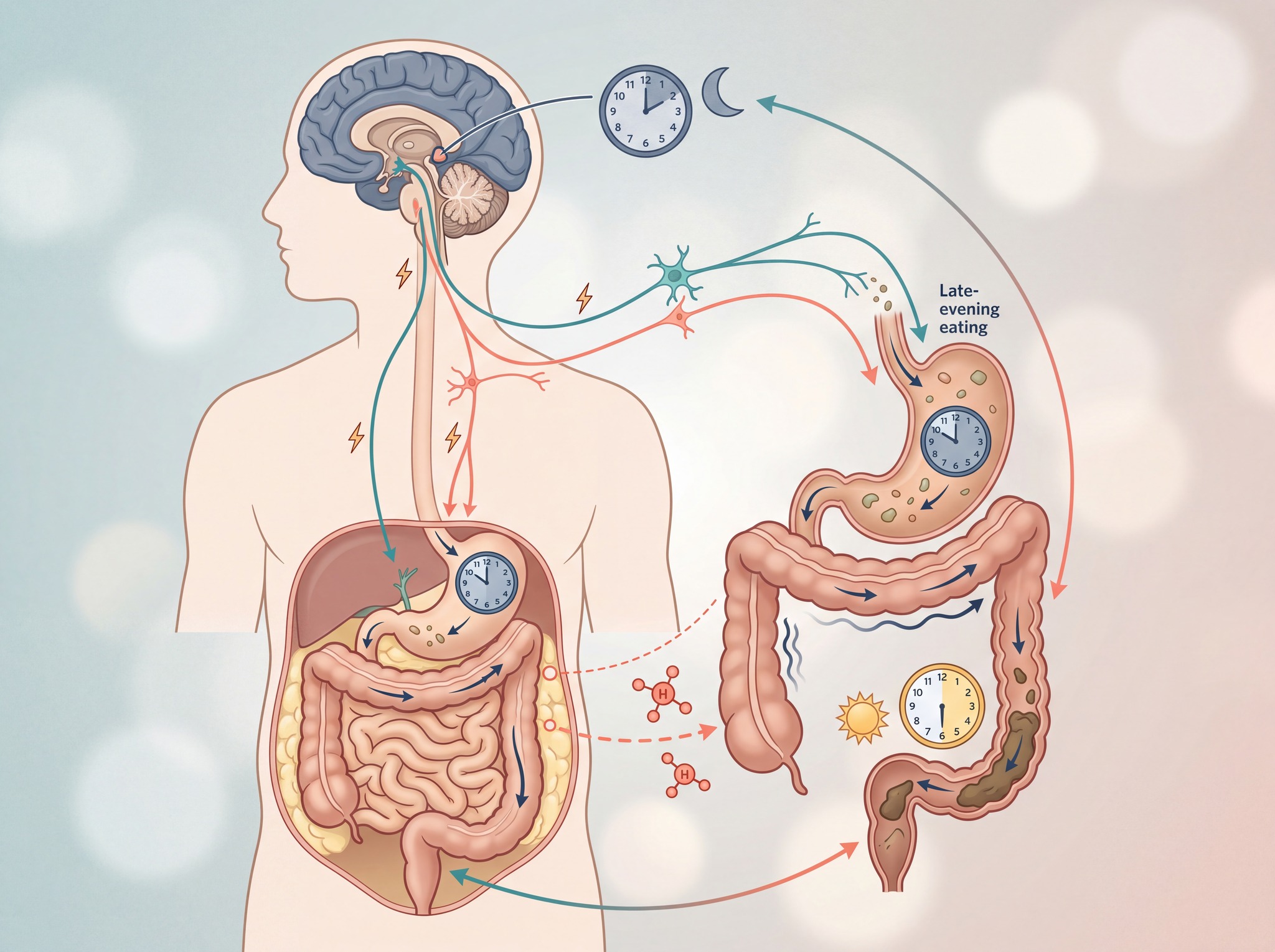
Sleep stood out because his schedule was consistently late, and the bowel pattern was consistently early. That combination creates circadian tension. The link between sleep timing and bowel movements became central to the case. Research on IBS shows that poor sleep quality, frequent awakenings, and non-restorative sleep are common, and sleep disruption tracks with symptom burden.[2] In parallel, population data show that late bedtime and short sleep travel with higher obesity risk, a major issue in Christian’s wider history.[5]
What seemed to be feeding the loop
More healthy lifestyle behaviours align with lower IBS incidence
Ho FF, et al. Gut. 2024, DOI 10.1136/gutjnl-2023-331254
Later bedtime aligns with higher odds of obesity
Tse LA, et al. JAMA Network Open. 2021, DOI 10.1001/jamanetworkopen.2021.13775
What did we want to learn next?
The next test proposed in Christian’s plan was a glucose tolerance test with measurements at 0, 60, and 120 minutes. That choice makes sense in a person who wakes into a highly active bowel state, lives with long-standing obesity, eats late, and often starts the day with fast carbohydrates. It gives us a clearer look at how the morning metabolic window behaves, and whether post-meal glucose handling is adding pressure to the wider picture.[4]
Why would a glucose test matter in a bowel case like this?
A bowel pattern can sit inside a broader timing problem. When a person lives with obesity, late sleep, and late meals, the first hours of the day may carry both digestive and metabolic stress. A three-point glucose test helps show whether morning bowel instability is unfolding in parallel with exaggerated glucose excursions or a strained insulin response.
Why did we choose these first recommendations?
Stop eating late at night
Late eating was a central target because his dinner pattern was spilling into the night while his bowel remained highly active the next morning. Earlier meal timing helps reduce circadian friction and supports long-term weight work, which matters when bowel instability and obesity are running together.[4][5]
Chew food thoroughly
We kept the chewing recommendation because digestion begins long before the bowel. More complete mastication changes gastric handling of food and usually makes meals slower, more deliberate, and easier to read symptomatically, which is useful in a case that already reacts strongly to meal timing and meal composition.
Track tolerance and expect it to vary
The report included an important teaching point, the same food may provoke a different response on different days. That is common when the system has a post-infectious history and symptom intensity is influenced by sleep, stress, and meal timing. A short symptom log turns that variability into useful pattern recognition.[1][2]
Do resistance training twice weekly and 45 minutes of aerobic work twice weekly
Movement entered the plan for two reasons. First, structured activity improves IBS symptom burden in intervention data. Second, it gives a practical route into weight reduction, stress regulation, and better daily timing. In a body already carrying hypertension and obesity, that is meaningful leverage. The overlap between late-night eating and obesity also made structured movement a useful counterweight.[3][4]
Aim to lose 40 kilograms over two years
The weight target was ambitious and long-horizon by design. Christian had lived with obesity for about 20 years, so the plan needed a durable pace built for long-term follow-through. A slower reduction strategy gives the bowel, appetite rhythm, and sleep timing space to stabilize while cardiometabolic pressure gradually comes down.[4][5]
Repair the sleep-wake cycle
This was one of the most important recommendations. His sleep was delayed, his eating was delayed, and his bowel was overactive early. Better sleep timing supports the gut-brain axis, often lowers symptom reactivity, and also strengthens the weight plan. That is why sleep earned its own place in the case and served as a central lever in the first phase.[2][5]
Put glutamine aside for the time being
He had already accumulated a broad supplement routine. Holding glutamine for the time being keeps the first phase cleaner and easier to interpret. In a case that already has many moving parts, a simpler first layer often makes the response to meal timing, chewing, sleep, and activity easier to read.
Eat seasonal vegetables every day
Seasonal vegetables served several aims at once. They add structure to meals, support lower energy density, and move the plan away from a starch-dominant pattern. In practical terms, they help the bowel plan and the weight plan meet in the same plate.[4]
Take dental hygiene seriously
Bleeding gums were part of the story, so oral hygiene was included deliberately. Periodontal inflammation is linked with a higher burden of systemic inflammation and with higher odds of hypertension, which matters in a person who already has elevated blood pressure. Tidying up the mouth was one more way to reduce background inflammatory pressure.[6]
What was the logic of the plan as a whole?
Four layers of action, one practical hierarchy
The outer ring carries the first daily wins, the center carries the longer arc
💡 Tap a ring — desktop: hover
Meal timing and chewing
Earlier dinners, slower eating, and more thorough chewing aim to reduce immediate friction in the hours that shape the next morning.
This first-phase plan works because it respects the shape of the story. The bowel issue began after infection, then settled into a rhythm sustained by timing, behaviour, and long-standing metabolic pressure. Each recommendation therefore supports the same direction, calmer mornings, steadier timing, less overall load, and a clearer read on what the body is doing next. It also respects the overlap between chronic prostatitis and bowel symptoms, where a shared pelvic context can keep tension active across systems.[1][4]
People who recognise their own pattern in this case often also relate to the broader topic of IBS symptoms in men, where morning bowel urgency, body weight, sleep, and daily functioning often overlap more than expected.
Your morning bowel pattern can have a traceable logic
In the assessment we map the same links between infection history, meal timing, sleep timing, weight, and targeted testing.
Frequently asked questions
Yes. A gut infection can leave behind a long post-infectious pattern in which motility, sensitivity, and timing stay altered. In some people, the bowel then becomes highly active in a short window soon after waking, especially when sleep, stress, and meal timing keep reinforcing the loop.
Yes. Delayed sleep timing and delayed eating can push the gut-brain axis into a less stable rhythm. In people who already have bowel vulnerability, that mismatch may show up as early-morning urgency, repeated bowel movements, or more reactive digestion.
It helps show whether the same morning window that brings bowel urgency also carries exaggerated glucose excursions or metabolic strain. That matters when bowel symptoms coexist with long-standing obesity, late-night eating, and a breakfast pattern built around fast carbohydrates.
References
- Thabane M, Kottachchi DT, Marshall JK (2007). Systematic review and meta-analysis: the incidence and prognosis of post-infectious irritable bowel syndrome. Alimentary Pharmacology & Therapeutics, 26(4), 535-544.
- Tu Q, Heitkemper MM, Jarrett ME, Buchanan DT (2017). Sleep disturbances in irritable bowel syndrome: a systematic review. Neurogastroenterology & Motility, 29(3), e12946.
- Johannesson E, Simrén M, Strid H, Bajor A, Sadik R (2011). Physical activity improves symptoms in irritable bowel syndrome: a randomized controlled trial. The American Journal of Gastroenterology, 106(5), 915-922.
- Ho FF, Sun H, Zheng H, Wong DCN, Gao YY, Mao C, Cheung YT, Lam CS, Wang MH, Wu IXY, Wu JCY, Chung VCH (2024). Association of healthy lifestyle behaviours with incident irritable bowel syndrome: a large population-based prospective cohort study. Gut, 73(6), 922-931.
- Tse LA, Wang M, Rangarajan S, et al. (2021). Timing and length of nocturnal sleep and daytime napping and associations with obesity types in high-, middle-, and low-income countries. JAMA Network Open, 4(6), e2113775.
- Muñoz Aguilera E, Suvan J, Buti J, Czesnikiewicz-Guzik M, Ribeiro AB, Orlandi M, Guzik TJ, Hingorani AD, Nart J, D’Aiuto F (2020). Periodontitis is associated with hypertension: a systematic review and meta-analysis. Cardiovascular Research, 116(1), 28-39.