
Who is Marios, and what had he already tried?
Marios, 28
Marios is 28 and works a desk job in Athens, the kind where lunch happens in ten minutes at the keyboard. Bread and cheese most days, a coffee to get through the afternoon, and a vape he reaches for between meetings. His bloating and constipation started about a year and a half before he came to see me, and by then he had already been through two rounds of a standard gastroenterology workup.
Two antibiotic rounds, same bloating
A gastroenterologist put him on Silactis and Colon Life, which helped for a while and then stopped working the moment he came off them. A breath test came back positive for small intestinal bacterial overgrowth, so he did a course of amoxicillin and metronidazole with a probiotic, then repeated a similar antibiotic and probiotic combination a second time when the bloating returned. Both rounds eased things for a while, and both times the bloating that won't go away came right back. Along the way he also mentioned frequent migraines and cold sores that flared whenever he was under pressure at work.
Clean scopes, one exception
A gastroscopy in June 2018 found nothing beyond Helicobacter pylori, and a colonoscopy that September came back completely clean. Every visit ended the same way, with the same sentence: your tests are clean, it's probably just stress.
The method behind cases like this
In IBSyncrasy I go through why gut findings like these get missed after two clean scopes and repeated antibiotics, and what actually helps. Buy IBSyncrasyWhy did I decide to look deeper?
- 1
About 18 months before
Bloating and constipation begin, worsening gradually.
- 2
Soon after
Silactis and Colon Life prescribed. Improvement, then relapse after stopping.
- 3
A few months later
A gastroscopy shows Helicobacter pylori, nothing else. A SIBO breath test comes back positive.
- 4
Right after that
Amoxicillin and metronidazole with a probiotic. Symptoms ease, bloating persists.
- 5
After the relapse
A different probiotic paired with a repeat antibiotic combination. Same pattern.
- 6
Around the same time
A colonoscopy comes back completely clean.
- 7
First visit with me
Full history taken. A molecular stool panel and immune and metabolic markers are ordered.
The pattern is what caught my attention, more than any single symptom. Marios had already done exactly what a standard workup asks for, twice, and the bloating kept coming back on schedule.
What the standard workup left open
A clean gastroscopy and a clean colonoscopy rule out ulcers, visible inflammation, and structural disease. They say nothing about bacterial balance, enzyme activity, or mucosal immune markers like secretory IgA.[1] In my experience, a third round of the same antibiotics rarely changes a pattern like this, it just resets the clock on the same relapse.
How SIBO comes back after one course of antibiotics
Lauritano EC, et al. Am J Gastroenterol. 2008;103(8):2031-2035
What I decided to check instead
After two rounds of antibiotics gave the same result, I ordered a molecular stool panel to look at what species were actually overgrown, along with secretory IgA, complement C3, homocysteine, folate, and fecal beta-glucuronidase.[2] Every one of these markers was new territory, absent from his previous workup.
What finally explained the bloating that won't go away?
The results came back a few weeks later and pointed, for the first time, to specific, measurable targets.
If my colonoscopy and gastroscopy were clean, how can something still be wrong in my gut?
Colonoscopy and gastroscopy are built to find structural problems: ulcers, polyps, visible inflammation, tumors. Bacterial balance, enzyme activity, and immune markers like secretory IgA show up on a stool or blood panel instead, and a gut can look completely normal on camera while carrying exactly that kind of imbalance. That gap is exactly why a molecular stool panel made sense here even after two clean scopes, and it is worth asking about whenever the same clean result keeps repeating without an explanation for the symptoms.
The intervention plan
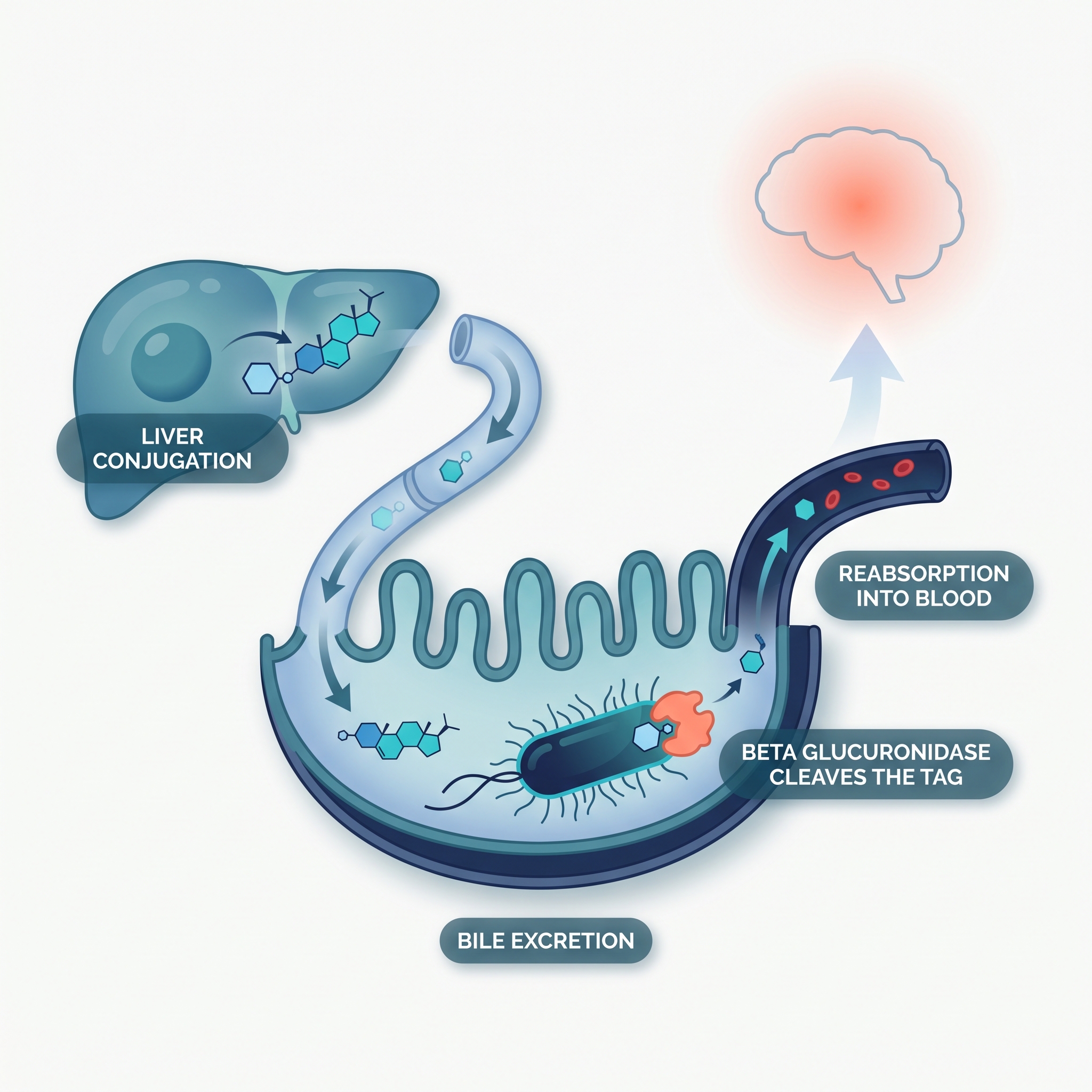
The plan builds directly on these seven findings: bring down the overgrown species, replace the missing folate while the treating physician tracks homocysteine, normalize the probiotic culture, and directly inhibit beta-glucuronidase, since this enzyme is central to how hormones and toxins recirculate through the body.
How fecal beta-glucuronidase reaches beyond the gut
Flores R, et al. J Transl Med. 2012;10:253
The treatment
| Intervention | For which finding, and why |
|---|---|
| Berberine Complex 400 mg | For the Bacillus overgrowth. This genus is sensitive to berberine, which helps bring the population back down. |
| Probiota Sensitive SCD and GAPS | For the very low sIgA and the broader dysbiosis. Aims to normalize the probiotic culture and support mucosal defense, the same defense that matters for his frequent cold sores. |
| MethylB12 and methylfolate | For the low folate and elevated homocysteine, replacing what is missing while the treating physician monitors the homocysteine trend. |
| Calcium D-glucarate | For the elevated fecal beta-glucuronidase, inhibiting the enzyme directly so fewer already-tagged compounds get pulled back into circulation. |
| 5-HTP Synergy | Supports the serotonin pathway, one of the stated goals alongside the antimicrobial and immune work. |
| Intestinal Repair | General mucosal support for the intestinal lining while the rest of the protocol takes effect. |
I explained the results to Marios in the order they mattered to him: first the overgrowth driving the bloating, then the weak mucosal defense that likely plays into how often his cold sores flare, then the beta-glucuronidase finding as a plausible piece of the migraine picture that deserves watching over time. Stress is a well-documented trigger for herpes simplex reactivation in its own right,[4] so supporting mucosal immunity works alongside stress management as one part of the picture.
What actually changed the picture?
🔴 Gut finding: H. pylori positive, SIBO test positive, otherwise unremarkable
🔴 Immune and metabolic markers: never tested
🔴 Explanation for the bloating: none, tests kept coming back clean
🟢 Gut finding: Enterococcus faecium and Bacillus overgrowth, elevated beta-glucuronidase
🟢 Immune and metabolic markers: sIgA very low, C3 low, homocysteine elevated, folate very low
🟢 Explanation for the bloating: a specific, testable mechanism with a matched plan
Why is this approach likely to work?
This case is working so far because the plan follows the findings uncovered in the stool and immune panel.[2] Overgrowth, weak mucosal defense, and an enzyme running hot are three separate, addressable targets that explain the pattern.
What this means in practice
In my experience, patients who hear “your tests are clean” for over a year are almost always missing one of these three markers.[1]
Your bloating might have a specific, testable cause
In the assessment we look at exactly the markers that were missing from Marios's case before the stool panel, secretory IgA, and the rest.
Frequently asked questions
Antibiotics bring down the bacterial overgrowth itself. What let it build up in the first place, whether that is motility, diet, or an unmeasured immune or enzymatic factor, usually needs its own look to hold the improvement. Relapse rates after a single antibiotic course are well documented in the literature. The treating physician decides whether repeat antibiotics, a different regimen, or further testing fits a given case.
Yes, this is common. Colonoscopy and gastroscopy are designed to detect structural problems such as ulcers or visible inflammation. Bacterial composition, enzyme activity, and immune markers need their own tests to show up, so a clean result on both still leaves room for a testable functional cause of bloating.
There is growing research linking gut microbiota and infections such as Helicobacter pylori to migraine frequency, likely through inflammatory and neuroinflammatory pathways. This remains an active area of research, and any migraine treatment decision stays with the treating physician.
References
- Lauritano EC, Gabrielli M, Scarpellini E, et al. (2008). Small intestinal bacterial overgrowth recurrence after antibiotic therapy. American Journal of Gastroenterology, 103(8), 2031-2035.
- Flores R, Shi J, Fuhrman B, Xu X, Veenstra TD, Gail MH, Gajer P, Ravel J, Goedert JJ (2012). Fecal microbial determinants of fecal and systemic estrogens and estrogen metabolites: a cross-sectional study. Journal of Translational Medicine, 10, 253.
- Bawand R, Ghiasian M, Samadyan M, Qaderi S (2023). Association of Helicobacter pylori with migraine headaches and the effects of this infection and its eradication on the migraine characteristics in adults: a comprehensive systematic review and meta-analysis. Helicobacter.
- Mantis NJ, Rol N, Corthésy B (2011). Secretory IgA's complex roles in immunity and mucosal homeostasis in the gut. Mucosal Immunology, 4(6), 603-611.
- Goswami P, Ives AM, Abbott ARN, Bertke AS (2022). Stress hormones epinephrine and corticosterone selectively reactivate HSV-1 and HSV-2 in sympathetic and sensory neurons. Viruses, 14(5), 1115.