Why does low muscle tone and autism happen together?
Low muscle tone in autism usually comes from more than one cause, and one of them is directly treatable.
Why is low muscle tone and autism such a common pairing?
Low muscle tone and autism show up together often enough that pediatricians expect to see one alongside the other. Hypotonia, the clinical term for reduced muscle tone, looks like a floppy trunk, a baby who feels heavier than expected when picked up, and motor milestones that arrive later than the growth chart suggests. It shows up often enough in autism that most clinicians expect to see it, sometimes as early as infancy.
In practice, hypotonia is often one of the early signs a clinician notices in infancy, well before a formal autism spectrum disorder evaluation is even complete. Parents often hear hypotonia, autism, developmental delay, and related terms in the same appointment, and rarely get told how they connect.
How many autistic children have low muscle tone?
Just over half of children with autism spectrum disorder show hypotonia as a measurable motor sign. A cohort study of 154 children with autism spectrum disorder found hypotonia in 51% of the group, ahead of motor apraxia and a history of toe-walking, and it stayed the single most common motor finding in the sample.
STUDY Hypotonia was the most common motor sign in a 154-child autism cohort, ahead of motor apraxia and toe-walking history. Ming, Brimacombe & Wagner (2007), Brain and Development.
Motor signs in one 154-child autism cohort
Ming, Brimacombe & Wagner (2007), Brain and Development, n=154
That number improved significantly over time in the same study. The reason the two conditions travel together so consistently starts in the part of the brain built specifically to coordinate movement, the cerebellum.
What neurological signs do doctors look for beyond a floppy baby?
Doctors look for dysdiadochokinesia, difficulty doing quick, alternating movements like flipping a palm up and down fast or tapping fingers in rapid sequence, as one of several soft neurological signs pointing toward the cerebellum, the brain region that governs motor control and muscle timing. A floppy baby often grows into a child who struggles with exactly these same coordination tasks years later, sometimes affecting fine motor skills like handwriting or buttoning a shirt.
- Dysdiadochokinesia
- Difficulty doing quick, alternating movements, like flipping your palm up and down fast or tapping your fingers in sequence.
Researchers who examined these same coordination signs in autism found them tied to social and communication scores as well as physical clumsiness.
Why the cerebellum matters for motor control and coordination
The cerebellum sits at the back of the skull, wired into the rest of the nervous system, and constantly compares an intended movement against the movement that actually happened, adjusting muscle tone and motor control on the fly. Researchers first linked this structure to autism in 1988, when brain scans showed a smaller cerebellar vermis, the cerebellum's central strip, in autistic patients compared with typically developing controls.
STUDY Brain imaging first showed a smaller cerebellar vermis in autism in 1988, one of the earliest structural brain findings in the condition. Courchesne et al. (1988), New England Journal of Medicine.
That single finding opened three decades of research into the cerebellum's role in autism, and it still shapes how clinicians think about hypotonia today. The next question is whether that same brain region explains every case, or just some of them.
My daughter is 3 and a half, diagnosed with autism this spring. Her pediatrician just mentioned she has hypotonia too, with no real explanation. She still can't jump with both feet off the ground. Is the low muscle tone part of the autism, or something separate?
It's worth asking your pediatrician that question directly, because hypotonia deserves more explanation than a passing mention. In most cases like your daughter's, hypotonia and autism share overlapping neurological roots, particularly around the cerebellum, the brain region that fine-tunes motor control and timing. That said, connective tissue laxity and sensory processing differences can also produce the same low-strength, low-tone pattern on their own. Her occupational therapist tracking core strength is a good sign, and early intervention tends to help regardless of the cause. If progress stalls, that's the point to ask about a pediatric genetic workup, since a small number of cases trace back to one specific, testable cause.
Get the fuller picture
The book maps exactly which cases trace back to a specific, testable cause, and what changes once you know. Buy the bookWhy can low muscle tone have several different causes in autism?
Recognizing the early signs matters, because low muscle tone in autism has more than one possible root, and the cerebellum is only one of them. Some autistic children show the opposite pattern entirely, higher muscle tone or hypertonia, which rules out a single universal explanation for either direction.
Beyond the brain: connective tissue and sensory processing
Loose or hypermobile joints, a form of connective tissue laxity independent of brain wiring, can produce the same low, doughy feel a parent notices at home. Sensory processing differences change how a child registers feedback from muscles and joints, which affects how efficiently those muscles get used even when strength itself is normal. Muscle strength, muscle tone, and motor coordination are three separate variables that shape both fine motor skills, like buttoning a shirt, and gross motor skills, like sitting, crawling, and walking, and a child can struggle with any one of them without the other two being affected.
One symptom, several possible roots, and only one of those roots comes with a genetic test a family can actually ask for.
What genetic causes of low muscle tone often go untested?
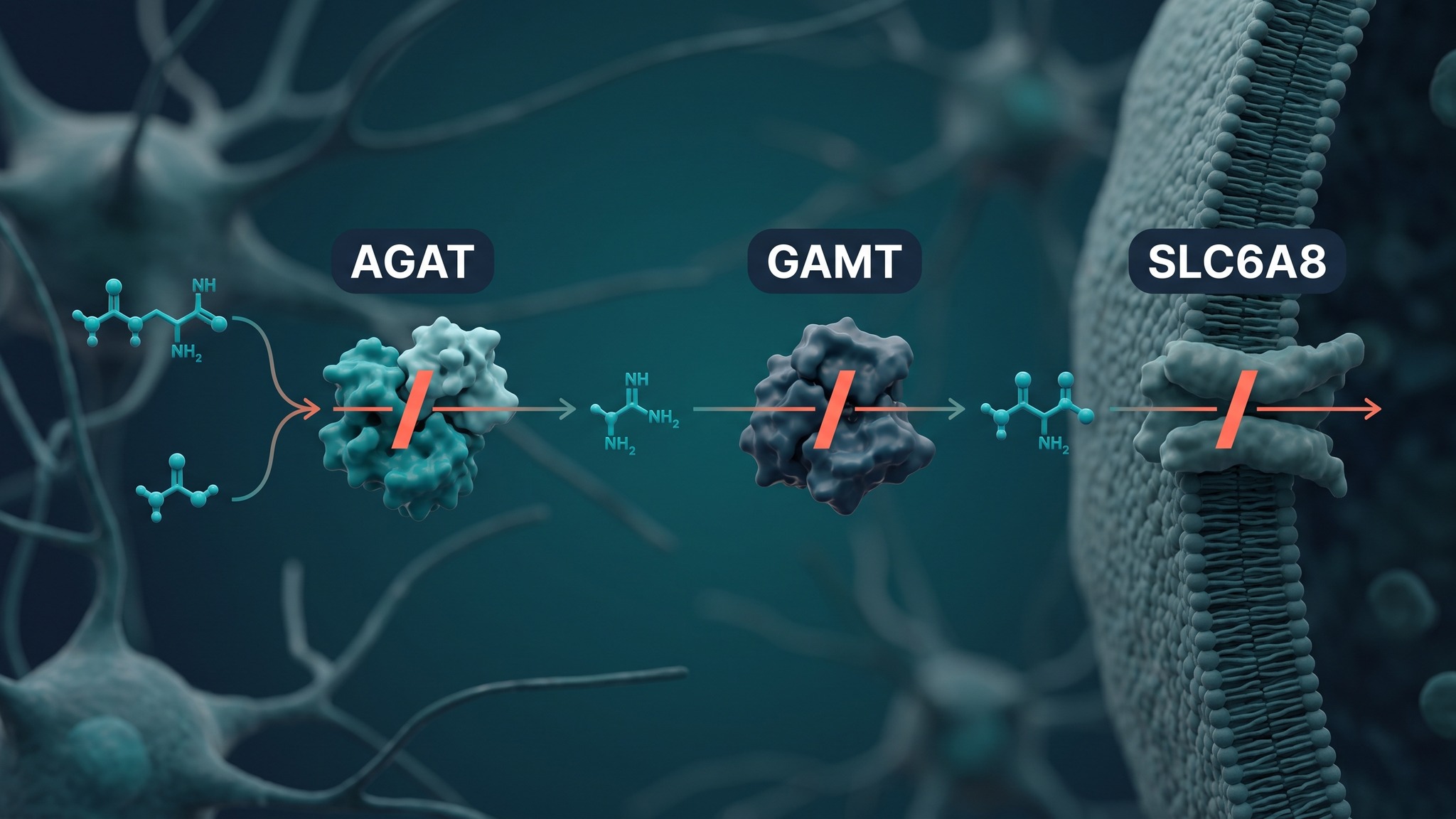
Three rare genetic conditions, GAMT deficiency, AGAT deficiency, and SLC6A8 creatine transporter deficiency, all list hypotonia as a hallmark feature, and none of them shows up on a standard genetic panel unless a doctor specifically asks for it. All three disrupt creatine metabolism, the pathway brain cells and the wider nervous system use to regenerate fast energy on demand, and all three list developmental delay among their core features.
Developmental delay and cognitive dysfunction or intellectual disability and speech-language disorder are common to all three creatine deficiency syndromes.
GAMT changes in particular have been linked to creatine deficiency in autism, developmental delay, and absent or severely limited speech, sometimes before a family ever hears the word creatine from a doctor.
| Gene | Responds to oral creatine? |
|---|---|
| GAMT | Yes |
| AGAT | Yes |
| SLC6A8 (transporter) | No, or only rarely |
How doctors test for these genetic causes
Brain MRS, short for magnetic resonance spectroscopy, is a scan that measures creatine levels inside the brain directly, and it shows an absent or sharply reduced creatine peak in all three conditions. A targeted genetic panel or a urine test for guanidinoacetate, a creatine-pathway byproduct, confirms which of the three genes is responsible. Because early signs like developmental delay and hypotonia tend to show up together in all three conditions, catching them sooner gives treatment the best chance to help.
Why do two of these three genes respond to creatine while a third resists it?
GAMT deficiency and AGAT deficiency both respond to oral creatine supplementation because the broken step sits in creatine's own manufacturing line, so supplying the finished molecule from outside skips the defect entirely. Decades of case reports describe normalized brain creatine levels and better developmental outcomes, especially when treatment starts early.
In clinical practice at medcasestudies.com, creatine only gets folded into a child's plan once that genetic and metabolic picture is actually clear.
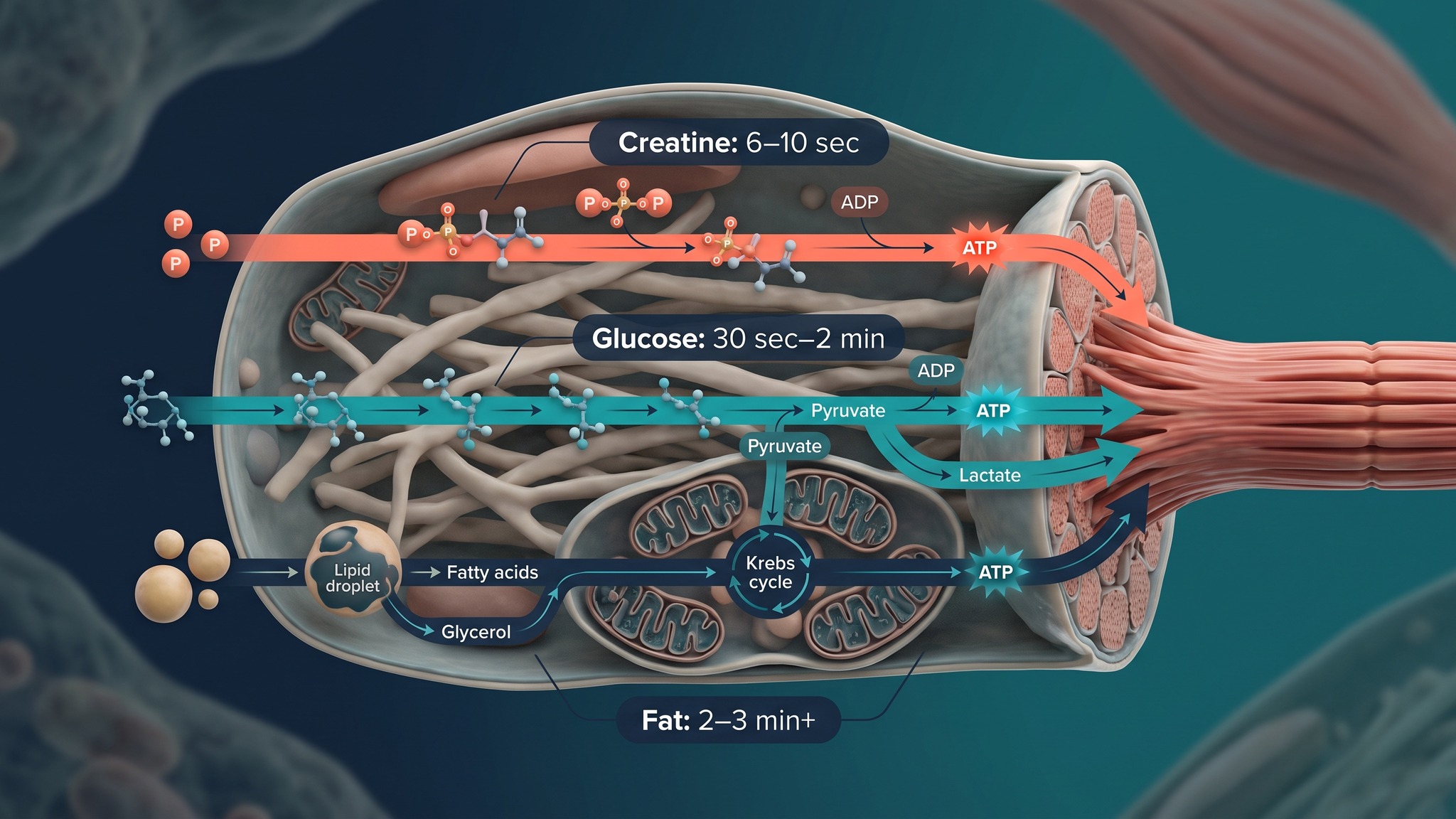
Muscle contraction and nerve signaling across the nervous system both run on three different fuels, and they arrive at completely different speeds. Creatine regenerates ATP, the cell's basic energy currency, in a single enzyme step that takes a fraction of a second, covering roughly the first 6 to 10 seconds of hard effort. Glucose takes over from about 30 seconds to 2 minutes, running through a longer, roughly ten-step enzyme chain to get there. Fat becomes the dominant fuel only after about 2 to 3 minutes, once oxygen delivery and a slower transport system catch up.
Think of it as the ten-second sprint to catch a bus against the slow burn of a Sunday afternoon walk. Creatine covers the sprint. Fat covers the walk. Glucose fills the gap in between. For a brain cell running short on that fast fuel, the shortfall shows up first in exactly the movements that depend on split-second timing.
How fast each fuel reaches working muscle
Exercise physiology, ATP-PCr / glycolytic / oxidative energy continuum
Why SLC6A8 is the exception
SLC6A8 deficiency follows a different path. Its defect blocks the transport step that carries creatine into cells, downstream of where GAMT and AGAT act. The mutated transporter fails to carry creatine across the blood-brain barrier and into neurons, however much extra creatine reaches the bloodstream, similar to deliveries piling up outside a door that stays shut. Oral creatine still gets tried in these cases, and some milder or partial mutations show a modest response, but the ceiling on what it can achieve is lower and less predictable than in GAMT or AGAT deficiency.
I've seen parent groups mention giving autistic kids creatine, which sounded ridiculous at first, since that's what my brother took at the gym. My son is 7, mostly nonverbal, with really weak muscle tone. Is there actual research behind this, or is it just a trend?
It's a fair thing to be skeptical about, and the gym-supplement association makes sense given how creatine gets marketed everywhere else. In your son's case, the research that matters isn't about bodybuilding. It comes from genetic studies on GAMT and AGAT deficiency, two rare conditions where the body can't make enough creatine on its own, and low muscle tone is a hallmark feature. When kids with those conditions get oral creatine, brain creatine levels rise on scans and development often improves, sometimes dramatically with early treatment. Every child responds differently, and the research behind creatine here comes from genetic studies on rare metabolic conditions published in real medical journals.
See the full creatine-and-autism map
The book walks through exactly how each genetic and metabolic picture responds to creatine, case by case. Buy the bookWhat does this look like in a real case?
A real case makes the mechanism concrete. One child in clinical practice had struggled with motor coordination for as long as anyone could remember, long before creatine ever came up as an option. At 9 years old, the clearest sign was simple. He consistently missed catching a ball thrown directly to him, a gross motor skills challenge his family had noticed for years, because his arm came up too late every single time.
A 9-year-old with lifelong motor coordination delay
The child had shown reduced muscle tone and slow motor responses for as long as his family could remember, well before any autism evaluation connected the dots.
A game of catch that never quite worked
Thrown a ball at an ordinary distance, he consistently raised his arm too slowly to catch it, missing passes that classmates his age caught without thinking.
Creatine added to the existing plan
Creatine was introduced alongside his ongoing occupational therapy, without changing anything else about his routine at the same time, so any shift in his catching would be easier to attribute.
A change within about three months
Within roughly three months, his ability to track and catch a thrown ball improved noticeably. His occupational therapists noted the same shift independently, and family members who saw him regularly, without knowing what had changed, described the same improvement unprompted.
A single case does not prove a mechanism by itself, but it lines up with exactly what the genetics predict, faster energy delivery reaching the muscles and nerves that needed it most.
Where does creatine fit into the bigger picture for low muscle tone in autism?
Low muscle tone and autism connect through a mechanism that goes well beyond the cerebellum alone, reaching down to how individual brain cells get their fastest usable energy. For most children, hypotonia comes from a mix of neurological, connective-tissue, and sensory factors, and it tends to improve with standard motor therapy over time. Hypotonia alone rarely predicts broader developmental delay, and most children catch up well. For the smaller group carrying a GAMT, AGAT, or SLC6A8 change, the biology points to a specific, testable answer, and in two of those three cases, creatine can genuinely help.
That same energy-delivery mechanism shows up again in broader developmental skills regression in autism, where mitochondrial reserve and creatine metabolism form part of a wider biochemical map behind skill loss. Testing for it starts with a simple question worth asking at the next appointment, whether anyone has actually checked creatine metabolism or just assumed the muscle tone will sort itself out.
See the full creatine and autism map
The book walks through every genetic and metabolic pathway behind low muscle tone in autism, including which ones respond to treatment.
Frequently asked questions
Yes. Hypotonia is one of the most common motor signs in autism spectrum disorder, showing up in roughly half of children with autism in at least one published cohort. The link runs through several mechanisms, cerebellar coordination, connective tissue, sensory processing, and in a smaller group of cases, specific creatine-related genes tied to developmental delay as well.
Early signs matter for treatment planning. Occupational therapy and physical therapy remain the standard first steps, building strength, fine motor skills, and motor planning through targeted exercises. Sensory integration work helps some children use the strength they already have more efficiently. For the specific genetic subset with GAMT or AGAT deficiency, oral creatine supplementation is a documented, targeted treatment for that exact cause.
No. Hypotonia has several independent causes, and not every autistic child has it. Some autistic children show the opposite pattern, higher muscle tone, which rules out any single explanation that applies universally.
Often, yes. In the same 154-child cohort study, hypotonia improved significantly over time as children grew older. Standard motor therapy plus, in specific genetic cases, creatine treatment both contribute to that improvement.