Andreas, 31, came to us after more than a year of episodic cramps in his abdomen, burning, and discomfort that persisted despite changes he had already tried on his own. A few months earlier, he had traveled to Thailand, and the first symptoms appeared almost immediately after he returned. His diet kept the same few foods on repeat, week after week, resulting in low fiber diversity and a narrow range of sources for his gut microbiome. In this case study we explain how Blastocystis hominis after travel settled into a gut with poor microbiome diversity, how gut dysbiosis connected to the persistent travelers' diarrhea that followed, and how a change in diet combined with targeted treatment gradually led to meaningful improvement.
The approach behind the case
In IBSyncrasy we describe how gut dysbiosis after travel keeps symptoms going like Andreas's, and which changes are worth trying first. Buy IBSyncrasyWho Andreas is and what he had already been through before he came to us
A 31-year-old with a history of frequent colds
Andreas is 31 years old, 190 cm tall and weighs 62 kg, a body mass index of 17.2, below the normal range. He had long described a tendency to catch colds easily and feel pressure in his ears, a pattern of mild immune sensitivity long before any gastrointestinal symptom appeared.
The trip to Thailand and the first episode
A few months after a trip to Thailand, Andreas felt intense pain in his upper abdomen during exercise. He was given esomeprazole for gastritis, with temporary relief. A stool test that followed showed the presence of Blastocystis hominis, and treatment with fluconazole and probiotics helped in part, but the cramps and discomfort persisted.
A diet with very little variety
His weekly diet kept nearly the same choices on a cycle, grains seven times a week, rice six times, chicken seven times, eggs every day, fish five times, no legumes, and minimal vegetable variety. The result was a diet with low fiber diversity, a pattern linked to a poorer gut microbiome.
Over a year of cramps, with calm stretches in between
A cycle of flare-ups and remissions followed for over a year, with two endoscopies showing reactive gastropathy and reflux-type esophagitis, but no sign of celiac disease or H. pylori on biopsy. During the same period, patchy hair loss appeared on his scalp and beard, along with mouth ulcers and a skin rash, signs of multiple simultaneous symptoms in different parts of his body.
Blastocystis hominis after travel, why we suspected a link to diet
We read Andreas's history with two questions in mind. First, why the symptoms started shortly after he returned from Thailand. Second, why a diet so consistent and seemingly healthy still left his gut vulnerable.
- 1
May 2024
Trip to Thailand, and a few months later, the first episode of intense upper-abdominal pain during exercise.
- 2
September 2024
First endoscopy with biopsies, negative H. pylori and normal mucosa, no sign of celiac disease.
- 3
January 2025
A new flare-up with headaches, improvement after stricter limits on acidic and spicy foods.
- 4
July 2025
Second endoscopy, reactive gastropathy and reflux-type esophagitis, H. pylori negative again.
- 5
September 2025
Return of the cramps, with relief after bowel movements and worsening during periods of stress, which led to the molecular stool test.
The trip as a starting point
In our experience, we often see people develop persistent gastrointestinal symptoms months after travel to countries in Southeast Asia, even when the initial episode seems to have passed[1]. The timing in Andreas's case matched this pattern, which is why we considered his recent trip a very likely cause.
How quickly travelers' diarrhea appears in Thailand
Sharma et al. (2020), American Journal of Tropical Medicine and Hygiene 102(5), 349 adult foreign travelers to Thailand, y-axis scale 0-40%
In this study, nearly one in three foreign travelers to Thailand developed travelers' diarrhea within the first month of their stay, with a median onset of around nine days[6]. This window matches the time between Andreas's trip and his first positive test for Blastocystis hominis.
We often see people develop symptoms after travel to these countries, especially when they've recently taken antibiotics or already have a chronically low-quality microbiome from diet or medication. Travel is often just the trigger that reveals a gut that was already vulnerable, alongside other contributing factors.
How three factors combined
Three factors that led to the same point
💡 Tap a ring — desktop: hover
Diet
Chronically limited food variety, with low fiber intake from different sources.
No single one of the three layers explains the full picture on its own. Together, though, they form a consistent chain, from long-term dietary monotony to the trip that became the trigger.
My stool test came back positive for Blastocystis hominis. Does that definitely mean it's causing all my symptoms, or could there be something else that hasn't been found yet?
In cases like this, the answer depends on the whole picture. Blastocystis hominis is often found in people with no symptoms at all. But when it's combined with low microbiome diversity, recent use of acid-suppressing medication, and a symptom pattern that lines up in time with its appearance, the likelihood that it's playing an active role increases significantly. The interpretation is always made together with the person's full history, step by step, in the context of their overall picture.
From suspicion to the decision to test
Based on this reasoning, we started two things right away, a set of initial changes to diet and lifestyle, and at the same time we recommended the molecular stool test that would confirm or correct our hypothesis.
Which interventions we started before the results came back
Before we had the test results in hand, we made changes based on Andreas's history and dietary pattern.
Less rice and chicken, more variety
Rice and chicken repeated almost every day in his diet, a pattern that keeps fiber diversity low and limits the different substrates the gut microbiome needs to stay rich. Rice is also one of the main dietary sources of inorganic arsenic, so its daily consumption added that factor to the decision as well. We limited both to three days a week, with alternative starch sources such as quinoa, buckwheat and potato, and legumes in place of chicken most days.
Less wheat, more alternative starch sources
Wheat appeared every day in his diet, mainly as bread. We limited wheat to three servings a week, with gluten-free oats, buckwheat and long-fermentation bread as alternatives, to reduce the load of fermentable carbohydrates while also increasing the overall variety of his diet.
Diaphragmatic breathing before every meal
We asked Andreas to do three minutes of diaphragmatic breathing before every meal. The goal was for him to start the meal with a calmer nervous system, which supports stomach motility and reduces pain sensitivity, two points that matched the pattern of burning and cramps he felt after eating.
What the molecular stool test finally showed
The stool test gave a picture far more specific than what the two normal endoscopy biopsies had shown.
What these findings explain
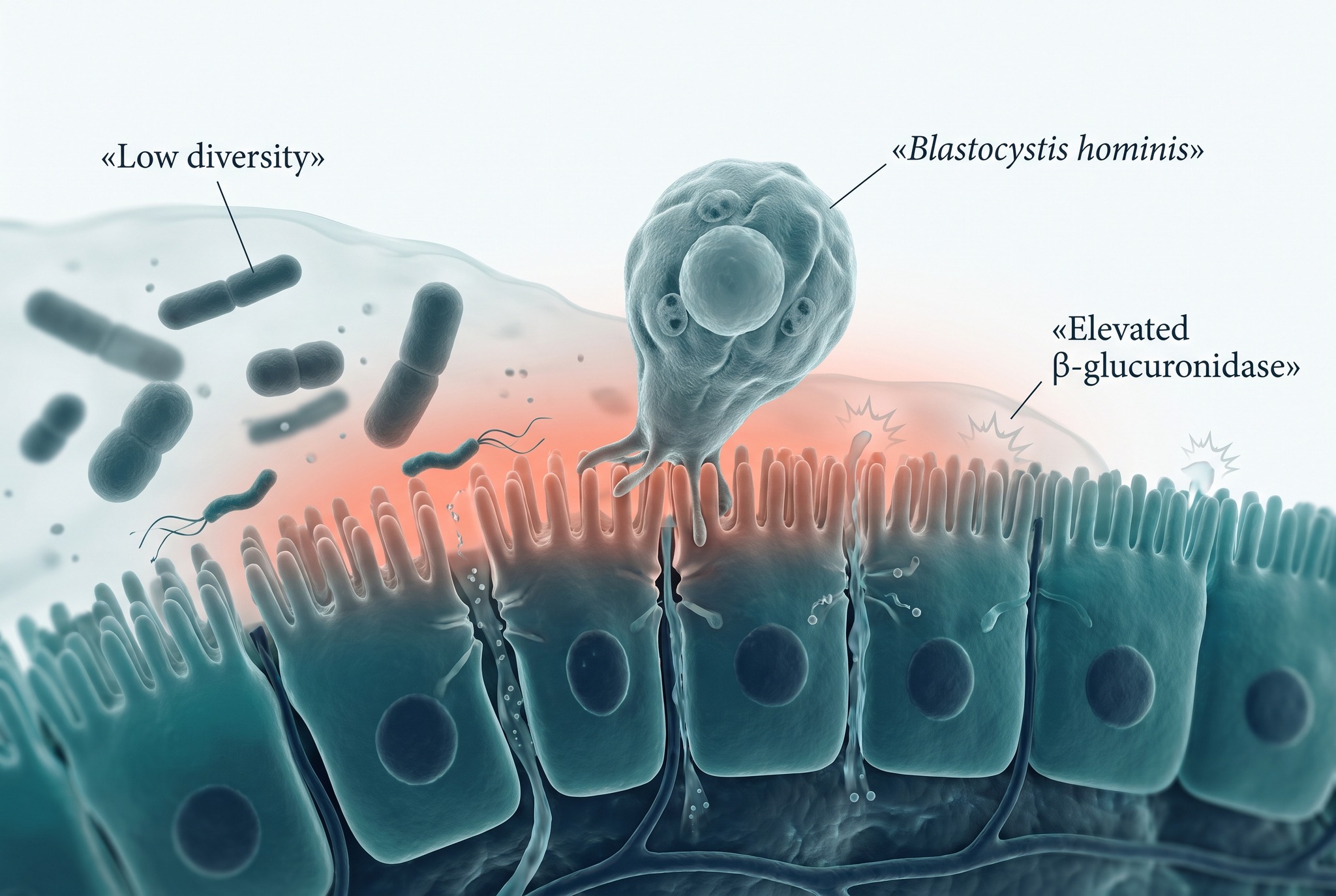
This pattern also fits his history of intermittent use of acid-suppressing medication, which has been linked to reduced microbial diversity and more favorable conditions for protozoan survival in the upper digestive tract[5]. Together, these findings point to a gut lumen with increased enzymatic activity and reduced microbial diversity, where Blastocystis hominis found less resistance than it would have in a richer microbiome.
How Blastocystis hominis settles in the gut
 Blastocystis hominis" width="1200" height="675" loading="lazy">
At the mucosal level, Blastocystis hominis attaches to enterocytes and binds preferentially at the intercellular junctions, where it disrupts proteins such as ZO-1 and occludin and increases paracellular permeability[2]. The intensity of this disruption varies by strain, which explains why two people with the same organism can have very different symptom pictures.
Why low fiber diversity favored colonization
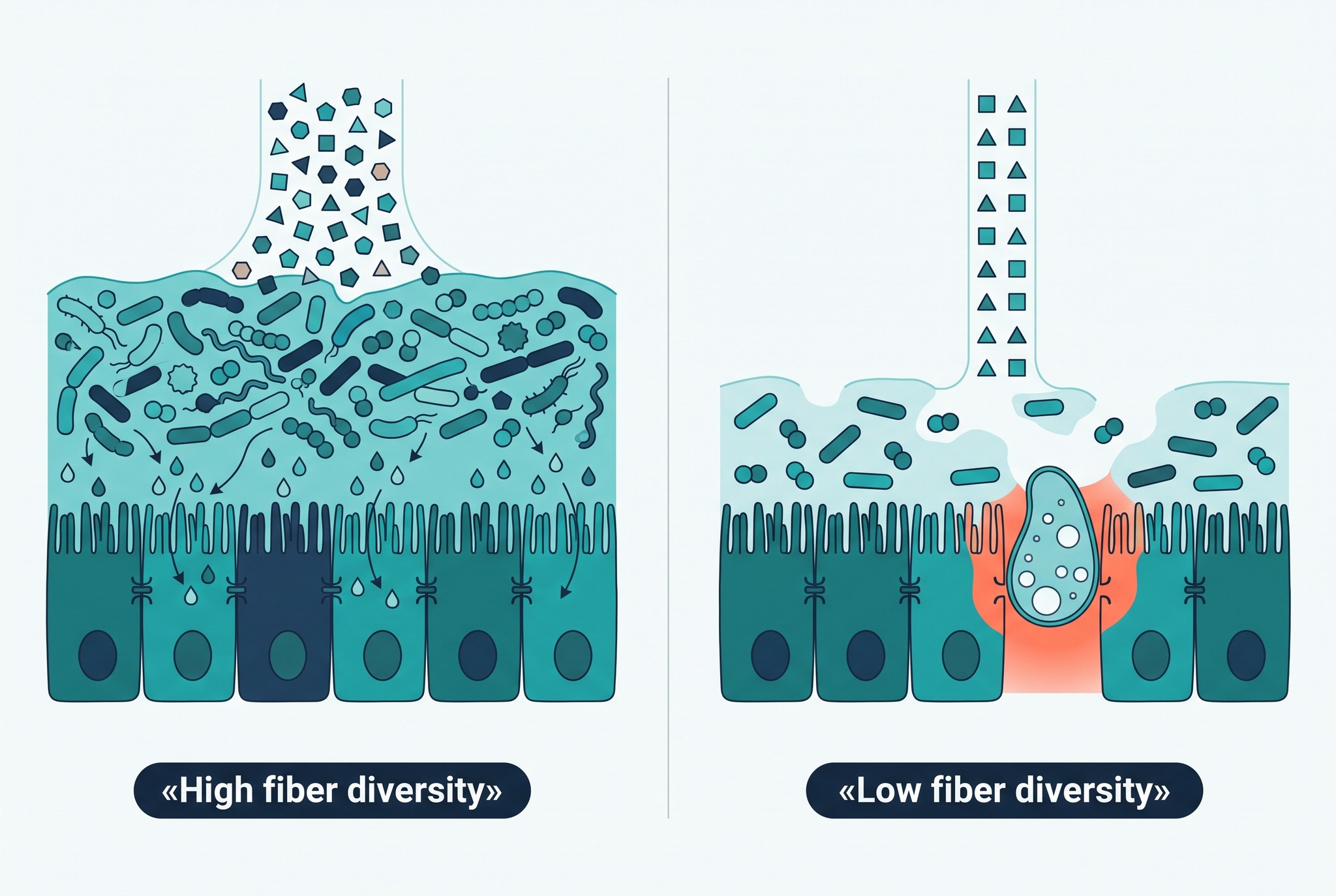
A microbiome fed by only a few fiber sources has fewer bacterial species and less production of butyrate and other short-chain fatty acids, which feed mucosal cells and maintain a dense, protective mucus layer[3]. With fewer species in the gut, a new colonizer such as Blastocystis hominis finds less resistance to settle in and persist[4].
Blastocystis hominis is always harmless and needs no treatment at all.
In many people with a rich microbiome, its presence goes unnoticed. In a gut with low diversity and a history of acid-suppressing medication, as in Andreas's case, the same mechanisms of attachment and disruption of cell junctions can sustain symptoms for months.
I was eating relatively healthy, without sugar or processed foods. Why was my microbiome still so vulnerable, when my diet seemed fine in the usual sense of the word?
Each different fiber source feeds different bacterial species in the gut. The more limited the variety of foods, the fewer species find the fuel they need to survive, and the microbiome ends up poorer and more vulnerable to new colonizers, even when the diet contains no sugar or processed food. This explains why an organism like Blastocystis hominis after travel can find very different guts in two people, depending on how varied their diet was in the years before the trip.
The intervention plan
We built the plan around five targeted interventions, each tied to a specific finding.
| Intervention | Which finding, and why |
|---|---|
| Calcium-D-glucarate (a natural substance that binds the enzyme β-glucuronidase) | For elevated fecal β-glucuronidase, it reduces the reactivation of substances in the gut lumen and takes pressure off the mucosa. |
| A blend of plant extracts with a broad antimicrobial profile | For colonization by Blastocystis hominis and the overgrowth of opportunistic bacteria, it targets the imbalanced microbial load without stripping the gut of beneficial species. |
| Butyric acid (a butyrate source for mucosal cells) | To support the energy supply of enterocytes and barrier integrity, in a gut where low fiber diversity was limiting natural butyrate production. |
| A probiotic formula with Akkermansia muciniphila | To boost strains that support the mucosa, since Akkermansia muciniphila was found at the low end of the reference range. |
| A formula for gastric mucosal protection | For the reactive gastropathy and reflux-type esophagitis recorded on both endoscopies. |
The plan targeted more than Blastocystis hominis alone. It also targeted the elevated β-glucuronidase, the overgrowth of opportunistic bacteria, and general mucosal support, so the gut could restore the diversity it was missing.
Blastocystis hominis in people with persistent symptoms after travel
Gefen-Halevi et al. (2022), Journal of Travel Medicine 29(4), taac011, 203 samples with persistent symptoms
What changed after treatment
We waited before repeating the stool test. We preferred to give the plan time to work and to track the course of symptoms before deciding when a new check was worth it.
🔴 Almost daily cramps in the abdomen, often after meals with acidic or spicy food
🔴 Diet limited to a few, repeating foods, with low fiber diversity
🔴 Burning at nearly every meal with acidic food, with frequent need for antacids
🟢 Rare, mild cramps, mostly during periods of intense stress, by his own account
🟢 Broader food variety, with more fiber sources and legumes on a regular basis
🟢 Burning only occasionally, with clearly identifiable trigger foods
The improvement came gradually. It took at least four months of consistent treatment and dietary adjustment for the difference to become clear, a reasonable timeframe for a goal as broad as restoring the diversity of an entire microbiome.
In our experience, improvement in cases like this comes gradually, since the microbiome needs time to restore the diversity it had lost.
Reducing microbial burden and supporting protective bacteria have been linked to fewer symptoms in people carrying Blastocystis hominis[4], which matches the course we saw in Andreas's case.
What this course shows
The most important finding went beyond the positive Blastocystis hominis result. It was the fact that a gut with chronically low fiber diversity needed far more time and a far more systematic intervention to regain balance, compared to what one might expect from a simple antiparasitic course.
What this case ultimately shows
Andreas's case shows something we often see in people with a consistent, seemingly healthy diet that nonetheless has very little variety. The range of foods someone eats matters as much as their quality.
A pattern beyond one case
Low fiber diversity builds up gradually, years before any symptom appears. The trip and Blastocystis hominis were the trigger that revealed a vulnerability that already existed, between diet, microbiome, and the gut's ability to resist new colonizers[3].
In Andreas's case, improvement came from the combination of targeted treatment and a diet with genuinely more variety, an approach that worked on both levels at once.
Your own gut may have a similar explanation
In the assessment we look at microbiome diversity and possible colonizers such as Blastocystis hominis, as we did in Andreas's case.
Frequently asked questions
Blastocystis hominis is a single-celled protozoan that colonizes the gut and is transmitted mainly through contaminated water or food. It's often found in people with no symptoms at all, but in some cases it's linked to cramps, bloating, and changes in bowel movements.
Travelers' diarrhea is one of the most common conditions among travelers to regions like Southeast Asia, with studies recording rates reaching up to a third of visitors within the first month of their stay.
Each different fiber source feeds different bacterial species in the gut. A diet with few, repeating fiber sources leads to a poorer microbiome, with fewer species and reduced production of substances that protect the mucosa.
References
- Gefen-Halevi, S., Biber, A., Gazit, Z., Amit, S., Belausov, N., Keller, N., Smollan, G., & Schwartz, E. (2022). Persistent abdominal symptoms in returning travellers, clinical and molecular findings. Journal of Travel Medicine, 29(4), taac011.
- Wu, Z., Mirza, H., & Tan, K. S. W. (2014). Intra-subtype variation in enteroadhesion accounts for differences in epithelial barrier disruption and is associated with metronidazole resistance in Blastocystis subtype-7. PLOS Neglected Tropical Diseases, 8(5), e2885.
- Kable, M. E., Chin, E. L., Storms, D., Lemay, D. G., & Stephensen, C. B. (2022). Tree-based analysis of dietary diversity captures associations between fiber intake and gut microbiota composition in a healthy US adult cohort. The Journal of Nutrition, 152(3), 779-788.
- Nourrisson, C., Scanzi, J., Pereira, B., NkoudMongo, C., Wawrzyniak, I., Cian, A., Viscogliosi, E., Livrelli, V., Delbac, F., Dapoigny, M., & Poirier, P. (2014). Blastocystis is associated with decrease of fecal microbiota protective bacteria, comparative analysis between patients with irritable bowel syndrome and control subjects. PLOS ONE, 9(11), e111868.
- Imhann, F., Bonder, M. J., Vich Vila, A., Fu, J., Mujagic, Z., Vork, L., et al. (2016). Proton pump inhibitors affect the gut microbiome. Gut, 65(5), 740-748.
- Sharma, C., Poovorawan, K., Piyaphanee, W., Soonthornworasiri, N., Angsuwatcharakon, P., Phumratanaprapin, W., et al. (2020). Incidence of travelers' diarrhea among adult foreign travelers in Thailand, a prospective study. American Journal of Tropical Medicine and Hygiene, 102(5), 1009-1015.