How to reduce Klebsiella in the gut naturally
The useful target is the ecology that lets Klebsiella expand, then the antimicrobial pressure that fits that ecology.

What actually helps reduce Klebsiella in the gut naturally?
If you want to reduce Klebsiella in the gut naturally, the most useful strategy works on two levels at the same time: lower the microbial pressure and change the gut environment that keeps selecting for it. That means looking at diet, microbial competitors, protected colony behavior, isolate susceptibility and the wider intestinal community as one connected treatment plan.
Klebsiella is an opportunistic pathogen that can also be a normal resident of the human gut. A fecal microbiome report can show intestinal expansion in someone whose current issue is intestinal rather than respiratory. The result becomes clinically useful when you place it beside digestive symptoms, antibiotic history, diet, SIBO findings and the broader microbial profile. That context tells you whether the main issue is fuel, weak colonization resistance, a protected surface community, or several of these at once.
The species also matters. Klebsiella pneumoniae, Klebsiella oxytoca and Klebsiella aerogenes can appear in gastrointestinal testing, and different isolates can carry different functional traits. The name Klebsiella pneumoniae is strongly associated with pneumonia because the same organism can cause serious pneumonia outside the gut. Hospital pneumonia, recurrent pneumonia in vulnerable patients and resistant pneumonia all belong to an acute infectious-disease setting. Some laboratory reports abbreviate Klebsiella pneumoniae as KP. Outside the intestine, this species can cause health problems that include pneumonia and urinary infection.
Why does Klebsiella overgrowth happen in the first place?
This expansion happens when the intestinal ecosystem gives the organism enough ecological space, enough usable substrate and too little competition from the microbes that usually keep opportunistic Enterobacteriaceae contained. Klebsiella, belonging to the Enterobacteriaceae family, can exploit that opening quickly. The useful question is which conditions are letting it overgrow in this particular gut and which competing microbe has lost ecological ground.
The gut microbiome can leave an ecological niche open for Klebsiella bacteria
A healthy gut contains gut microbes and gut bacteria that normally compete for nutrients, occupy attachment sites and help maintain colonization resistance. Antibiotic exposure can compromise that network quickly, especially when repeated courses reduce beneficial bacteria and change the gut flora. The surviving Klebsiella population then has more room to thrive. This is one reason an antibiotic can be clinically necessary for an infection and still become part of the history when a later gut dysbiosis pattern is interpreted.
In practice, I read a high result as an ecosystem signal. Gut health depends on the relationship between the organism and the community around it. Bifidobacteria, another microbe in the competitive network, the mucosal barrier, immune function and available nutrients all help decide whether Klebsiella stays quiet or becomes an intestinal overgrowth problem.
The factors of Klebsiella persistence include isolate behavior, substrate access and protected microbial matrices
A strain that produces a strong protective matrix has a different persistence profile from an isolate that grows mainly in free form. The same applies to enzyme output and antibiotic resistance. Those biological traits help explain why two people with a similar abundance can respond differently to the same antimicrobial. The chronicity of colonization adds another layer because a longer-standing ecosystem often needs more than one short active phase.
Which symptoms can Klebsiella produce once it expands?
Klebsiella can produce gut symptoms through several biochemical routes at once. The most useful ones to understand are substrate metabolism, bacterial histamine, proteolytic enzymes and LPS-driven gut inflammation from the outer membrane of gram-negative bacteria. That combination helps explain why bloating can sit beside abdominal pain, food reactions, fatigue or skin symptoms in the same person.
Starch metabolism can turn the same dietary substrate into gas and pressure
Klebsiella pneumoniae and related Klebsiella species produce pullulanase, a starch-digesting enzyme that breaks down branched carbohydrate structures. In real-life terms, Klebsiella thrives on starch because this substrate can become a usable energy source for the organism. Fermentation and bacterial metabolism then add to gas production, bloating and pressure. This is also why a SIBO pattern can feel similar even though the location and community structure can differ.
Bacterial histamine can connect the intestine with pain and food reactions
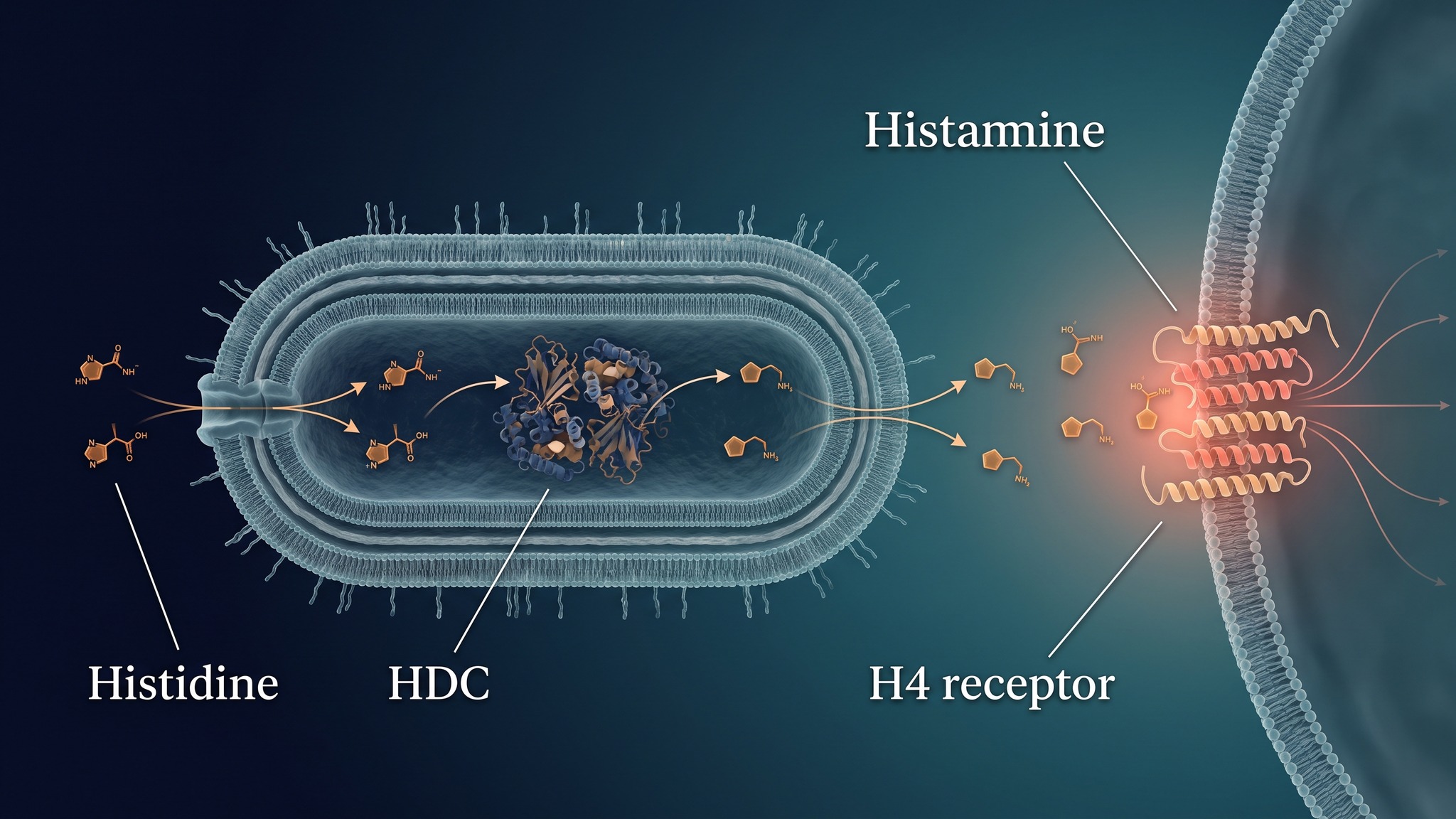
Klebsiella aerogenes carries a strain-specific hdc gene variant that converts dietary histidine into histamine. The supplied study material links this bacterial histamine to visceral pain through histamine-4 receptor signaling. That gives histamine a direct microbial route from a food-derived amino acid to a signaling molecule that can influence the gastrointestinal tract and the immune system.
STUDY Klebsiella aerogenes converted dietary histidine into histamine through a strain-specific histidine decarboxylase pathway, with bacterial histamine driving visceral hyperalgesia through H4 receptor signaling. De Palma et al., 2022, Histamine production by the gut microbiota induces visceral hyperalgesia through histamine 4 receptor signaling in mice, Science Translational Medicine.
Proteases, urease and LPS add tissue irritation and inflammation
Clinical isolates of Klebsiella pneumoniae can produce protease, gelatinase, lipase, siderophore and structured surface-colony phenotypes. Urease can split urea into ammonia, while LPS on the outer membrane provides a strong immune signal when bacterial cells break apart. These routes help connect local mucosal inflammation with wider symptoms in susceptible people.
Virulence traits reported across 150 Klebsiella pneumoniae isolates
Hullur, Natarajan and Sreeramulu, 2022. Phenotypes reported among 150 clinical Klebsiella pneumoniae isolates.
STUDY Among 150 clinical Klebsiella pneumoniae isolates, protease was detected in 90%, gelatinase in 84%, lipase in 79%, siderophore in 73% and biofilm production in 54%. Hullur, Natarajan & Sreeramulu, 2022, Journal of Pure and Applied Microbiology.
For a deeper biochemical breakdown of histamine, LPS, urease and pullulanase, read my detailed Klebsiella mechanism guide.
| Common symptom pattern | Biochemical context discussed here |
|---|---|
| Gas and bloating | Dietary substrate utilization and microbial fermentation can increase luminal gas and pressure. |
| Abdominal pain | Microbial histamine and H4 receptor signaling provide one mechanistic route to visceral pain. |
| Food reactions, itching or hives | Histamine signaling and LPS-driven inflammation can connect a gut imbalance with symptoms in other parts of the body. |
| Fatigue or joint aches | Immune signaling from bacterial outer-membrane material can add a systemic component when barrier function is compromised. |
| Looser bowel movements or digestive discomfort | A dysbiotic microbial environment can combine fermentation, mucosal irritation and altered gut function. |
What foods influence Klebsiella overgrowth and gut health?
Food changes Klebsiella through the nutrient environment it creates for both the organism and its competitors. The strongest diet signal in the supplied Klebsiella material comes from dietary substrate-restriction protocols studied in rheumatology cohorts. Those data make diet a useful mechanistic lever when the organism is exploiting a substrate-rich environment.
Bread, pasta, rice and potatoes were the main foods restricted in the clinical protocol
The practical translation is a targeted carbohydrate restriction. Bread, pasta, rice, potatoes, cereals and refined sugar formed the restricted group in the supplied protocol. Whole foods such as fish, eggs, meat, many vegetables, some fruit and dairy formed the practical base. The aim was to change substrate availability for months, long enough for the microbial ecosystem and clinical markers to shift.
In 36 patients with active ankylosing spondylitis, nine months of dietary restriction produced significant falls in erythrocyte sedimentation rate, total serum IgA and anti-inflammatory drug requirements.
That rheumatology dataset provides a mechanistic clue for dietary substrate control. In day-to-day gut work, processed foods, fermented foods, fiber-rich foods and different dietary substrates can each shape tolerance and microbial competition differently. The useful question is which dietary environment is supporting this person’s Klebsiella expansion while still supporting the wider microbial community.
Can a probiotic or prebiotic make Klebsiella less competitive?
A probiotic or prebiotic can be useful when the goal is to rebuild microbial competition around Klebsiella, especially after the active antimicrobial phase. This part of microbiome-directed care gives beneficial bacteria a stronger ecological position, supports barrier function and reduces the empty niche that lets the organism expand again.
Bifidobacteria are especially relevant in the supplied material because an early-life study linked a higher Klebsiella-to-Bifidobacterium ratio with later allergic disease. Inulin is one prebiotic that appears frequently in gut protocols, while Saccharomyces boulardii is a probiotic yeast often discussed in dysbiosis work. The clinically useful choice still comes from the whole microbiome profile, current symptoms and tolerance. A person with active SIBO may experience a very different digestive response from someone whose problem is mainly colonic gut dysbiosis.
STUDY A higher Klebsiella-to-Bifidobacterium ratio in early stool samples correlated with later pediatric allergic disease. Low et al., 2017, Ratio of Klebsiella/Bifidobacterium in early life correlates with later development of paediatric allergy, Beneficial Microbes.
I think of this phase as ecological reinforcement. The active phase lowers microbial pressure. The rebuilding phase aims to support gut resilience, immune function and the immune system at the mucosal interface, creating a healthier competitive network so Klebsiella has less ecological room to return.
Which botanicals have evidence against Klebsiella?
A natural treatment for Klebsiella can draw on herbal antimicrobials, yet the evidence sits on several levels. Human data support multi-herb antimicrobial regimens in SIBO, while direct Klebsiella evidence for berberine, oregano-derived compounds and thymol is mainly laboratory or preclinical. That hierarchy matters because an antimicrobial effect in a dish answers a different question from symptom improvement in a person.
Berberine may weaken the protective Klebsiella matrix at sub-killing concentrations
Berberine has laboratory evidence against structured Klebsiella pneumoniae surface communities at concentrations below those required for direct microbial killing. That makes it interesting when the treatment of Klebsiella is designed around persistence and protected growth. A matrix-focused strategy can matter most in a chronic case where several previous rounds created only temporary improvement.
The supplied Klebsiella article links this matrix-disrupting effect to a PubMed-indexed laboratory study. Clinically, berberine fits inside a broader protocol, with the dose, formulation and duration chosen around the person and the product being used.
Oregano oil brings carvacrol and thymol into the antimicrobial phase
Oregano oil is rich in carvacrol and thymol, lipophilic phenols that can disrupt microbial membranes, alter permeability and interfere with cellular integrity in laboratory models. The oregano material in the folder also places oregano inside multi-herb SIBO protocols that included berberine-containing plants and other compounds. That is the human evidence layer most relevant to a blend-based approach.
STUDY Among 104 SIBO patients who completed follow-up testing, breath-test normalization occurred in 17 of 37 people receiving one of two multi-herb regimens and in 23 of 67 receiving rifaximin. Chedid et al., 2014, Herbal therapy is equivalent to rifaximin for the treatment of small intestinal bacterial overgrowth, Global Advances in Health and Medicine.
Breath-test normalization in the human multi-herb SIBO study
Chedid et al., 2014. Follow-up breath-test normalization: 17/37 with multi-herb therapy and 23/67 with rifaximin.
Thymol and thyme combinations show direct activity against structured Klebsiella pneumoniae communities
Thymol emulsions reduced surface-associated biomass by up to 74% in resistant clinical isolates in one laboratory study. Another in-vitro experiment using thyme and oregano oil disrupted more than 90% of a mixed microbial matrix that included Klebsiella. These are strong preclinical signals for matrix disruption and a useful reason to think in combinations when a persistent isolate is involved.
Thymol emulsions reduced surface-associated biomass by up to 74%, while thyme plus oregano disrupted more than 90% of a mixed microbial matrix in the second laboratory model. Berberine adds a different matrix-targeting effect, which is one reason a blend can be more biologically interesting than relying on one fashionable compound.
In my clinical experience, I usually see the best results when the active phase uses a blend of antimicrobials selected around the organism, the microbiome pattern and the person’s tolerance. Klebsiella often returns when the protocol lowers microbial load while leaving the same ecological conditions in place.
My stool test showed high Klebsiella. I used oregano oil and berberine, my bloating improved for a few weeks, and then Klebsiella came back high again. Does that mean the herbs stopped working?
A temporary response followed by a high Klebsiella result usually makes me look at the whole ecosystem again. The first protocol may have lowered bacterial pressure while a protective matrix, isolate susceptibility, substrate exposure or weak microbial competition kept the niche open. This is where I often prefer a blend of antimicrobials and a deliberate rebuilding phase. The goal is durable control of Klebsiella together with a gut environment that makes reseeding less likely.
One organism is only one layer of the system
Your Klebsiella result becomes much easier to act on when you can see how food, motility, the intestinal barrier and the rest of the microbiome interact. IBSyncrasy explains that system through real clinical cases. Buy IBSyncrasyHow is Klebsiella linked with ankylosing spondylitis and autoimmune inflammation?
The clearest autoimmune connection in the supplied material is a genetically susceptible axial spondyloarthritis phenotype. Specific Klebsiella proteins share short amino-acid similarities with the host molecule and spinal collagen, creating a molecular-mimicry route through which an immune response against the bacterium can cross-react with host tissue.
The pullulanase story is especially interesting because the same bacterial enzyme connects diet and immunity. Pullulanase helps Klebsiella metabolize dietary polysaccharides, while a region of the protein has been studied as a cross-reactive target. That gives one organism a direct biochemical bridge between substrate use, gut ecology and immune recognition.
STUDY Antibodies from genetically susceptible patients reacted with Klebsiella pneumoniae antigens sharing a six-amino-acid sequence with the host molecule, supporting molecular mimicry as a disease mechanism. Schwimmbeck, Yu & Oldstone, 1987, Autoantibodies to HLA-B27 in the sera of patients with ankylosing spondylitis and Reiter’s syndrome, Journal of Experimental Medicine.
Kl. pneumoniae may be an initiating agent in ankylosing spondylitis.
For the full antibody, genetic-marker and dietary evidence chain, read Ankylosing spondylitis and Klebsiella: what the data show. Inflammatory bowel disease, including ulcerative colitis, also sits in a mucosal immune context where microbiome structure matters. The supplied Klebsiella material develops the autoimmune mechanism most fully through the molecular-mimicry pathway.
Why is Klebsiella difficult to get rid of and why does it keep coming back?
Klebsiella becomes difficult to clear when the organism has a persistent isolate phenotype and the surrounding gut microbiome still offers the same ecological opportunity after treatment. A protected surface community, chronic colonization, antibiotic history, diet and weak microbial competition can all help explain why the same overgrowth returns after a seemingly successful active phase.
A protective microbial matrix can give chronic Klebsiella colonization staying power
In the supplied clinical-isolate dataset, 54% of Klebsiella pneumoniae isolates formed biofilm. A biofilm is a structured bacterial community embedded in a protective matrix, and it changes the exposure of the bacteria to an antimicrobial. This structured matrix can help explain a temporary reduction followed by renewed growth.
Die-off can temporarily raise the immune load during treatment
Klebsiella is gram-negative, so rapid microbial disruption releases outer-membrane material that includes LPS. In a person with leaky gut or existing mucosal inflammation, that immune load can coincide with a short-lived flare in bloating, fatigue, skin symptoms or general discomfort. Clinically this is often described as a die-off response. The intensity tends to depend on microbial load, barrier status and the wider immune context.
Susceptibility testing can make treating Klebsiella more precise
Different Klebsiella strains can respond differently to the same antimicrobial. When a culture-based isolate is available, I prefer susceptibility testing for each antimicrobial the laboratory can validly test. A conventional antibiogram guides antibiotic selection. Some functional laboratories also offer botanical susceptibility panels, which can help compare individual natural compounds before a blend is built.
This is where persistence matters more than chasing a single supplement. A chronic overgrowth may need repeated reassessment of the protocol, the probiotic and prebiotic rebuilding phase, diet and the rest of the microbiome. People with SIBO can add another layer because the small intestine and a fecal sample represent different microbial neighborhoods.
My GI-MAP keeps showing high Klebsiella after two protocols. I still have bloating, food reactions and occasional skin symptoms. How do I know whether I should keep targeting Klebsiella or look at the rest of my microbiome?
After two protocols, I would read the Klebsiella result beside the wider microbiome. Isolate behavior, Bifidobacteria, SIBO, diet, antibiotic exposure and the chronicity of colonization can all change what the next step should look like. A complete microbiome profile becomes especially useful here because the same Klebsiella number can sit inside very different ecosystems. The next intervention should match the mechanism that is still keeping the niche open.
What should you do next when Klebsiella stays high after treatment?
When testing for Klebsiella keeps showing persistent expansion, the next step is to connect the abundance with isolate behavior, symptoms, diet, previous antibiotic exposure, microbial competitors and the duration of colonization. This is the point where a full microbial profile becomes more useful than another random round of supplements. Complete microbiome mapping can then show whether the same Klebsiella number sits inside a very different ecological pattern after treatment.
In practical terms, I want to know what is feeding the organism, whether a protected surface community is likely to be important, which natural compounds or antibiotics the isolate is susceptible to when testing is available, and what the rebuilding phase will do for helpful commensals. The same logic applies whether the original trigger was gut dysfunction, SIBO, repeated antibiotic use or a context-dependent expansion after another disruption.
The deeper goal is a gut ecosystem that makes Klebsiella less competitive. That usually takes persistence. The chronicity of colonization and the starting microbiome shape how many phases are needed, how intense a die-off-like response may feel and how quickly gut health becomes stable. For many people, a personalized antimicrobial blend paired with a deliberate ecological rebuild becomes the most durable strategy.
Understand the ecosystem that keeps Klebsiella coming back
IBSyncrasy connects microbial findings with food, motility, barrier function and treatment sequence through real clinical cases, so a microbiome result becomes a system you can actually understand.
Frequently asked questions
Natural compounds with evidence against Klebsiella or its protective matrix include berberine, thymol and oregano-derived compounds. Human evidence in the supplied material comes from multi-herb SIBO regimens that combine several compounds. In practice, the antimicrobial phase works best when it is matched to isolate susceptibility, protected growth and the rest of the gut ecosystem.
Klebsiella can persist through matrix formation, isolate-specific antimicrobial resistance, a nutrient environment that continues to favor growth and weak competition from the surrounding microbiome. Chronic colonization makes those layers more important. A durable plan combines the active antimicrobial phase with diet and microbial rebuilding, then reassesses the ecosystem when the same organism returns.
Common digestive symptoms include gas, bloating, abdominal discomfort and looser bowel movements. The supplied Klebsiella material also connects bacterial histamine and LPS with food reactions, itching, hives, fatigue and joint aches in some people. These symptoms overlap with several other gastrointestinal and immune-related problems, so a test result becomes more useful when it is interpreted with the full clinical context.
A high fecal result describes intestinal abundance. Pneumonia is a respiratory infection that needs its own clinical picture, and Klebsiella pneumoniae is one organism capable of causing pneumonia outside the gut. The same species can therefore appear in a microbiome report and in hospital pneumonia literature. Pneumonia symptoms, urinary symptoms or systemic illness belong to acute medical assessment, while an isolated intestinal expansion belongs to microbiome interpretation.