Ankylosing spondylitis and Klebsiella
Klebsiella and ankylosing spondylitis keep turning up together in the research, tied by a shared piece of biology inside the immune system. A gut bacterium most people carry without any trouble can, in the right genetic background, look enough like the body's own HLA-B27 to set off years of joint and spine inflammation. Here is what the data actually show, mechanism by mechanism.
What's the real link between ankylosing spondylitis and Klebsiella?
Ankylosing spondylitis and Klebsiella are connected through a well-documented immune mechanism, built from decades of overlapping evidence. Klebsiella pneumoniae is a gut bacterium that most people carry in small numbers as part of a normal gut microbiome, usually without any trouble. In people who carry the HLA-B27 gene variant, an overgrowth of Klebsiella in the bowel can push the immune system into attacking the body's own spinal and joint tissue, because part of the bacterium looks almost identical to part of HLA-B27 itself, and produces the chronic pain and stiffness that mark active disease.
This process has a name, molecular mimicry, and the HLA-B27 and Klebsiella relationship has been studied since the 1970s at King's College London under rheumatologist Alan Ebringer. The case rests on dozens of overlapping findings across genetic, immunological and microbial research, from more than a dozen countries, and it points to a specific cause of ankylosing spondylitis that goes well beyond genetics alone.
From gut bacteria to spinal inflammation
STUDY A study of 163 ankylosing spondylitis patients followed across 433 visits found active inflammatory disease strongly tied to Klebsiella pneumoniae in the faeces, and a positive Klebsiella culture during quiet periods predicted a flare that followed. Ebringer et al., 1978, Sequential studies in ankylosing spondylitis, Annals of the Rheumatic Diseases.
What is Klebsiella pneumoniae, biochemically speaking?
Klebsiella pneumoniae is a Gram-negative, encapsulated, rod-shaped gut bacterium, and four of its biochemical traits matter for ankylosing spondylitis specifically. The most important by far is the pair of proteins behind the molecular mimicry itself, followed by its protective capsule, its taste for starch, and the inflammatory potential of its outer membrane. Strains of Klebsiella vary in how strongly they carry the mimicry-linked genes, which likely explains why not every carrier reacts the same way. Overgrowth appears able to initiate the inflammatory cascade in a genetically susceptible gut.
Klebsiella pneumoniae, from core mechanism to supporting trait
Ranked from the strongest driver of disease to a secondary biochemical detail
Tap a ring for detail
Shared epitopes with HLA-B27
Pullulanase D and nitrogenase reductase carry a short amino acid sequence nearly identical to part of the HLA-B27 molecule and to spinal collagen.
Which Klebsiella proteins cross-react with human tissue in ankylosing spondylitis?
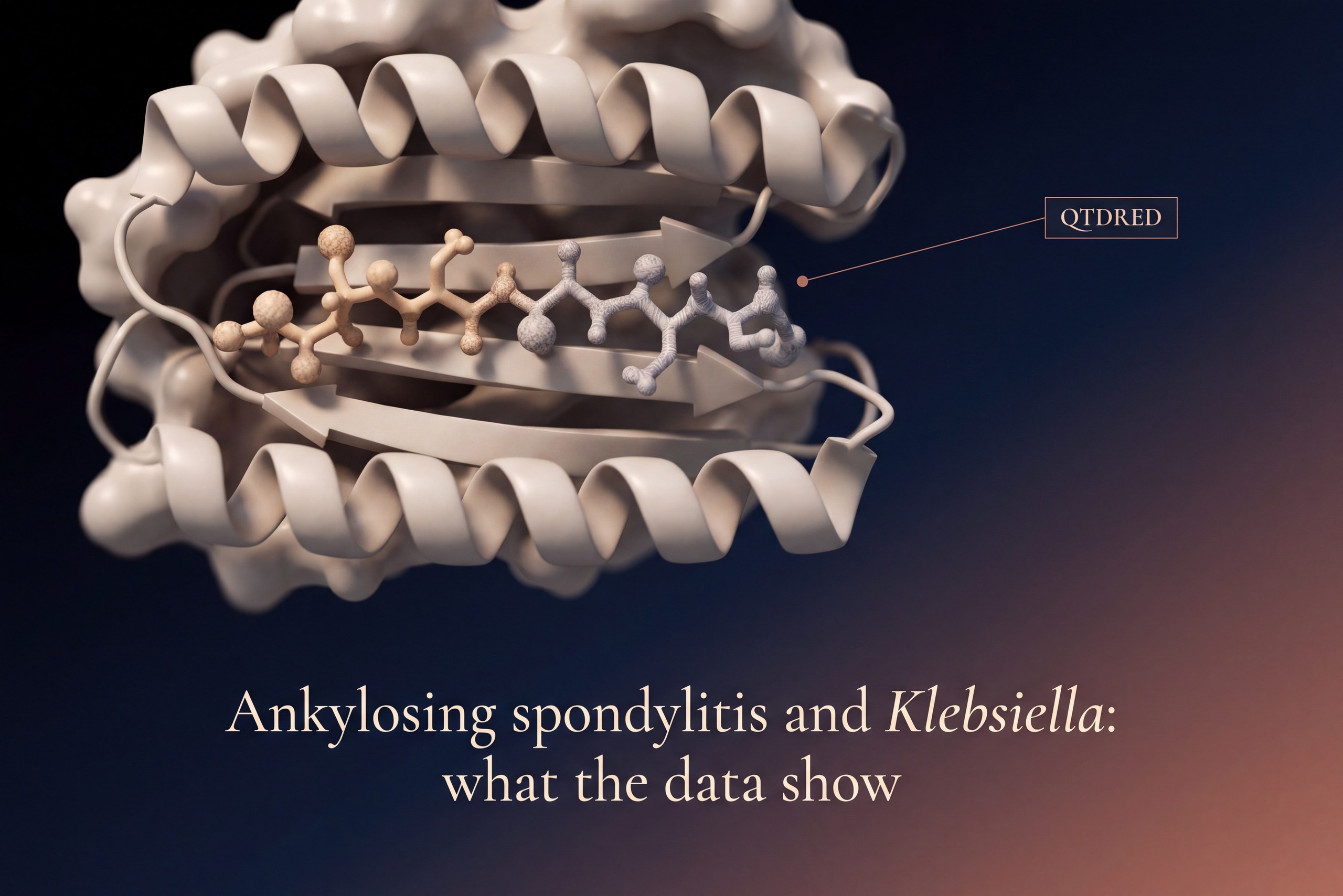
Two Klebsiella enzymes carry most of the blame, pullulanase D and nitrogenase reductase. Both contain a short six amino acid sequence, glutamine-threonine-aspartic acid-arginine-glutamic acid-aspartic acid, written as QTDRED, with a striking similarity to a sequence sitting inside the peptide-binding groove of HLA-B27.
When the immune system raises antibodies against these bacterial antigens, the same antibodies can bind HLA-B27 on the surface of a person's own cells, and separately bind spinal collagen types I, III and IV. Researchers found the nitrogenase-derived epitope directly inside inflamed articular tissue taken from HLA-B27 positive ankylosing spondylitis patients, a stronger finding than a shared sequence identified on paper alone.
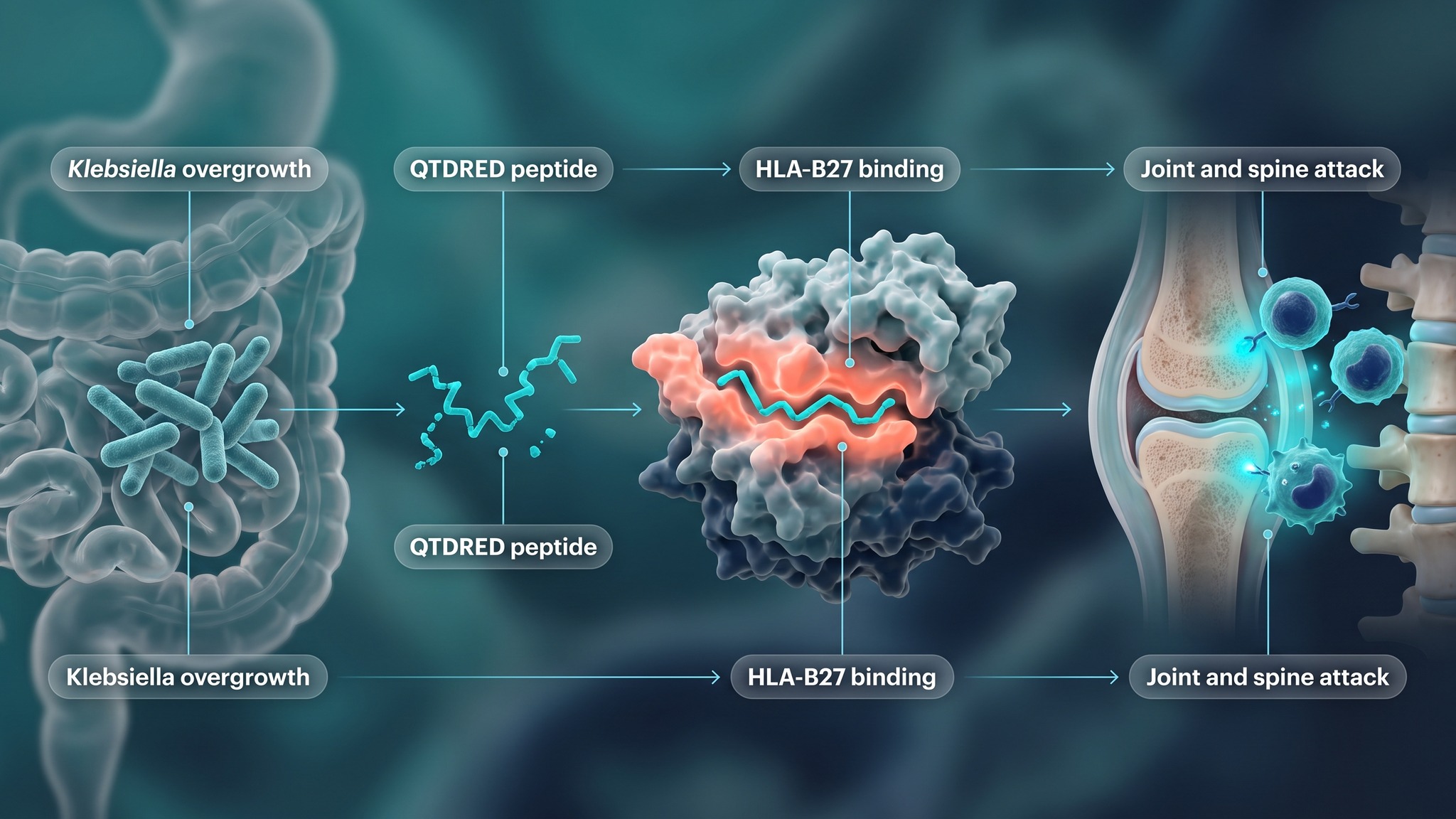
Kl. pneumoniae may be an initiating agent in ankylosing spondylitis.
How was the pullulanase connection actually discovered?
A separate line of work identified pullulanase D itself as a second cross-reactive target, adding a starch-metabolizing enzyme to the mimicry picture alongside nitrogenase reductase. Pullulanase matters twice over here, once as an immune trigger and once as the enzyme that lets Klebsiella feed on starch in the first place, exactly why diet becomes relevant later in this article. Increased gut permeability, sometimes called leaky gut, likely plays a supporting role in letting these bacterial antigens reach the immune system in the first place.
STUDY Antibodies raised against a synthetic HLA-B27 peptide containing the shared QTDRED sequence cross-reacted with the matching Klebsiella nitrogenase peptide, and also bound articular tissue from HLA-B27 positive ankylosing spondylitis patients. Schwimmbeck, Yu and Oldstone, 1987, Autoantibodies to HLA-B27 in ankylosing spondylitis and Reiter's syndrome, Journal of Experimental Medicine.
None of this means every HLA-B27 carrier who meets Klebsiella develops ankylosing spondylitis, since genetic background, gut permeability and how much Klebsiella actually overgrows all shape the outcome together. Gastrointestinal changes resembling Crohn's disease, sometimes with occasional diarrhea, have also been documented in the ileo-caecal region of ankylosing spondylitis patients with active Klebsiella overgrowth, one more thread tying gut biology to spinal disease. What the shared QTDRED sequence establishes is a specific, testable biochemical bridge between an ordinary gut bacterium and an autoimmune disease of the spine.
How often does Klebsiella actually show up in the gut in ankylosing spondylitis?
Fecal Klebsiella pneumoniae turns up far more often in ankylosing spondylitis patients than in healthy people, and even more often during active flares than during quiet periods. A 2022 systematic review pooling 25 case-control studies confirmed a significantly higher rate of fecal Klebsiella, and of serum IgA and IgG antibodies against it, in ankylosing spondylitis compared with healthy controls.
Fecal Klebsiella pneumoniae isolation rate
Ebringer, Cawdell and Ebringer 1979, cited in Pease et al. 1982, Journal of Hygiene, Cambridge
In my own clinical stool PCR panels, Klebsiella overgrowth shows up in more than half of the patients who come in with ankylosing spondylitis or a closely related autoimmune diagnosis. That is a clinical observation from my own case load, and it lines up closely with what four decades of published research keeps finding, exactly the kind of pattern a comprehensive stool test is built to catch. This kind of gut dysbiosis often carries no obvious digestive symptoms at all, which is part of why it goes undetected without targeted testing.
So i just got diagnosed with ankylosing spondylitis and im hla b27 positive, my functional med doctor ran a stool test and it came back with klebsiella overgrowth too, is that even related to my diagnosis at all
It's related more often than people expect. In my own stool panels, Klebsiella overgrowth shows up in more than half of the ankylosing spondylitis and related autoimmune cases I test. There's a real mechanism behind it too. HLA-B27 and specific Klebsiella proteins share a short stretch of amino acids, so your immune system can end up flagging your own joint tissue by mistake while it's still trying to fight the bacterium. It's a real, testable piece of your puzzle worth acting on, and worth bringing straight to whoever manages your ankylosing spondylitis care.

See what your own gut testing could show
If Klebsiella keeps surfacing in your own results, IBSyncrasy walks through the same kind of root-cause stool testing and interpretation, case by case, so you can read your own report with real context. Buy IBSyncrasyDo Klebsiella antibody levels actually differ in ankylosing spondylitis?
Yes, and the gap is large enough to be genuinely useful as a marker. When researchers tested serum IgG against a specific Klebsiella-derived peptide, ankylosing spondylitis patients tested positive at a dramatically higher rate than people with other forms of inflammatory arthritis, and healthy donors tested negative almost across the board.
Serum IgG positivity against a Klebsiella-derived peptide (DPP121-145)
Puccetti et al. 2017, PLoS One, serum IgG against Klebsiella DPP121-145 peptide, 200 AS, 200 RA, 100 PsA, 100 healthy donors
Do antibody levels actually drop with treatment?
They do, at least for the IgA class. In a 26-week trial of 84 ankylosing spondylitis patients, sulfasalazine treatment produced a statistically significant fall in IgA antibodies against Klebsiella, tracked against 100 healthy blood donors as controls. The antibody response tracks disease activity and treatment over time, which is exactly what makes it worth monitoring across repeat visits. Klebsiella behaves as an opportunistic pathogen here, quietly overgrowing whenever gut conditions allow it.
STUDY Serum IgG antibodies against a Klebsiella-derived DPP peptide were present in 190 of 200 ankylosing spondylitis patients, compared with 3 of 200 rheumatoid arthritis patients and 1 of 100 psoriatic arthritis patients, with no reactivity in healthy donors. Puccetti et al., 2017, Antibodies directed against a Klebsiella pneumoniae peptide epitope in ankylosing spondylitis, PLoS One.
Ive had ankylosing spondylitis for years and someone in a facebook group told me to cut out bread, pasta and potatoes because of some klebsiella diet thing, is that actually backed by real research, is it just another fad people push online
There's actually decades of research behind it, it's not a random internet trend. Klebsiella feeds heavily on starch, and one of my favorite old findings is that Klebsiella grown on sugars multiplied about ten times faster than when it was fed amino acids instead. Patients on a genuinely low-starch diet for several months have shown real drops in inflammation markers and antibody levels in published trials. I've watched joint stiffness ease in my own ankylosing spondylitis patients within weeks of cutting starch hard, and the biology behind it holds up.
Does a low-starch diet help ankylosing spondylitis linked to Klebsiella?
A genuinely low-starch diet has measurable evidence behind it for ankylosing spondylitis, dating back to a chance discovery in 1982 when a patient on a low-carbohydrate diet for weight loss noticed his back pain disappearing. Since Klebsiella runs almost entirely on dietary starch for fuel, cutting starch intake goes straight at the bacterium's own energy source.
Klebsiella growth on sugars versus amino acids
Klebsiella culture yield on glucose, sucrose and lactose versus 11 amino acid substrates, cited in Yang et al. 2016, International Journal of Molecular Sciences
What does the low-starch diet actually restrict?
The diet removes bread, pasta, rice, potatoes, most cereals and refined sugar, while keeping meat, fish, eggs, most vegetables, some fruit and dairy on the table. It is a targeted starch restriction, meant to run for several months to give Klebsiella levels a genuine chance to fall.
What did Ebringer's own low-starch diet trials find?
Over 450 ankylosing spondylitis patients went through the diet at Middlesex Hospital in London under Ebringer's supervision. In one published trial of 36 patients with active disease, nine months on a low-starch diet brought a significant drop in erythrocyte sedimentation rate, total serum IgA and anti-inflammatory medication use. A newer randomized trial of 300 ankylosing spondylitis patients at the University of Porto is testing the same approach against a standard balanced diet, with Klebsiella levels and disease activity as outcomes.
STUDY In 36 patients with active ankylosing spondylitis, nine months on a low-starch diet produced a significant fall in erythrocyte sedimentation rate, total serum IgA and anti-inflammatory drug requirements. Ebringer, 1996, The use of a low starch diet in the treatment of patients suffering from ankylosing spondylitis, Clinical Rheumatology.
What about calcium and other practical concerns on this diet?
Cutting bread and cereals removes a common fortified calcium source for many people, so dairy, leafy greens, tinned fish with bones and, where needed, a calcium supplement deserve real attention on this diet, alongside the starch changes themselves. Anyone with osteoporosis risk, and ankylosing spondylitis itself carries some, benefits from tracking calcium and vitamin D as part of the same plan.
What role do antibiotics or probiotics play against Klebsiella overgrowth?
Diet remains the best-studied intervention for Klebsiella-linked ankylosing spondylitis, while a single antibiotic course, sulfasalazine and probiotics play smaller, more situational roles alongside it.
| Approach | What the evidence actually shows |
|---|---|
| Antibiotic courses | Early trials with low-dose antibiotics against Klebsiella showed limited benefit on their own, likely because the gut reseeds quickly once starch intake resumes. |
| Sulfasalazine | This disease-modifying drug lowered IgA antibodies to Klebsiella over 26 weeks in a controlled trial, alongside its established antiinflammatory effect. |
| Probiotics | Targeted strains that compete with Klebsiella for gut real estate show early promise, and overlap here with strategies used for SIBO, small intestinal bacterial overgrowth. |
| Low-starch diet | The most consistently reproduced intervention, with measurable drops in inflammation markers and antibody levels across multiple decades of trials. |
A comprehensive stool test that actually measures Klebsiella overgrowth turns any of these interventions into a targeted plan grounded in your own numbers, built to restore a more balanced gut microbiome over time.
What should you actually do next if you suspect Klebsiella is behind your symptoms?
Start with a comprehensive stool test that specifically screens for Klebsiella overgrowth, since it catches the mechanism directly. From there, an HLA-B27 result, a Klebsiella antibody panel and a genuine low-starch trial of several months give you three concrete, testable levers to work with.
Have you ever been checked for Klebsiella overgrowth?
Thanks for weighing in. If Klebsiella is part of your picture, the next step is understanding what to actually do about it.
Show me the IBSyncrasy method
Ready to look past the label on your diagnosis?
Ankylosing spondylitis has a fixed genetic side and a gut side you can actually work on. IBSyncrasy shows the same root-cause process used to spot Klebsiella overgrowth, worked out case by case.
Frequently asked questions
Klebsiella acts as a trigger. In someone who carries HLA-B27, Klebsiella overgrowth in the gut can set off molecular mimicry against the body's own tissue, with genetics and gut permeability shaping how far that process actually goes.
Klebsiella pneumoniae carries the strongest and longest evidence trail, and it has also been studied in reactive arthritis, a related condition triggered by gut or urinary infections.
Klebsiella proteins share a short amino acid sequence with HLA-B27 and spinal collagen, so an immune response built against the bacterium can end up cross-reacting with a person's own spine and joints.